
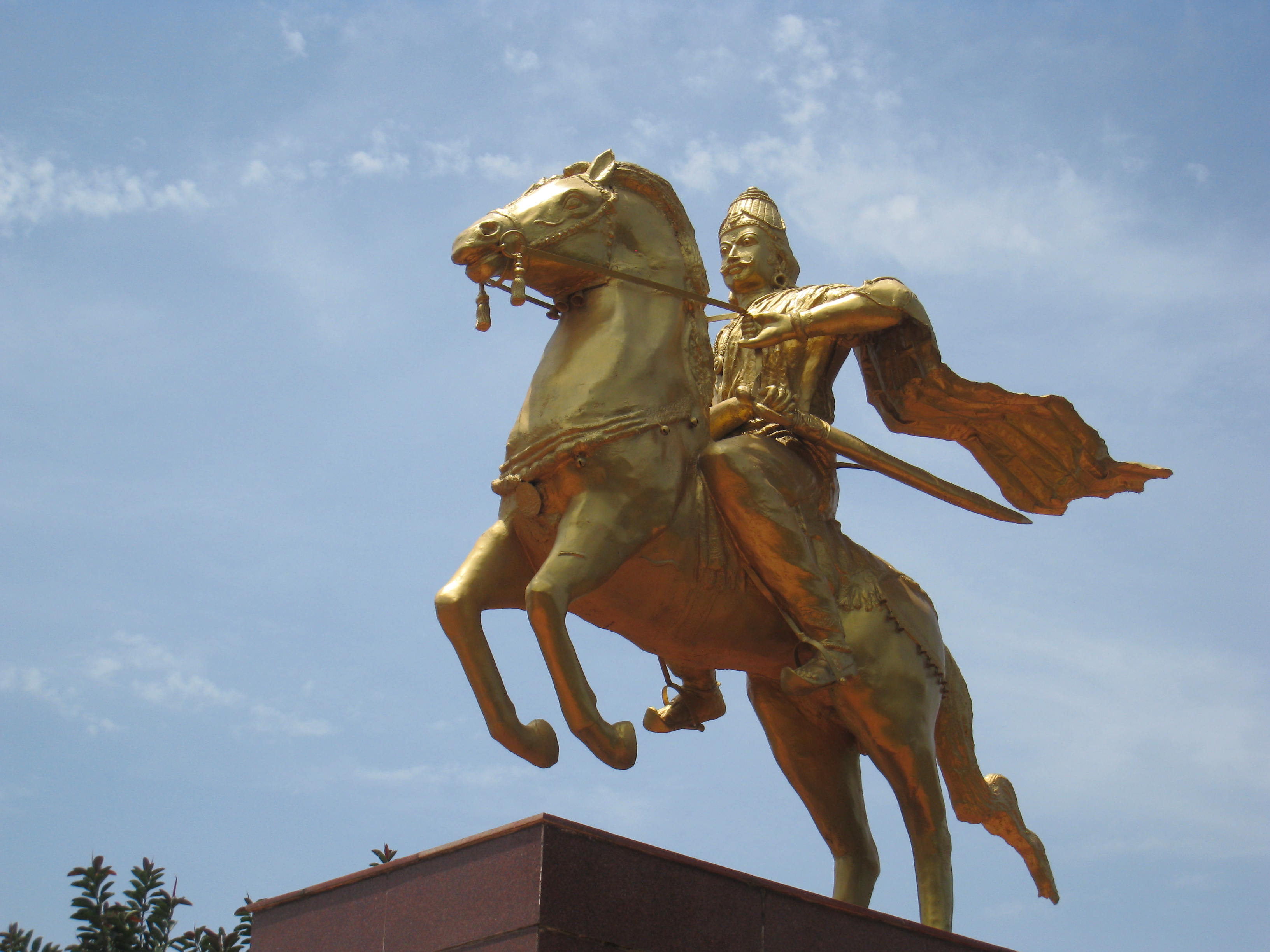
There are kings and kings, but very few who contributed to more fields than one.The Tamil region’s Rajaraja Chola is one such ruler whose ability and fame were extraordinary.
India has produced many great kings. There are those who expanded their kingdoms to faraway lands due to their valour. There are those who did great things to society. Then there are those who patronised art and culture. There are only a few among them who contributed immensely to more than one field and are truly qualified to be labelled ‘Great’. The Chola emperor Rajaraja is definitely one of them.
A lot has come to light in the recent recent past about the great king Raja Raja Chola. Unfortunately Most of that is about hatred and ignorance. A few of these allegations are half-truths and most of them are without any substance. Thankfully, the Chola era and Rajaraja’s times are well researched and documented.
Recording History
When Rajaraja started to take part in political affairs the Chola kingdom was relatively small . Aditya Karikala, his elder brother, had only been assassinated recently and his uncle was eyeing the throne while confusion prevailed all round. Rajaraja is said to have given up on the throne and instead took to the battlefield to strengthen the Chola frontiers. Raja Raja’s conquests and expansion of the kingdom is well documented in his ‘Meikeerthi’ – ‘true achievements’.
He was the first king to institutionalize the process, putting the correct information about the victories in the form of verses. His magnanimity can be understood by the fact that he didn’t name any of the kings he defeated but mentions only the places conquered by him. Even his son, Rajendra, didn’t follow this as his Meikeerthi style and has the names of all the kings defeated by him.
Administration
Rajaraja strengthened the administrative structure of the Cholas, which had been taking shape since Parantaka I’s time. Villages were the smallest administrative units. They were combined to form ‘kuttam/Kuttram’. Many kuttrams joined together to form a ‘Nadu’/ValaNadu and many Nadus formed a ‘Mandala’.
There were about 8 to 9 Mandalas during Rajaraja’s regime including that of Sri Lanka. Each of these were governed by an official equivalent to today’s secretaries. There were various designations and hierarchies present in the governance structure and the promotions were by strictly by merit
Even the Prince ‘Ilavarasar ’ is coronated only on merit and need not be the first born. Many of Rajaraja’s inscriptions and all his donations written in copper plates were verified and countersigned by a number of local officials who ensured that the orders did not just remain on text. He had also ensured that the common man was not affected by such a bureaucratic set up and kept one official ‘Naduvirukkai’ who acted as a medium of communication between the king and the commoners.
Land Ownership Survey
Rajaraja launched a land survey around 1001 AD as part of his Land Reform. He was also the first Tamil king to conduct such a survey as such a grand scale.
As part of this, the boundaries of various types of land was measured and the information about ownership were documented in government records in detail. This land survey corrected the ownership anomalies as well as encroachment of government and common property such as those belonging to canals, rivers et cetera.
The land ownership was then clearly demarcated as “privately-owned” and those owned by the village assemblies/government. The entire exercise was completed in about two years, a remarkable achievement at that time.
One of the major criticisms against Rajaraja was that he had taken land forcibly and given it to Brahmins. This has no basis as we can see.
There were three major categories of land.
- One, owned by the farmers called as ‘Velan Vahai’.
- The second category is the one which was given to a few categories of workers in lieu of the professional services provided by them. These were called as Seevitham, Bogam, Kani etc.
- Then the third category which were given as donations such as Brahmadeyam and Devadhanam. The last category is often the subject of controversy.
It is often misunderstood that Brahmadeyams, which were donated to Brahmins and Devadhanams which were donated to temples, were forcibly taken from farmers. This is not true.
Firstly, giving land as Brahmadeyams was an age-old practice right from the Sangam age. Kings donated lands to Brahmins and temples for the welfare of the state, based on the beliefs in those times. Rajaraja just followed this practice. The land thus donated were mostly owned by the government or the village assemblies. In cases where the land was acquired from a private owner, suitable compensation was given to the individual.
This is not a notional compensation from the government as it is done today. The actual value of the land was calculated and either the king or his relatives bought the land and then donated it. An example to this effect was Rajaraja’s sister, Kunthavai, who bought the land belonging to Rajakesari Chaturvedi Mangalam and donated it back. It has also to be noted that compensation is not just given to the land owners only but to the tillers as well.
Another important aspect of such land donations, especially on Devadhanams (donation to temples) was that it did not change the land ownership in most cases.
- Instead of paying taxes to the government, the land owners were asked to pay taxes to the temples so that the temples could be run using this contribution.
In some cases, like the one mentioned in the Thiruvallangadu Copper plates, the Brahmadeyam Pazhayanur was changed to Velan Vahai and the taxes from these lands were redirected to be paid to the temple.

This shows that changing the category of lands from Brahmadeyam and Velan Vahai (vice-versa too) was a common practice. It should also be noted that the taxes collected from lands categorised as Brahmadeyam is higher compared to the taxes from the other categories. Clearly, there was no undue favouritism towards any particular community.
Post-documenting the land ownership, the taxes to be paid were also structured according to that. Generally, there were two types of taxes collected – one to be paid to local bodies and the other to be paid to the king (like the federal tax). There were special taxes based on need as well. The tax exemption, called as ‘Irayili’ was given only in very few cases and even in those, not all taxes were exempted.
To ensure continuity of these ‘Irayili’ lands, there was an amount collected from time to time by the government. In every village, there were a few types of lands which were always tax-exempt.
They were temple lands, ponds, canals, Paraicheri, Kammalacheri and the graveyard. This practice was followed uniformly throughout the country.
Irrigation And Water Resource Management
Tamil region was a rain shadow region and it was critical to store whatever water it gets in its reservoirs. Nobody understood this better than the Chola kings who ruled a region which had the bulk of farm lands in Tamil Nadu. Rajaraja is no exception to this as he had built major reservoirs, lakes and also built a number of canals to feed various parts of his country including the dry northern lands.
It is said that about 5,000 lakes were created during his regime. One such example of a canal is the ‘Uyyakkondan Kalvai’ near Tiruchirappalli.
This canal is about 71-km-long and has about 120 branches. About 32,000 acres was irrigated using this canal. Rajaraja also constituted a formal water management board to oversee the irrigational aspects in his country. There was no drought recorded in any part of his country when he ruled.
Bhakti Canons
Rajaraja was a stanch Saivite and was instrumental in bringing out the Shiva canons, the Thirumurais, from the locked chambers of Chidambaram. Nambiyandar Nambi, the Tamil saint of his time, compiled these in proper format with the help of Rajaraja.
The king ensured that these were sung in all the temples and provided for the upkeep of this service, a tradition which is continued till date. This is, perhaps, Rajaraja’s greatest service to Hinduism and Tamil.
While he did have his personal religious preference, he had remained a truly secular king. He and his family donated lavishly to build Vinnagarams – Vishnu temples throughout. When the Srivijaya king (present Indonesia) approached Rajaraja to help him in constructing a Buddha Vihara, he had donated an entire village, Anaimangalam near Nagappattinam, for the purpose and for the upkeep of the Chudamani Vihara in Nagappattinam.
While going through history, one can find that there is no ideal or perfect regime which has satisfied all aspects of society. Hence, it is imperative to consider the times, the situations and the overall contribution of a king to judge him. In this light, one will hardly come across a king like Rajaraja who immensely contributed to a number of issues like people’s welfare, farming, administration, religion and art and culture, during his regime. It is for no reason that an eminent historian like K A Neelakanta Sastri called him as ‘Rajaraja the Great’ in his magnum opus The Colas.
 UPSCLOGY