
The impact of the 𝘉𝘭𝘢𝘤𝘬 𝘏𝘰𝘭𝘦 tragedy (1756) has echoed down the centuries, so much so that Mark Twain during his stay in Calcutta in 1896 was keen on visiting the historic venue where the incident had allegedly taken place. Just about everything we know of how the situation had unfolded on that fateful night of 20 June 1756 is what John Holwell, an East India Company official and a survivor of the purported tragedy, chose to tell us in his memoir.
Simplified, the story goes like this: The aggressive young Nawab of Bengal, Siraj-ud-Daulah, who had recently wrested power from his maternal grandfather, Alivardi Khan, invaded the flourishing British trading city of Calcutta in order to teach the East India Company a lesson for their failure to pay him taxes. Siraj was also unhappy with the Company for their involvement in unauthorised fortifications at Fort William.
After a military engagement of five days that saw the hugely outnumbered Company militia being overrun by the Nawab’s forces, the entire garrison of the East India Company at Fort William under the leadership of John Holwell surrendered.
Once Fort William fell into Siraj’s hands, 146 Company personnel including Holwell were herded into a small cell that measured 18 feet by 14 and locked overnight on 20 June 1756. It was the hottest night of the year as the monsoon had not broken till then and the temperatures had soared to unimaginable heights. Holwell claims that 123 inmates died of suffocation or of wounds and only 23 survived when the prison door was opened the next morning.
Numerous scholars have dismissed Holwell’s account as a fictional figment. Many others claim that the reality of the incident was far less brutal than it was made out to be.
Karl Marx opines that it was a sham scandal. Bholanath Chandra, a nineteenth century scholar and a classmate of Michael Madhusudan Dutt, mathematically proved that 146 people could not be physically accommodated in a chamber measuring 18 feet by 14.
Jadunath Sarkar’s widely accepted theory is that the incident was a reality, but the numbers given by Holwell were grossly exaggerated as not more than sixty prisoners were incarcerated on that fateful June evening.
R. C. Majumdar agrees that some prisoners might have been cast into the dungeon, but the tragic details that followed only to suit an inflated number of inmates, is an outcome of Holwell’s fertile imagination. Dr. Majumdar adds that Siraj-ud-Daulah was not in any way personally responsible for the incident.
Stanley Wolpert, the American historian, suggests that Siraj was not aware of the imprisonment of English people in the dungeon, nor did he order their confinement. J. H. Little, the renowned British scholar, claims that Holwell’s story is a ‘giant hoax’.
Be that as it may, the East India Company adroitly used Holwell’s 𝘉𝘭𝘢𝘤𝘬 𝘏𝘰𝘭𝘦 fable as a tool, a so-called proof of Indian savagery, to justify and pursue their empire building exercise. The event, according to Nirad C. Chaudhuri, threw a moral halo over the British conquest of India.
Holwell’s narrative became a rallying point for the apologists of British imperialism resulting in a retributive military campaign under Robert Clive that witnessed Britain’s recapture of Calcutta after the battle of Plassey in 1757. The foundations of the British Empire in India were thus laid.
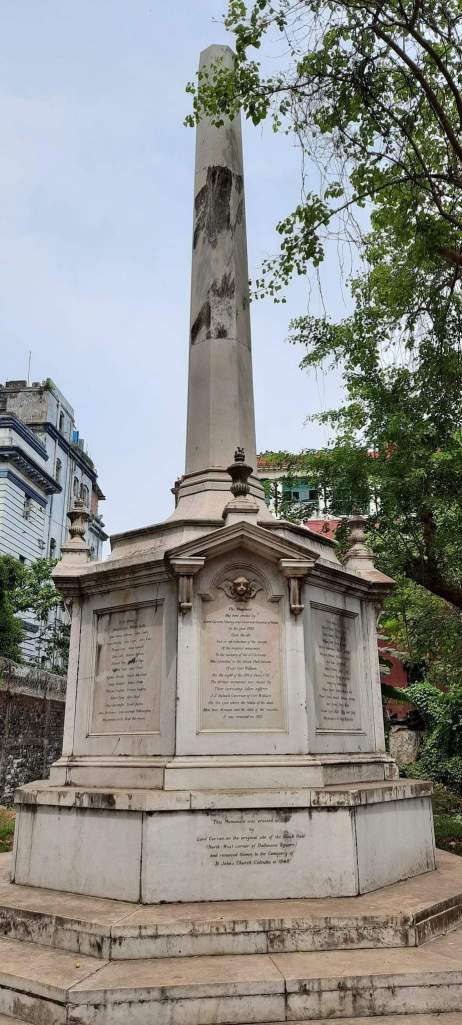
In order to commemorate the victims of the tragedy, Holwell ensured that a tablet was erected on the site of the cell, which later disappeared without a trace. Nearly one-and-a-half centuries after the incident, Lord Curzon commissioned an obelisk in the vicinity of the Writers’ Building at Dalhousie Square in 1901.
Subhash Chandra Bose led an anti-Holwell Monument agitation claiming that the monument was an unwarranted stain on the memory of Nawab Siraj-ud-Daulah. As a consequence, the monument was removed from the Writers’ Building compound in 1940 and tucked away in a corner of St. John’s Church where it stands today as a testimony to imperial falsehood and chicanery.
 UPSCLOGY