
There is a lot of mystery surrounding where Jainism came from. The adherents of Jainism are of the opinion that their religion predates the Vedic religion by the same amount of time. In point of fact, there is a mention of Rishabha and Arishtanemi, two of the Jain Tirthankaras, in the canonical texts of the Vedas. It is generally agreed that he was the first person to practise Jainism. Rishabha is portrayed as an incarnation of Narayana not just in the Vishnu Purana but also in the Bhagavata Purana.
It is possible, on the basis of these references, to assert that the Jain religion is just as old as the Vedic religion. The followers of Jainism believe that the teachings of their religion are the labour of twenty-four Tirthankaras, and as Mahavira was their last Tirthanakara, they consider him to be the final Tirthankara. They go on to explain that the first Tirthankara was a monarch who gave up his throne in preference of passing it on to his son Bharata and became a monk instead.
They claim that the name Bharata was chosen for our country in honour of this Bharata. Even while the Vedic literature contains only a few allusions concerning the earlier Tirthankaras, some academics maintain that these references have no historical basis, despite the fact that they do exist. Only Parsva Nath and Mahavira are acknowledged by them as genuine historical characters.
PARSVA NATH WAS THE REAL FOUNDER OF JAINISM, ACCORDING TO PROFESSOR JACOBI, AND HE HAS BEEN DESCRIBED IN THE PURANIC TEXTS AS ONE OF THE TWENTY-FOUR INCARNATIONS OF GOD. PARSVA NATH WAS THE SON OF ASVASENA, THE KING OF KASHI.
At the age of 30, he decided to lead an ascetic lifestyle. He attained enlightenment after fasting and praying for 84 days in order to make amends. He lived to the ripe old age of one hundred years before passing away. The remaining seventy years of his life were spent in selfless service to the Jain religion. Yojnas, as well as the worship of gods and goddesses, were practises that Parsva Nath did not approve of. In addition, he was against the caste system as well as the sacrifice of animals, and he believed that everyone, despite their status, had the potential to find redemption.
He advocated for the advancement of women in the religious arena to the same level as males. In general, he insisted on four vows: non-harming of living beings, truthfulness, non-stealing, and non-possession. He also forbade possession of material goods. Additionally, he founded an association with the purpose of preaching values.
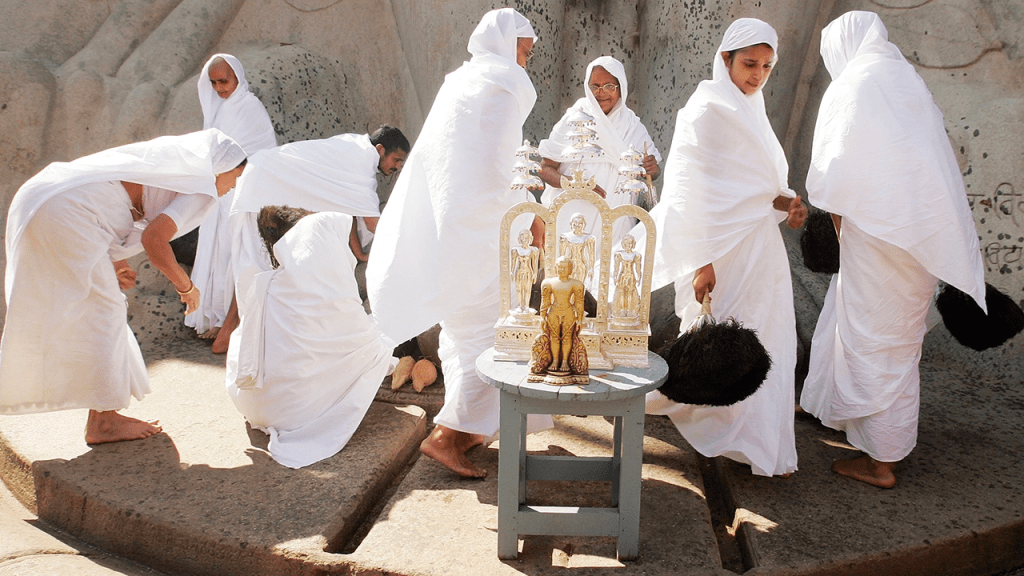
In his younger years, the teachings of Parsva Nath had a significant impact on Mahavira, who later became one of the religious reformers associated with this tradition. He devoted the entirety of his life to spreading Jainism in the regions of Magadha and Anga.
FEATURES OF JAINISM
The Jainas held the belief that their most influential religious figure, Mahavira, had twenty-three religious teachers before him who were known as tirthankaras.
If Mahavira is considered to be the final or twenty-fourth tirthankara, then the beginning of Jainism can be traced back to the ninth century B.C.
Some Jainas hold the belief that Rishabhadeve was the first tirthankara, or teacher, of Jainism. However, he is associated with Ayodhya, which did not begin to experience significant settlement until 500 BC.
Although it is believed that the majority of tirthankaras up to the fifteenth were born in eastern Uttar Pradesh and Bihar, the historicity of these claims is very questionable. Before the fifth century BC, the Gangetic plains in the middle were completely devoid of any significant human habitation. It would appear that the mythology of the tirthankaras, the most of whom were born in the middle of the Gangetic basin and gained nirvana in Bihar, was concocted in order to give the impression that Jainism has been around for a very long time.
It is impossible to pinpoint the exact dates of birth and death of the great social reformers Gautama Buddha and Vardhamana Mahavira. There is a story that states that Vardhamana Mahavira was born in the year 540 B.C. at a village close to Vaishali, which is the same place as Basarh and is located in the Vaishali district in north Bihar.
His mother, Trishala, was the sister of the Lichchhavi lord Chetaka, whose daughter was married to Bimbisara. His father, Siddhartha, was the head of a prestigious Kshatriya tribe, and his mother was Chetaka’s sister. As a result, Mahavira’s family had a connection to the royal line of Magadh, and this allowed him to approach princes and nobles with relative ease in the course of his mission.
The first significant Jain teachings are said to have been given by Parshvanatha, the twenty-third tirthankara. Parshvanatha, who was born in Banaras and later became an ascetic, is credited with having given these teachings. On the other hand, the true founder of Jainism was his spiritual successor Vardhamana Mahavira. Jainism is named after him.
In the beginning, Mahavira lived the life of a householder; nevertheless, in his search for the truth, he gave up the world when he was 30 years old and became an ascetic. During those twelve years, he moved around from one location to the next, never remaining in one village for more than a day and never in one town for more than five days. It is said that he never changed his clothes during the duration of his long journey of twelve years, and that he gave up clothes entirely at the age of 42 when he acquired omniscience (kaivalya). His journey lasted for twelve years.
He overcame both his misery and his delight with the help of kaivalya. Because of this victory, people refer to him as Mahavira, which means “great hero,” or jina, which means “conqueror,” and the people who follow in his footsteps are called Jainas. During those thirty years, he travelled all around to spread his religion, visiting places like as Koshala, Magadha, Mithila, and Champa among other places. In the year 468 BC, at the age of 72, he passed away in the region that is now known as Pavapuri, which is close to the city of Rajgir. Another myth claims that he went away in the year 527 BC; however, archaeology can not provide any evidence to substantiate his presence in the sixth century BC. Around the year 500 B.C. was when he first became affiliated with the towns and other communities that eventually bore his name.
Concepts central to Jainism include:
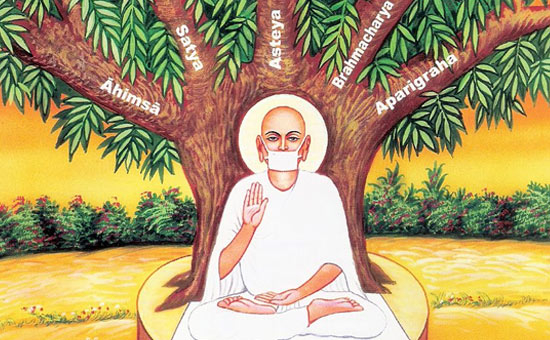
Jainism was based on the following five doctrines:
(i) Do not commit violence,
(II) DO NOT DECEIVE OTHER PEOPLE,
(iii) Do not steal,
(iv) Refrain from hoarding, and
(v) Practise abstinence (also known as brahmacharya).
It is stated that Mahavira was only responsible for the establishment of the fifth doctrine; the other four were inherited by him from his predecessors. Ahimsa, often known as nonviolence towards living beings, was considered to be of the ultimate significance in Jainism. This often led to ludicrous results, such as certain Jaina kings ordering the execution of those who were guilty of murdering animals.
In contrast to what Parshva, Mahavira’s predecessor, had instructed his followers to do, which was to cover the upper and lower sections of their bodies, Mahavira instructed his followers to do away with all of their clothing. It can be inferred from this that Mahavira urged his followers to adopt a more virtuous way of living. Because of this, Jainism eventually splintered into two different sects: the shvetambaras, also known as those who wore white clothes, and the digambaras, also known as those who did not cover their bodies.
Although it acknowledged the gods’ existence, Jainism ranked them below the jina in importance and did not view the Varna system in the same negative light as Buddhism did. According to Mahavira, a person is born in a higher or lower Varna as a direct result of the sins they committed or the virtues they acquired in their previous life. These factors determine whether or not they will have children. Even in a chandala, Mahavira searches for examples of human values.
Members of the lower castes, in his perspective, can find their way to emancipation if they live a life that is both holy and meritorious. The primary objective of Jainism is to liberate oneself from all ties to this material world. This kind of emancipation does not require any kind of rite. It is possible to acquire it through acquiring the proper information, the correct faith, and the right actions. According to Jainism, these three things make up the religion’s “three jewels” or “triratna.” Because the cultivation of crops and the fighting of wars both involve the taking of the lives of other living things, Jainism forbade both practises for its adherents. After some time, the Jainas mostly devoted themselves to mercantile and commercial pursuits as their primary focus.

Dissemination of Jainism:
In order to disseminate the principles of Jainism, Mahavira established a religious order of his disciples that welcomed both men and women into its ranks. He delivered his sermons in Prakrit, which was the language spoken by the common people at the time. It is believed that there were just 14,000 people who followed him, which is not a very high number. Because Jainism did not identify itself from the brahmanical religion in a way that was extremely evident, it was not successful in attracting the public. In spite of this, Jainism eventually made its way into south and west India, regions of India where the brahmanical religion was not as prevalent. Chandragupta Maurya (322–298 BC) is credited in a later legend with being the person responsible for the propagation of Jainism in the state of Karnataka.
This legend claims that the emperor converted to Jainism, abdicated his throne, and spent the final years of his life in the state of Karnataka living the ascetic life of Jainism; however, this claim cannot be verified by any other source. It is believed that the severe famine that took place in Magadha 200 years after the death of Mahavira was the second factor that contributed to the expansion of Jainism in southern India.
The famine lasted for twelve years, and in order to protect themselves, many Jainas moved to the south under the leadership of Bhadrabahu, while the remainder of them remained in Magadha under the leadership of Sthalabahu. Both of these leaders were Jainas. Emigrant Jainas were responsible for the development of Jainism throughout southern India. After the hunger was over, they travelled back to Magadha, where their relationship with the Jainas who lived there began to deteriorate.
Those who returned from the south reported that they had rigorously adhered to the religious commandments even when they were suffering from the effects of the hunger. They further said that the Jaina ascetics who lived in Magadha had broken those precepts and had grown more relaxed in their observance of asceticism. A council was called to order at Pataliputra, which is now known as Patna, in order to iron out these discrepancies and compile the primary teachings of Jainism; however, the Jainas who had returned from the south boycotted the council and refused to accept its judgements.
From this point forward, those from the south were referred to as digambaras, while those from the Magadhan were called shvetambaras. The tradition that belongs to a later time period and speaks to drought as the cause is deemed to be suspect because it relates to that time period. There is no question that the Jainas were split into two different factions; nonetheless, the earliest epigraphic evidence of the introduction of Jainism in Karnataka dates back to the third century ad. In the following decades, particularly after the fifth century, a large number of Jaina monastic communities known as basadis established themselves in Karnataka. In exchange for their assistance, the monarch awarded these communities land.
In the fourth century B.C., Jainism made its way to the region of Kalinga in Orissa. In the first century B.C., the Jain religion had the patronage of the monarch of Kalinga, Kharavela, who had previously prevailed over the princes of Andhra and Magadha. Additionally, it appears to have made its way to the southern areas of Tamil Nadu somewhere during the second and first centuries BC.
In subsequent decades, Jainism spread throughout Malwa, Gujarat, and Rajasthan; even today, these regions are home to a sizeable population of Jainas who are mostly involved in commercial and economic activities. Despite the fact that Jainism did not receive as much governmental patronage as Buddhism did and that it did not spread particularly quickly in early times, it nevertheless maintains its influence in the areas where it did spread. However, Buddhism almost completely vanished from the Indian subcontinent during this time.
The following are Jainism’s contributions:
The first significant effort to combat the negative effects of the Varna social structure and the ritualistic Vedic religion was undertaken by Jainism. Sanskrit, which was primarily used by brahmanas, was abandoned by the early Jainas as their primary language of communication. Instead of using Sanskrit, the language of the nobility, they preached their ideas in Prakrit, the language of the common people. Their holy literature was composed in Ardhamagadhi, and the writings were eventually gathered in Gujarat at a town named Valabhi in the sixth century ad. Valabhi was a great hub of education at the time. The Jaina religion became fluent in Prakrit, which aided in the development of both the language and its body of written work. Prakrit served as the foundation for the development of a great number of regional languages, including Shauraseni, which eventually gave rise to the Marathi language.
The Jainas are credited for writing some of the earliest significant works in Apabhramsha as well as the language’s first grammar. Jaina literature contains epics, Puranas, novels, and theatre. A significant portion of Jaina writing is still kept in the Jaina shrines of Gujarat and Rajasthan in the form of manuscripts that have not yet been put into publication. These manuscripts make up the majority of Jaina writing. The Sanskrit language was used extensively by the Jainas during the early middle ages, and they produced a large number of books in that language. Last but certainly not least, they were instrumental in the development of the Kannada language, which they wrote extensively in.
In the beginning, Jainas did not worship images in the same way that Buddhists did not. After some time, they started worshipping Mahavira in addition to the other twenty-three tirthankaras. The states of Karnataka, Gujarat, Rajasthan, and Madhya Pradesh, in particular, are home to some particularly stunning and occasionally colossal works of stone sculpture. Although ancient Jaina art is not nearly as elaborate as its Buddhist equivalent, Jainism made significant contributions to the development of art and architecture during the mediaeval period.
Contributions of Jainism to Indian Culture
Jaina literature and the growth of Vernacular Language:
Jainism had played a pivotal role in the development of the language of the country.
Sanskrit and Pali have been the medium of writings and preaching’s of Brahmanas and Buddhists.
But the Jains gave a definite literary shape to some vernaculars for the first time.
In order for the people who spoke “Magadhi” and “Sauraseni” to readily understand what Mahavira was saying, he preached in a dialect that was a mixture of the two languages and was named Ardha-Magadhi. His teachings, which are written down in the script known as Ardha-Magadhi, are organised into twelve books called Srutanga. Later on jaina books were published in Prakrit language. The Prakrit language was the foundation for the development of many regional languages, including the Marathi language, which sprang from the ‘Sauraseni’ language branch.
The Jainas are credited with writing some of the earliest significant works in the language of Apabharamsa, as well as the language’s first grammar. Before the development of Hindi, Gujarati, and Marathi, a language known as “Apabhramsa” was often used. On the one hand, it has linkage with Sanskrit and Prakrit, while on the other side, it has nexus with modern vernacular languages. The jainas also produced a significant body of work in the Kannadic language. Sanskrit is the language that was used to write some of the Jain scriptures. The jaina scriptures like ‘Anga’, ‘Upanga’, ‘Agama’ and ‘Kalpasutra’ were written in Sanskrit. Because of this, Indian languages and literature have been enormously enriched by Jainism.
The Establishment of a Sound Society:
ADVERTISEMENTS:
The first religion to make an effort to counteract the negative effects of the Varna hierarchy was Jainism. The caste system was the foundation of the later Vedic society. The people who lived in upper castes almost invariably took advantage of those in lower castes. On the other hand, Jainism accorded the same respect to persons of every caste. Its adherents, regardless of the castes they belonged to, interacted with one another as though they were siblings. Therefore, Jainism contributed to the development of a more robust civilization.
Architecture of the Jaina
Jaina art and architecture had an important role in the development of Indian art. Stupas were built in the early centuries to glorify the saints of that region together with its accompanying accessories, which included stone railings, decorative gateways, stone umbrellas, pillars, and sculptures. Mathura, Bundelkhand, and the northern region of Madhya Pradesh are home to some stunning examples of jaina art.
Excellent examples of jaina architecture may be seen at Sravan Belgola and Karkal in the state of Karnataka. Gomatesvara is the name of the statue depicting Bahubali. In the year 984 A.D., the minister of the Ganga king, Rachamalla, named Chamundaraya, constructed a statue of Bahubali that stood 21 metres tall and was carved out of a lump of granite.
ADVERTISEMENTS:
The Jaina caverns with their relief works and statues can be found in the Udayagiri hills near Bhilsa in Madhya Pradesh and at Ellora in Maharashtra. Both of these locations are in India. Other examples of Jaina architecture can be seen in Junagarh, Junnar, and Osmanabad. The Jainas are known for constructing cave temples that are cut into the rocks. These temples can be found in Orissa and are called Hatigumpha cover.
Temples and other architectural structures can be found in several of the Jaina pilgrimage centres, such as the Parsvanath Hills, Pavapuri, and Rajgiri in the state of Bihar, as well as Girnar and Palitana in the district of Kathiawar. The jaina temple atop Mount Abu in Rajasthan, which was constructed in the eleventh century, is considered to be the pinnacle of jaina architectural perfection.
The term ‘Buddhism’ refers to a religion that was developed later than Jainism. It proclaimed its opposition to the Brahmanical hegemony that prevails throughout Hinduism. Jainism became more widespread as a result of Mahavira’s own example of asceticism, penance, and simplicity. It is not possible for Jainism to become the dominant religion in India.
It was impossible to propagate Jainism in other countries. However, its status as a powerful sect in the country did not change. Today, the Jainas are a very tiny yet prosperous society that may be found primarily in the states of Gujarat and Rajputana. The religion of Jainism has left its mark on the sculpture, architecture, and art of India. It is still practised across India and is considered to be a major religion.
 UPSCLOGY