
Relationships With People in the Outside World:
The invasion of foreigners from the north-west was the most significant political change that took place in the time after Maurya’s reign.
The first of them were the Bactrian Greeks, who were referred to as the Yavanas in older Indian literature. This name derives from the Old Persian term Yauna, which initially referred to the Ionian Greeks but eventually came to refer to all persons of Greek ethnicity.
Wikipedia, the free encyclopaedia has more information about Bactria.
Image obtained from the following location:
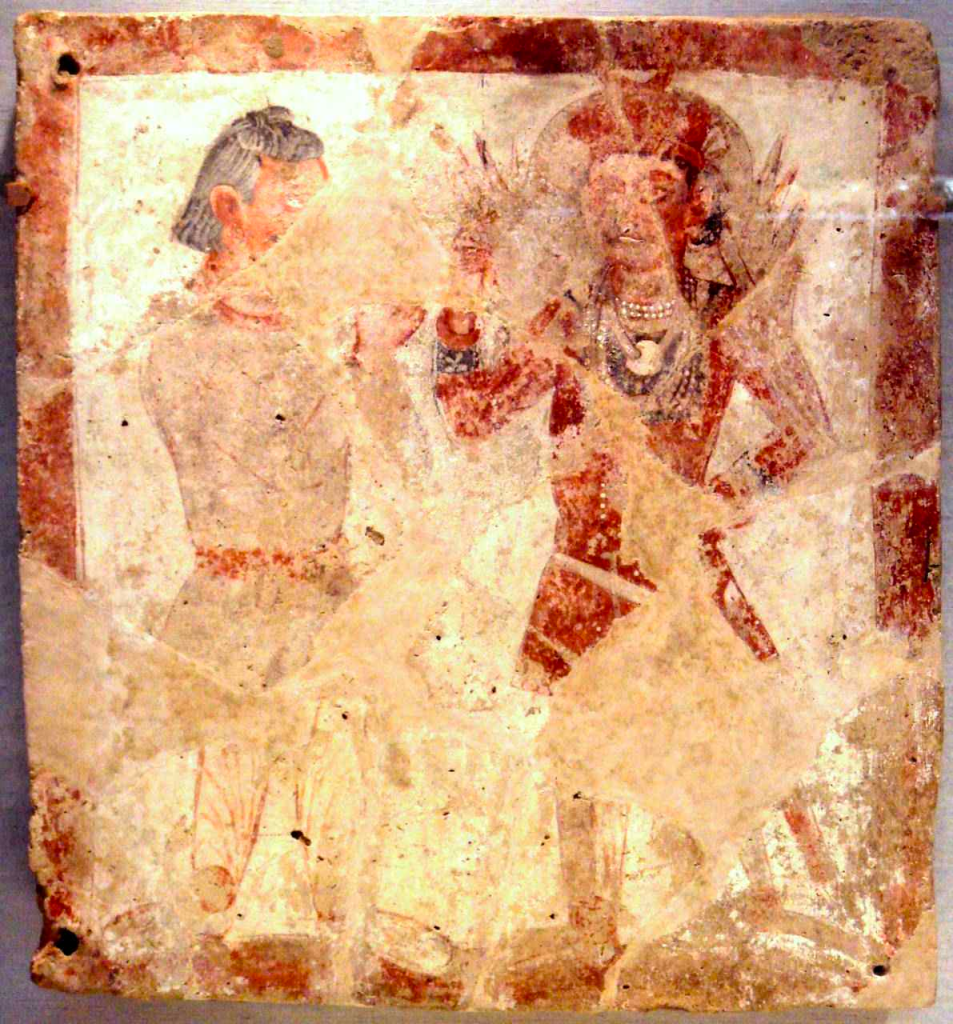
http://upload.wikimedia.org/wikipedia/commons/e/ea/PharroAndWorshipperBactria3rdCenturyCE.jpg.
Indians and Greeks:
In the early second century B.C., the Indo-Greeks or Greeks from Bactria, sometimes known as the Greeks, were the first people to enter India. They were also known as the Greeks from Greece. To a large extent, the history of the Indo-Greeks has been reconstructed based on the evidence of their coins, which originally bore legends written in Greek and, subsequently, also in Brahmi.
COMMERCIAL SPONSORSHIP:
Demetrius, son of Euthydemus and king of Bactria, is said to have been the first foreign (Indo-Greek) ruler to carry Greek arms into the interior of India after Alexander the Great. He ruled Bactria. A significant chunk of Afghanistan, the Punjab, and Sind were brought under his control and he brought them all to subjection.
A catechismal discussion in Buddhism that was supposedly conducted by Menander and the Buddhist philosopher Nagasena, which resulted in Menander’s conversion to Buddhism, is known as the question of Milinda and attained fame in the Buddhist text Milindapanho or the question of Milinda. Menander, who ruled from 165 to 145 B.C., is the Indo-Greek king who is best remembered today.
In addition to expanding the boundaries of Greek influence in India, Menander was instrumental in the consolidation of Indo-Greek dominance.
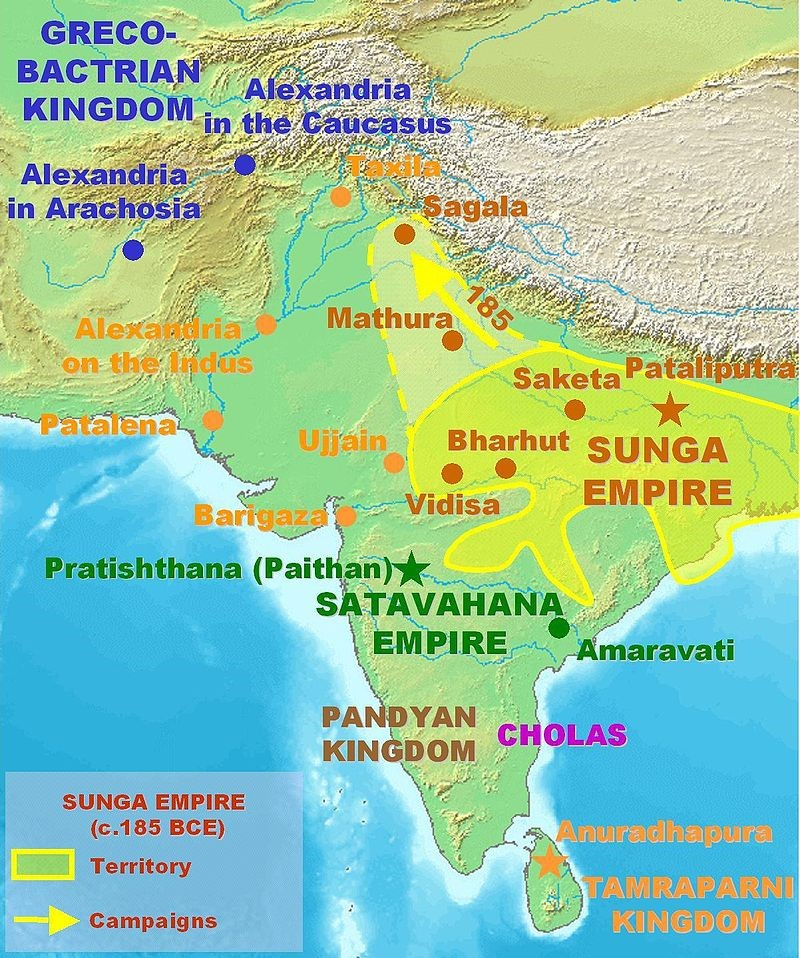
Sakala, which is now known as Sialkot, was the location of his capital in Punjab. There is considerable doubt he sought to acquire land in the Ganges valley, but he was unable to maintain it once he won the conquest. If not Pataliputra proper, then the Sungas who lived in the Yamuna region would have been the target of his assault. According to a Brahmi inscription discovered on a Garuda Pillar in Besnager, which is located close to Bhilsa, it is recorded that Antialkidas of Taxila dispatched an envoy by the name of Heliodorus to the court of Kasiputra Bhagabhadra, who is identified as Bhagavata, the last Sunga but one.

In this inscription, Helidorus proclaims himself to be a devotee of Vasudeva, who is closely identified with the God Vishnu. Hemaeus was the final Indo-Greek emperor, and he was faced with the challenge of defending his tenuous grasp on power against the oncoming threat posed by the Sakas, the Parthians, and the Yuechis.
The significance of the Indo-Greek reign is as follows:
The Indo-Greeks were the first people to ever produce money, and these coins can unquestionably be ascribed to the monarchs of the time. They were the first people in India to produce gold coins, and the production of such coins grew during the Kushans.
- The practise of military governance, which the Greeks termed strategos, was also adopted by the Greeks as a means of preserving the power of the new rulers over the people they had conquered.
COMMERCIAL SPONSORSHIP:
- In the region of India’s northwestern boundary that was ruled by the Greeks, elements of Hellenistic art were imported. In its early stages, the art of Gandhara was predominately of the Hellenistic type. However, as more time passed, the aesthetic shifted towards becoming more Indian and less Greek. Idol worship, which involves depicting the Buddha as a human being, is said to have originated in Greek culture.
- The use of curtains, which the Indians call Yavanika, Sutradhara (stage manager), and Nepathya (behind stage, etc.), was introduced to India by the Greeks, who were instrumental in the creation of Indian theatre.
- Greek astrology eventually made its way to India, and from the Greek word for horoscope, the Sanskrit word for astrology, horasastra, was developed. Horasastra literally translates to “horary science.”
The Shaka dynasty
At the same time as the Greek kingdoms in the north-west were falling into collapse, nomadic tribes from central Asia launched an assault on Bactria itself. Scythians were among these tribes; they were chiefly responsible for the downfall of Bactrian dominance.
Nomadic tribes from central Asia, such as the Yuechis, were forced to relocate westward as a result of the consolidation of the Chinese empire by Shi Huang Ti, who was responsible for the construction of the Great Wall, and the drying up of their pastures. The Scythians were under pressure from both the north and the east, so they attacked and captured Bactria.
The Yuechis were following quite closely behind them. Because of this, the Scythians, who are referred to as Shakas in Indian literature, migrated from Bactria and attacked Iran before moving on to attack the Greek kingdoms in India. By the middle of the first century before the common era (B.C. There were only a few of Greek leaders that controlled India, and the Shaka dominance reached all the way into the country’s interior, all the way to Mathura. The Shaka family was divided into five branches, each of which held their seats of power in a separate region of India or Afghanistan.
Afghanistan became the home of one of the branches. The second branch established its homeland in Punjab, and the city of Taxila served as its capital. The third branch established their home at Mathura, where it thereafter governed for around two hundred years. The Shaka dynasty remained in power in western India far into the fourth century A.D., when the fourth branch of the family consolidated its control there. The supremacy of the Shaka dynasty was established by the fifth branch in the upper Deccan region.
Maues or Moga, who ruled around 80 B.C., was the first Shaka monarch in India. He is credited with establishing Shaka dominance in Gandhara. The majority of the Maues coins were made of copper, although there were a few silver ones as well. Maues took up the title of Maharaja Mahatma, which literally translates to “great king of kings” in Prakrit. This is an exact translation into Prakrit of the title basileos megalou, which was used by a number of Indo-Greek rulers.
His dominion spanned from the western city of Pushkalavati all the way to the eastern city of Taxila, which is located on the Indus River. Numismatic evidence reveals that Maues was replaced by Azes I, who was then succeeded by Azilises and Azes II. Azilises introduced coins with a typical Indian deity, Abhishekha – Lakhshmi. Azes II continued the practise of minting coins with the deity. Following the reign of Azes II, Parthian Gondophernes gained control of the land once held by the Saka.
System of Satrapals and Western Kshatrapas:
The Achaemenid Empire was responsible for the initial implementation of the satrapal system of administration in India when they conquered the northwestern part of the nation. Kshatrapavan is the Hellenized version of the Old Persian word shatrapavan, which meaning “protector of the kingdom.” The title satrap or kshatrapa is the Hellenized form of this word.
A new push was given to the satrapal style of administration during the Scythian dominance in India. The system of joint rule by a mahakshatrapa and a satrapa was the defining characteristic of the Scythian regime in India at the time.
Inscriptions and coins have provided us with information on the two groups of satraps. Bhumaka and Nahapana, both of whom are members of the Kshaharata race, make up the sole members of the earlier group. On the other hand, the latter group is made up of a huge number of satraps who are known to have descended from Chashtana.
- The Kshaharatas: (Sanskrit)
Bhumaka, a member of the Kshaharata line, is credited with being the first Ksatrap. It is likely that the Kushanas delegated to him the responsibility of overseeing the south-western region of their kingdom. The usage of Kharoshthi and Brahmi scripts on Bhumaka’s coinage hints at the fact that the satrapa kingdoms not only included districts where Brahmi was the common language, such as Malwa, Gujarat, and Saurashtra, but also included certain sections of western Rajasthan and Sind in which Kharoshthi was the dominant language. This suggests that Bhumaka’s realms included both Brahmi- and Kharoshthi-speaking areas.
Nahapana, who succeeded Bhumaka, is famous not only for the silver and copper coins he issued but also for the several inscriptions that bear his name. Quite a few academics are of the opinion that Nahapana is the same as Mambarus of the Periplus, whose capital was located in Minnagara in Ariake. Both Minnagara and Ariake are believed to be modern-day versions of the city of Mandasor.
Inscriptions written by his son-in-law and general Ushavadata were found at Junnar, Karle (in the district of Pune), and Pandulena (near Nasik). These inscriptions demonstrate that Nahapana ruled over a significant portion of the state of Maharashtra. It would appear from the Nasik inscription and the Jogalthembi trove of coins that the authority of Nahapana was subdued by the monarch of Satavahana, Gautamiputra Satakarni, who acquired the southern regions of the Kshaharata dominions. Both of these artefacts were discovered in the Nasik area.
Chashtana was named viceroy of the southwestern region of the Kushana empire by the Kushana when Nahapana passed away and the Kushana nominated him to the position. In his coin legends, Chashtana was the only member of this family to employ all three scripts—Greek, Kharoshthi, and Brahmi—in their respective languages.
It is not possible to determine with absolute precision how long he was in power, but his reign must have come to an end somewhere between A.D. 120 and 130 of the Christian era A.D. Ptolemy’s Geography makes mention of both Tiastenes (Chashtana) and his capital Ozene (Ujjain), which is evidence that both of these places existed.
After Chashtana, his grandson Rudradaman I (A.D. 130-150), who went on to become the most well-known Shaka monarch in India, took the throne. According to the inscription found on Junagarh Rock, he was able to earn the title of Mahakshatrapa for himself. It is also evidence that Rudradaman I beat Satakarni twice, who was the Lord of the Deccan at the time and was most likely Vasishthiputra Satakarni, but spared him because he had filial respect for him.
Not only did he govern over Sindh, but he also dominated large portions of the states of Gujarat, Konkan, the Narmada Valley, Malwa, and Kathiawar. Because of the work he did to restore and develop the Sudarshana lake, which is located in the semi-arid region of Kathiawar, he is renowned throughout history.
This lake has been utilised for the purpose of irrigation for quite some time, and its history dates back to the Mauryan era. Rudradaman was an avid student of the Sanskrit language. Even though he was a foreigner who had moved to India, he was the first person to ever write a long inscription in pure Sanskrit.
Following Rudradaman I were seven kings who were not very powerful. The reign of the last known ruler, Rudrasimha III, lasted until the year A.D. Chandragupta II, the ruler of the Gupta dynasty, is said to have murdered Saka King in 388, according to Bana’s Harshacharita. After this, the Guptas acquired the Saka territory.
- These were the Parthians:
In several ancient Indian Sanskrit manuscripts, the Shaka and the Parthians are referred to collectively as the Shaka-Pahlavas. This is because the Parthians succeeded the Shaka as the dominant people in the northwestern region of India. In point of fact, they dominated this country along parallel lines throughout a good portion of its history. When they went to India, the Pathians came from Iran, where they had originally dwelt. They occupied a very little section of northwestern India in the first century, particularly when compared to the Shakas and the Greeks.
The most well-known of the Parthian kings was Gondophernes, and the year 1945 A.D. is firmly established as the beginning of his reign according to the well-known inscription on the Takht-i-Bhai. According to the version of the Acts of St. Thomas that was written in Syria, St. Thomas is supposed to have been to India during his reign in order to spread Christianity there. This information comes from the original text that was written in Syria. In the course of time, the Parthians, much like the Shakas before them, evolved into an essential component of the political and social fabric of Indian culture.

Those of the Kushanas:
After the Parthians came the Kushanas, who are sometimes known as Yuechis or Tocharians depending on the context. One of the five subtribes that comprised the Yuechi people was known as the Kushanas. The Kushan people had two separate dynasties that succeeded one another.
The first dynasty was established by a house of leaders known as the Kadphises, and they came to power around the year A.D. They were in power for around 28 years. 50.
The reign of the Kadphises:
According to the writings of the Chinese historian Ssu-ma-chien, a Yuechi chief by the name of Kujula Kadphises was responsible for unifying the five Yuechi tribes and leading them across the northern highlands into the subcontinent. He did this by killing Hermaeus, the last of the Bactrlan-Greeks and establishing himself in Kabul and Kashmir. Not long after the middle of the first century A.D., the city of Rome was founded. After Kujula’s death at the age of eighty, his son Vima Kadphises took over as king. Vima Kadphises led an invasion of India and made significant headway into the interior of North India.
There is sufficient evidence to support the hypothesis that the Kushana Empire stretched from the Oxus River or even farther to the east till it reached the boundary of Uttar Pradesh. Vima Kadphises, on the other hand, did not personally reign over the lands that they had conquered. He established a number of Satraps to rule over the various regions of his Indian realm that he controlled.
In contrast to the coins struck by his father, which featured copper imitations of Roman denarii, those issued by Vima were made of gold and exhibit a significant amount of Indian influence. Vima Kadphises was one of the rare early foreign monarchs who became a devout adherent of an Indian ideology called the Pasupata. He was known for his intense devotion to this Indian religion. All of his coins include unambiguous identifiers that point to Saiva as their creator.
The wealth of the Kushana Empire may be inferred from the copious amounts of gold and copper coins that were issued by Vima Kadphises. During his lifetime, there was a thriving commerce between India, China, and the Roman Empire in a variety of goods, including silk, spices, diamonds, and other commodities. The Roman gold coins that made their way into India had an impact on the gold currency that was used by the imperial Kushanas.
The Kanishka dynasty consisted of:
The family of Kanishka came to power after the fall of the Kadphises dynasty. The power of the Kushana dynasty was spread by its monarchs over upper India and the lower Indus basin. The Kushana dynasty reached the height of its power during Kanishka’s reign. The exact year of his coronation is up for controversy, although historians agree that it took place around 78 A.D. This date, among all those that have been proposed up until this point, appears to be the most likely.
In the year 78 AD, Kanishka initiated a new era. It is being employed by the Government of India and is known as the Shaka period. The Kushana Empire reached the pinnacle of its strength and established itself as a formidable contender in the world of its period during Kanishka’s reign.
His suzerainty in India went all the way to Sanchi in the south and all the way to Banaras in the far east. His sphere of influence in Central Asia was rather vast. Mathura was considered the second most important city in the empire, and its capital was Purushapura, which is now known as Peshawar.
Buddhism is one of the things that brings Kanishka’s name to people’s minds when they think of him. In addition to becoming a Buddhist himself, he was instrumental in the organising of the fourth Buddhist Council in Kashmir, which was responsible for finalising the teachings of the Mahayana school of Buddhism. He inspired people to engage in missionary work, which resulted in Buddhist missions being dispatched to China and central Asia.
Kanishka was a very generous benefactor to the arts and letters. During the reign of Kanishka, some of the finest examples of work in the Gandhara style were produced. It is reported that he built a multistoried relic tower at Peshawar that enshrined the relic of the Buddha under the supervision of a Greek engineer named Agesilaos. This tower was located in the city of Peshawar.
A very thorough account of the stupa may be found in the writings of the Chinese traveller Hiuen Tsang, who visited India in the seventh century. Near Taxila, Kanishka constructed a tower, and it is likely that he was responsible for laying the foundation for the city of Kanishkapura in Kashmir.
Ashvaghosha, Vasumitra, Parshva, Sangaraksha, Dharmatrata, and Matricheta are some of the Buddhist theologians that are connected with Kanishka. Nagarjuna is considered to be the most influential proponent of the Mahayana ideology. Both Charaka, the most well-known Ayurvedic authority, and Mathara, a politician of exceptional quality, served as Kanishka’s ministers. Charaka was Kanishka’s court physician. Mathara was Kanishka’s minister. According to the common belief, Kanishka passed away while engaged in combat in central Asia.
The following rulers succeeded Kanishka I:
The reign of Kanishka spanned a total of twenty-three years. His immediate successor was Vasishka, who had a brief reign before being followed by Huvishka. Huvishka became king after Vasishka. The territory under Huvishka’s rule was comparable in size to that of Kanishka’s empire. Given that a record of his rule was discovered in Wardak, which is located to the west of Kabul, it is possible that it stretched even further to the west.
Mathura was now a great centre of Kushana power, and it was adorned with monuments by Huvishka, who ruled simultaneously with Vasishka II or Vajheska and with the latter’s son Kanishka II. Kanishka II received the novel title of Kaisara “Caesar” in addition to the titles of great king, the king of kings, and son of heaven (devaputra)assumed by his predecessors. The abundant currency issued during the reign of Huvishka, which featured portraits of the monarch in a variety of artistic styles, differed from that issued during Kanishka’s reign.
Similar to Kanishka’s coins, the obverses of his coins include a variety of diverse gods and goddesses, including Skandakumara, Visakha, Mahasena, and Uma, the Alexandrian Serapis, the Greek Heracles, and a few Zoroastrian deities. Kanishka’s coins also feature these same gods and goddesses. The fact that Huvishka did not depict the Buddha on any of his coins gives rise to the presumption that he held a favourable opinion of Brahmanism.
Vasudeva I, who reigned from around the year 67 until the year 98 of the Kanishka period, is considered to be the final great Kushana ruler. The majority of his inscriptions have been discovered at or close to Mathura, and the god Siva appears on the majority of his coinage, rather than any Iranian deity.
The establishment of the Sasanian dynasty in Persia in the third century A.D. was a major factor in hastening the fall of the Kushana authority in the northwestern region of the continent. At the beginning of the third century A.D., the emergence of autonomous republics such as the Yaudheyas, Kunindas, and Malavas was one of the factors that contributed to the demise of the Kushana dynasty. They divided up the areas that had been controlled by the Kushanas and distributed them among themselves. It would appear that the Nagas have taken the place of the Kushanas as the dominant power in certain areas of the Yamuna valley.
The Expansion of Urban Centres:
Because this phase marked a discernible progress in building activities, urban centres began to expand throughout this time period. As a result, there are more urban centres today than there were back then. We discover that burnt bricks were utilised for flooring and roofing, as well as the construction of brick kilns, the utilisation of script files, and the utilisation of red pottery.
Both the Economy and the Coinage:
The period of time when India was under foreign dominion had the greatest positive influence on the country’s trade and commerce. In contrast to earlier periods of foreign domination, the Sakas and Kushans were responsible for the development of superior cavalry as well as the introduction of the turban, tunic, pants, and heavy long coat. The Altai Mountains in central Asia provided India with a significant amount of the precious metal gold.
The Kushans had control over the silk road, which originated in China and went through the middle of their kingdom in central Asia. With the assistance of the tolls that were collected from the travellers along the route, the Kushans were able to build a great empire. The fact that the Kushans were the first rulers in India to produce gold coins on a widespread basis is an important historical fact.
The Evolving Nature of Religion:
Vaishnavism won over the hearts and minds of some of the other world’s rulers. In the vicinity of Vidisa, in the state of Madhya Pradesh, the Greek envoy Heliodoros erected a monument in praise of Vishnu. Buddhism was Menander’s path to enlightenment and he became a legendary Greek emperor. Both Shiva and Buddha were deities that were revered by the Kushan kings, and pictures of both deities may be seen depicted on Kushan currency.
The Mahayana:
One of the two schools of Buddhism that, about the first century A.D., emerged as a significant political and cultural force in India. Hinayana is the name of the other religious group. The Mahayana, which literally translates to “the great Vehicle,” was a school of Buddhism that focused on the redemption of all of mankind as a whole.
On the other hand, Hinayana, also known as “the Little Vehicle,” focused on the redemption of the individual. Mahayanists, on the other hand, thought that the Buddha had only preached a more advanced truth to a select few people, and that this knowledge was only going to be made public after a period of five centuries had passed after the Buddha’s nirvana.
The Intersection of Society, Education, and Culture:
Even if the Indians had heard of the Greeks before Alexander’s invasion, the first actual interaction between the two groups didn’t begin until after Alexander’s conquest. Alexander’s invasion of India was apparently without consequence because he arrived in the country like a hurricane and left like a whirlwind shortly afterward.
After his death, further invasions by Indo-Bactrians, Indo-Parthians, Sakas, Kushans, and other foreign peoples resulted in the establishment of their kingdoms on Indian territory. After then, India continued to maintain contact with these individuals over a considerable span of time. During this time period, the Native Americans were instructed by the Europeans in a variety of subjects, including but not limited to the following: government, currency, astronomy, art, literature, religion, and science.
Administration of Politics and Political Life:
Both the Kushans and the Saka emperors referred to themselves as “Devputra,” which literally means “son of God.” They did this by strengthening the idea that royalty stems from a heavenly origin. The Kushans were victorious against a number of the Indian kings and their kingdoms, but they agreed to reinstate those monarchs only provided they accepted their supremacy. This event marked the commencement of the feudal system that existed in India.
The territory that comprised the Kushan Empire was subdivided into smaller regions that were ruled by Kshatraps or Satraps. It was the first time that the Kshatrapa system had been used. They also pioneered the peculiar custom of hereditary dual rule, in which both the father and the son jointly controlled the same country at the same time. In addition, the practise of military governorship was initiated during this time period since it was highly vital to have military governors in order to maintain control over the rebellious population.
Social Life – Emerging Aspects of Indian Society:
Bactrians, Parthians, Sakas, and Kushans travelled to India and established permanent settlements there. As a result, these peoples became an essential component of the Indian social fabric. As a result, they were unable to maintain their own social identity and instead were fully Indianized. They were accepted into the Indian social structure as members of the Kshatriya caste due to the fact that they were courageous and fearless conquerors.
The Spiritual Way of Life:
Some of the foreign monarchs converted to Hinduism and became devoted followers of Vishnu and Shiva when their religions were introduced to India. Buddhism was adopted by a few of the others. Buddhism became the official religion of the Greek tyrant Milind. The ancient Greeks were largely image worshippers, therefore it was only natural for them to create representations of the Buddha and begin worshipping his deity. It was the beginning of the Buddhist practise of worshipping statues and other forms of imagery.
Buddhism was adopted by the outsiders, but it was unable to fulfil their religious needs since it was an abstract religion and there was no space for worship inside it. Despite this, the outsiders continued to practise Buddhism. Therefore, it was during the reign of the Kushan King Kanishka that Buddhism was subjected to significant changes, and a new school of Buddhism that came to be known as the Mahayana emerged as a result of these reforms. The ancient sect was given the name Hinayana at this point.
It was believed that the Buddha was a deity, therefore people began to create and worship pictures of him and his followers, the Budhisatvas. The attainment of ‘Swarga,’ also known as heaven, was substituted for ‘Nirvana’ as the ultimate aim of one’s life. Along with it, the ancient language of Pali was abandoned in favour of Sanskrit, and reasoning and reason were replaced by blind faith. As a direct consequence of these transformations, Buddhism attained an unprecedented level of popularity and quickly expanded throughout India as well as a number of other nations, including China, Japan, Tibet, and Central Asia.
Science of the Heavens:
The Greeks were an invaluable source of knowledge for the Indians in the science of astronomy. The knowledgeable Greek astronomers were held in high regard by the Indians, who were also amazed by the Greeks’ level of expertise in this discipline. According to the famous Indian astronomical book known as the Gargi Samhita, “The Yavanas are barbarians yet the science of astronomy originated with them and for this reason they must be revered like Gods.” The Indians learned many of the different astronomical ideas from the Greeks who were active during that time period. In Indian astronomy, some names that originated in Greek are still often used. Some academics are even of the opinion that the ancient Greeks were the ones who taught the Indians how to do horoscope readings.
Paper money:
Before the arrival of the Greeks, the Indian coins were crude and marked with punches. These coins were not cast in moulds, and only one side featured any kind of inscription or design. The skill of coin moulding was something the Greeks taught the Indians, and as a result, the Indians were able to strike beautiful coins with inscriptions on both sides. Kanishka’s gold coins, which included intricately designed depictions of gods and goddesses, were also stunning works of art in their own right.
A Brief History of the Gandhara School of Art:
Before the Kushans, the Gandhara School of Art emerged as a consequence of cultural exchange between the Greeks and the Indians who lived in the region. Gandharan art, on the other hand, reached its pinnacle during the rule of the Kushan. The area of northwestern India known as Gandhara is credited with the development of this art form. As a result of this, other names were given to it, including the Gandhara School of Art and the Indo-Greek Art. The talented artisans of Gandhara created stunning life-size statues of the Buddha, other bodhisattvas, and the Kushan kings and queens.
On stones were carved representations of incidents from the life of the Buddha. Stone was the medium of choice for the majority of the Ghandara Artefacts that date to this time period. However, some of the artefacts discovered in Taxila are made of stucco (lime), cement, terracotta (baked clay), and clay. Others are made of clay. The Gandhara Art had a significant impact on the development of sculpture in other Indian schools.
Even in the realm of architecture devoted to temples and palaces, the influence of Greek culture may be seen. The Sun Temple at Taxila has elements that are designed in the Greek style, including some of the walls and pillars. Cave-cutting was another skill that was mastered by the Native Americans. There are a number of caves carved out of rock in the state of Maharashtra.
Learning and the Study of Literature:
The Sanskrit academics were encouraged to write many works of high quality as a result of the patronage of Sanskrit by the various foreign monarchs. The rulers of the Kushan empire were great admirers of learning, and they supported the academic endeavours of a number of academics, which resulted in the production of excellent Sanskrit literature, notably during the reign of Kanishka.
Asvaghosha, Vasumitra, and Nagarjuna were three well-known Sanskrit intellectuals who lived during this time period. The “Buddha Charita,” the “Saundrananda,” and the “Sahputra” were all written by Asvaghosha. The ‘Prajnaparmita,’ ‘Sutra Shastra,’ and the ‘Mahavibhasha’ were all written by Vasumitra.
The development of plays may be traced back to the expansion of the Mahayana religion. The drama that took place in Greece had a significant impact on the Indian drama as well. It was on the Greek model that the figure of a clown (Vidushaka) was created, and it was on the Greek model that the usage of a curtain, which is termed ‘Yavanika’ in Sanskrit, was began.
The fields of Science and Technology are:
In the sciences of astronomy and astrology, the Greeks were a great source of information for the Indians. They also learned how to make leather shoes and items out of glass from the Kushan people. The coinage of the Kushan civilization were a knockoff of Roman coins.
The study of plants and medicine:
Because India had already attained a sufficient level of development in the sciences of botany, chemistry, and medicine, the contributions made by other countries to India were of negligible importance. The ‘Charka Samhita’ was written by Charka, who was considered to be the greatest Indian physician of his day. This text discusses a variety of illnesses and the herbs (aushadhis) that are most helpful in treating them.
The information presented above is sufficient to reach the conclusion that the Indians gained a great deal of knowledge from the foreigners. However, they never did it in an unthinking manner. They assimilated the new information while keeping the conditions of their original culture in mind. Whatever outside influences the Native Americans were exposed to, they were able to incorporate them into their way of life to such an extent that it would be nearly impossible to tell one from the other.
 UPSCLOGY
