
Fa Hien (Faxian), a Chinese Buddhist, was one of the pilgrims who visited India in
search of original Buddhist texts, during the reign of Gupta emperor Chandragupta II.
He stayed in India up to 411 CE. He went on a pilgrimage to Mathura, Kanauj,
Kapilvastu, Lumbini, Kushinagar, Vaishali, Pataliputra, Kashi and Rajgriha and made
careful observations about the empire’s conditions.
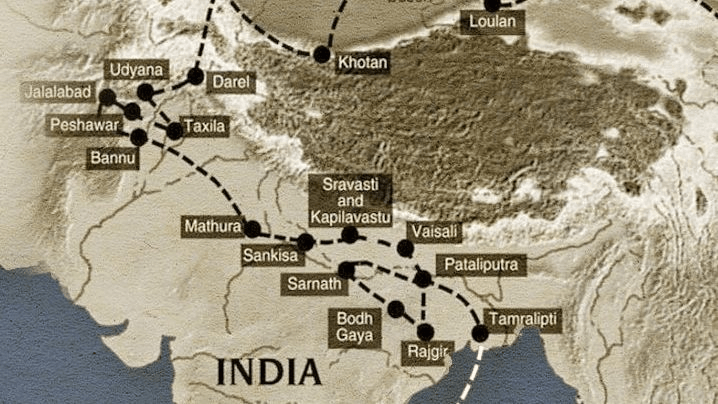
His travelogues give a fine impression about Chandra Gupta’s empire. The various
aspects of his empire. i.e. political, religious, social and economic, were clearly
reflected in his writings
Social condition:
Fahien noted the peacefulness of India, the rarity of serious crime, and the
mildness of the administration. He stated that it was possible to travel from one
end to another in the country without molestation, and without passports.
- Hiuen Tsang had said he had been robbed twice which implies there were
law and order problem during Harsha period.
In his remarks on social custom he stated that all respectable persons were
vegetarians, meat eating being confined to low castes and untouchables. Most
citizens did not consume onions, garlic, meat, and wine.
- Hiuen Tsang was also aware of the four classes and had mentioned many
mixed classes, but he shows no clear knowledge of the existence of caste
in its modern form. Yuan Chwang had mentioned both about vegetarian
and non vegetarian.
According to Fahien, the Shudras were kept outside the town and entered the
town by making a noise with a stick. They were butchers, hunters, and fishermen.
- Hiuen Tsang had also described this.
Religious Conditions :
He found Buddhism still flourishing, but theistic Hinduism was very widespread.
His record shows that in place of the old sacrificial Brahminism, Hinduism has
appeared. But in the best days of the Gupta Empire Indian culture reached a
perfection which it was never to attain again. Humanitarian ideas, probably
encouraged by Buddhism, were effective in Gupta period in moderating the fierce
punishments of earlier days.
Fahien stated that the death penalty was not imposed in north India, but most
crime was punished by fines and only serious revolt by the amputation of one
hand. Executions were rare.
- Hiuen Tsang, 200 years later. reported that prisoners were not executed
under Harsha. but were left to rot in dungeons. Punishments were rather
mild as compared to the later times
He had given a detailed description of the Buddhist pilgrimages. According to
him, the Buddhist religion was divided into Mahayana and Hinayana. He saw
twenty Buddha vihars in Mathura. But in Kapilavastu. Gaya and Kushinagar the
condition was deteriorating which indicated the weakening of Buddhism.
In the description of Fahien, it is not clear whether Brahmin religion was prevalent
in the country or not. He visited two vihars near the stupa of an Ashoka in
Patliputra- in one of them the Mahayana monks resided and in the other the
Hinyana monks. The ruler of Madhya Pradesh was a worshipper of Vishnu.
According to F Hien, mutual relation was cordial and peaceful among the Hindus
and the Buddhists. This indicates the religious tolerance of the society –
Hiuen Tsang had also described the religious conditions of India at that
time. The Buddhist religion was clearly declining. Despite of this, hundreds
of monks resided in the country.
Fahien had mentioned about the Jainism, Shaiv and Vaishnav also. But there is
no mention of the Jain religion in Hiuen Tsang’s texts.
Economic condition:
From Fa Hien’s accounts, the Gupta Empire was a prosperous period, until the
Rome-China trade axis was broken with the fall of the Han dynasty, the Guptas’
did indeed prosper.
Fahien states that the income of the government was mainly based on the
revenue taxes which were one-sixth of the total production. There was absence
of poll-tax and land tax.
Faxian wrote. “The people were rich and prosperous and seemed to emulate
each other in the practice of virtue. Charitable institutions were numerous and
rest houses for travelers were provided on the highway. The capital possessed an
excellent hospital.” Fahien had made special note of free hospitals maintained by
the donations of pious citizens.
Government officials were given fixed income and there was no contribution from
the people. Donation was prevalent in those times. Fahien had made special note
of free hospitals maintained by the donations of pious citizens.
- Hiuen Tsang had also reported that Nalanda was supported by the
revenues of an enormous estate of one hundred villages, and by the alms
of many patrons, including the great Harsha himself; it provided free
training for no less than 10,000 students, who had a large staff to wait on
them.
Fahien was enamored by Patliputra and the huge palace of Ashoka.
- According to Hiuen Tsang, Patliputra was not a main city of north India and
its place was taken by Kannauj. Hiuen Tsang had mentioned about the
social and economic conditions. He reported about varna system and
marriage. Fahien had not described all this. But both of them had stated
that the economy was based on agriculture.
Political condition:
As his main interest was religion, Fa-hien did not record anything specifically
about the political condition of India. He did not mention even the name of
Chandra Gupta II in whose dominion he must have lived for more than five years.
But his account for other aspects of society does implies that the administration
of the Guptas was benevolent and successful and the rulers not only maintained
peace and security within the empire but also looked after the welfare of their
subjects.
Hiuen Tsang had glorified Harsha, he said Harsha was a great King and he
had a great army
Criticisms of Faxian’s account
Fahien, in comparison to Hiuen Tsang, had not been so observant and
informative with regard to social, economic and political conditions of the society.
Hiuen Tsang had completely described the period of king Harshavardhana but Fa
Hien did not mention name of Chandragupta Vikramaditya.
Faxian presented an idealized picture of Indian society, happy and content
people enjoying life of peace and prosperity.
Faxian’s account contains very few descriptions of lives of ordinary people and
these tend to be rather idealized. He focused mainly on Buddhist monasteries,
Buddhist practices, Buddhist pilgrimage sites etc.
Descriptions given by him like no corporal punishment, no theft, no sale of liquor,
vegetarianism etc are not supported by other contemporary sources and need to
be refuted.
Faxian came to India as a Buddhist adherent and wanted to present India as an
ideal to Chinese people, so, he did not display descriptive and analytical
approach
 UPSCLOGY