
India-Bangladesh Relations
- Bangladesh-India relations are the bilateral relations between the People’s Republic of Bangladesh and the Republic of India, both of which are South Asian neighbours.
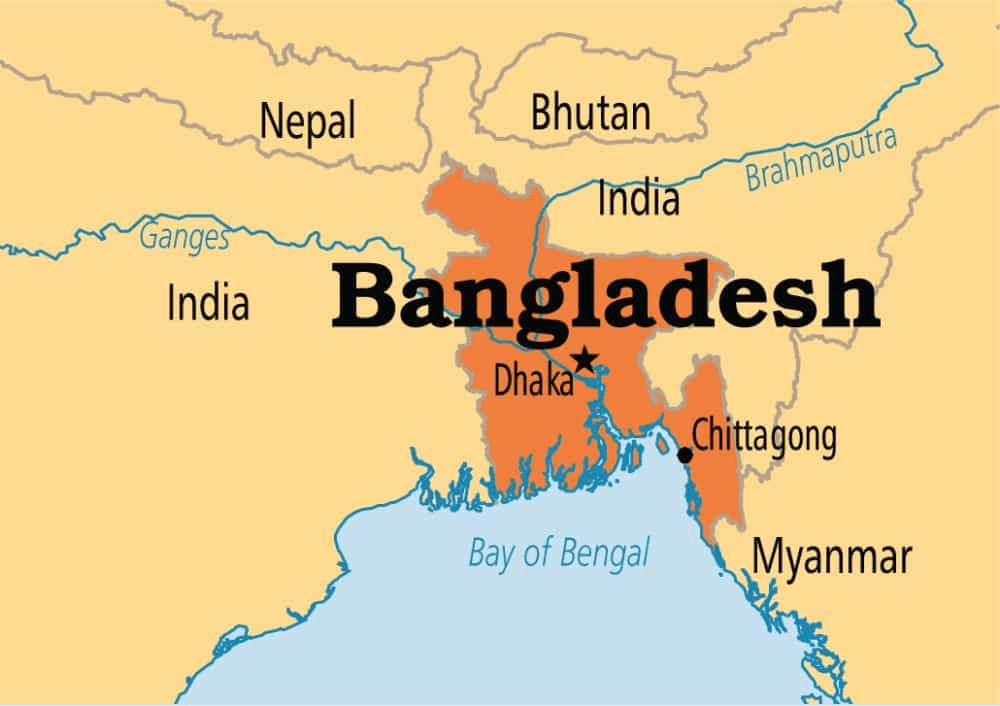
- Three sides of Bangladesh’s land border are shared with India, and one side runs along the Bay of Bengal. India and Bangladesh share 4096.7 km of border, which is the longest land boundary that India shares with any of its neighbours.
- India and Bangladesh are not just neighbours, but are bound by an umbilical connection of ethnicity and kinship. India attaches highest importance to bilateral relations with Bangladesh because of our shared history, heritage, culture, language, physical proximity and passion for music, literature and arts. Also, Rabindranath Tagore, created the National Anthems of both India and Bangladesh.
- The two nations can together play a significant role for the development and prosperity of the entire subcontinent and beyond.
- The edifice of this unique relationship between the two neighbouring nations is based on the unwavering faith in democratic values, principles of liberalism, egalitarianism, secularism and respect for each other’s sovereignty and integrity.
- The cordial relation is reflected through multidimensional and expanding relations between the two countries. In the last four decades, the two countries have continued to consolidate their relations and have built a comprehensive institutional framework to promote bilateral cooperation in all areas.
- India was the first country to recognize Bangladesh as a separate and independent state. India established diplomatic relations with Bangladesh immediately after its independence in December 1971. Bangladesh and India are common members of SAARC, BIMSTEC, IORA and the Commonwealth.
- The relations between the two countries have been characterised as a special relationship, although some disputes remain unresolved.
- The historic land boundary agreement was signed on 6 June 2015, which settled decades-old border disputes, while negotiations are still ongoing over the sharing of water of the transboundary rivers.
- In recent years, Bangladesh has seen rising anti-India sentiments among its citizens due to the Indian government’s perceived anti-Muslim and anti-Bangladeshi activities like India’s interference in Bangladeshi politics, killings of Bangladeshis by the Indian BSF, Citizenship Amendment Act, rise of Hindutva in India as well as India’s reluctance to solve the water disputes in common rivers with Bangladesh.
Areas of Cooperation b/w India-Bangladesh Relations
Political
- The independence of Bangladesh unfolded an environment of cordial relations between Bangladesh and India.
- India’s humanitarian, moral, diplomatic and military assistance played a crucial role in the liberation of Bangladesh.
- Bang Bandhu (Sheikh Mujeeb ur Rehman) had openly acknowledged that “Friendship with India is a cornerstone of Bangladesh’s foreign policy”.
Security and Border Management
- A number of agreements related to security cooperation have been signed between both the countries. These include a coordinated Border Management plan signed in 2011 to synergize the efforts of both border guarding forces for effective control over cross-border illegal activities and crimes.
- The India-Bangladesh Land Boundary Agreement (LBA) came into force following the exchange of instruments of ratification during Hon’ble PM’s visit to Bangladesh in June 2015.
- Under this agreement, the enclaves of India and Bangladesh in each other’s countries were exchanged, and strip maps were signed. The agreement will help improve border management and control the problem of trafficking, illegal movement, etc.
- The settlement of the maritime boundary arbitration between India and Bangladesh, as per UNCLOS award on July 7, 2014, paved the way for the economic development of this part of the Bay of Bengal, and will be beneficial to both countries.
- India and Bangladesh instituted a Coordinated Patrol (CORPAT) as an annual feature between the two Navies. The first edition was inaugurated from June 24 to 29 (2018). It is a major step towards enhanced operational interaction between both Navies.
Sharing of River Water
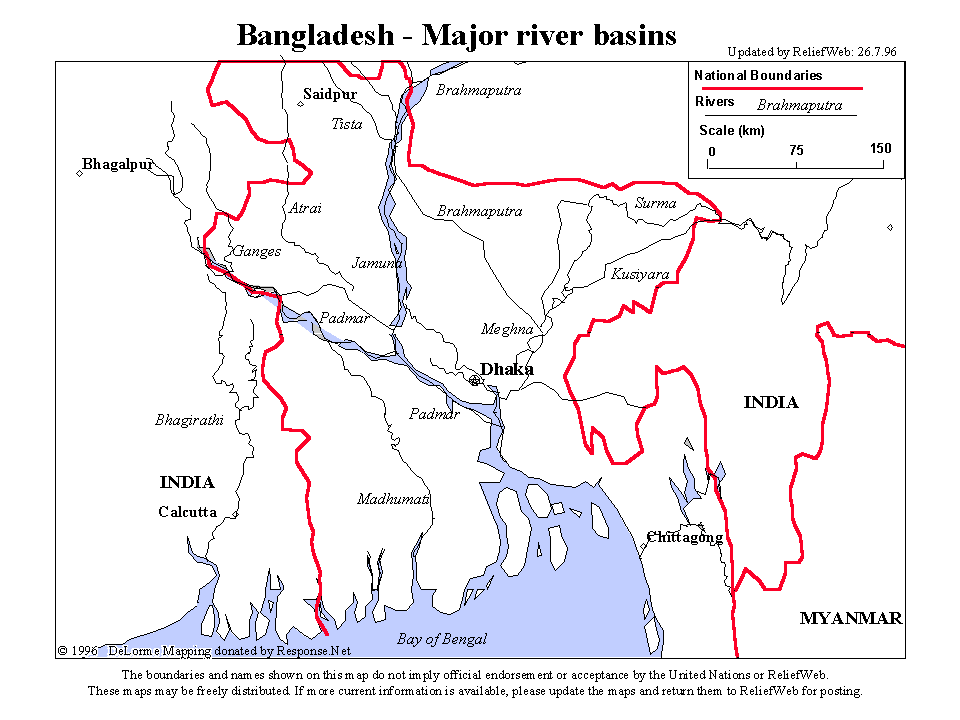
- India and Bangladesh share 54 common rivers where Bangladesh is the lower riparian country. As a lower riparian country, Bangladesh remains at risk from the impacts of rivers from India. However, India does share seasonal water flow and rainfall data to aid Bangladesh with flood forecasting.
- A bilateral Joint Rivers Commission (JRC) has been functioning since November 1972 to maintain liaison between the two countries to maximize benefits from common river systems. The Ganges Waters Treaty, signed in 1996 for the sharing of waters of the River Ganges during the lean season has also worked satisfactorily.
Ganga Water Agreement (1996):
- It was signed on December 12, 1996, by PM H. D. Deve Gowda (India) and PM Sheikh Hasina (Bangladesh) to share the Ganga’s dry season flow.
- It aimed to ensure water availability for irrigation, ecology, and navigation in both countries, especially at the Farakka Barrage, which diverts water to sustain the Kolkata Port.
- Duration: It replaced earlier short-term deals and set a 30-year framework (1996–2026), with a renewal clause by mutual consent.
- Key Terms of the Agreement:
- Lean Season Period: The treaty applies from January 1 to May 31, with water sharing calculated in 10-day intervals.
- Sharing Formula at Farakka:
- ≤ 70,000 cusecs: 50% each
- 70,000–75,000 cusecs: India gets the remainder after Bangladesh gets 35,000
- ≥ 75,000 cusecs: India gets 40,000; Bangladesh gets the balance
- Alternate Sharing: From March 11 to May 10, both countries receive 35,000 cusecs alternately every three 10-day blocks.
- No Minimum Guarantee: If flow falls below 50,000 cusecs, Article II allows for consultations and emergency adjustments.
- Monitoring Mechanism: The Joint Rivers Commission (JRC) ensures implementation and dispute resolution.
- Project Provisions: Both countries may construct water projects for irrigation and navigation.
India’s Considerations for Treaty Revision
- India wants to amend the treaty to better align with its current development needs, including irrigation, port maintenance, and power generation.
- India desires an additional 30,000 to 35,000 cusecs of water during the same period to meet these emerging requirements.
- The West Bengal government supports the central government’s position, believing the current treaty provisions inadequately address its needs.
Bilateral Trade
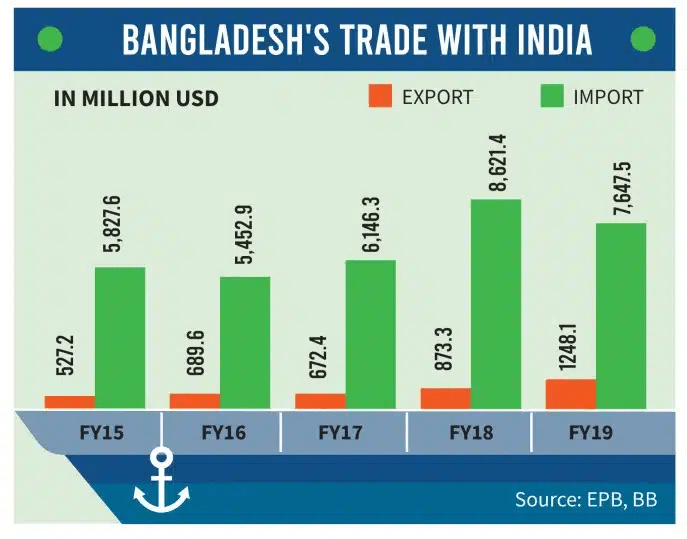
- India-Bangladesh trade has grown steadily over the last few years. The current dynamics of the relationship are very positive.
- Bangladesh is India’s largest trade partner in South Asia, while India is its second-largest trade partner in Asia. In FY 2023-24, the total bilateral trade stood at USD 12.9 billion.
- India’s exports to Bangladesh stood at USD 11.06 billion and India’s imports from Bangladesh were at USD 1.8 billion.
- India’s key exports to Bangladesh include cotton, petroleum products, engineering goods, and chemicals.
- Major imports from Bangladesh are apparel, textiles, jute goods, and aerospace parts.
- The volume of bilateral trade between India and Bangladesh was about $ 9.3 billion (2017-18), representing more than three times the value of $ 2.67 billion a decade ago.
- India’s exports to Bangladesh stood at USD 11.06 billion and India’s imports from Bangladesh were at USD 1.8 billion.
- India and Bangladesh are looking at strengthening economic cooperation through joint investments and cooperation under the ‘Blue Economy’ programme, which entails synergised efforts of littoral states in the exploration of hydrocarbons, marine resources, deep-sea fishing, preservation of marine ecology and disaster management.
Trade and Duty Concessions
- India’s exports to Bangladesh stood at USD 11.06 billion, and India’s imports from Bangladesh were at USD 1.8 billion in FY 2023-24.
- India’s exports to Bangladesh in 2017-18 were around US $ 8.4 billion, and imports from Bangladesh during the same period were around US $ 900 million.
- Substantial duty concessions have been extended to Bangladesh under SAFTA, SAPTA and APTA.
- India has provided duty free, quota free access to Bangladesh (and other SAARC LDCs) on all tariff lines except on the items in sensitive list (for example, Tobacco and Alcohol) under SAFTA since 2011.
- Four Border Haats, two each in Tripura and Meghalaya, have been established for the benefit of communities along the border.
Investment
- Rising Indian Investments:
- Traditionally, India’s investments in Bangladesh were modest (approx. US$ 3.11 billion cumulative stock, with FDI inflows of only US$ 88 million in 2015-16).
- Over the past decade, Indian investment has accelerated, reflecting deepening economic engagement.
- Key Developments:
- During PM Sheikh Hasina’s visit to India in 2017, MoUs worth US$ 9 billion were signed by Indian private sector firms in power, energy, and infrastructure.
- In 2022-23, India became the second-largest source of proposed foreign and joint-venture investments in Bangladesh:
- India’s proposals: US$ 185 million.
- China’s proposals: US$ 425 million.
- India’s share rose sharply from 0.8% in 2018-19 to 24.1% in 2022-23.
- Sectoral Focus:
- Textiles and weaving (a backbone of Bangladesh’s exports).
- Banking and financial services.
- Connectivity and infrastructure projects: Khulna–Mongla rail line, Akhaura–Agartala rail link, Mongla Port modernization.
- Power and energy cooperation: e.g., Rampal Maitree Super Thermal Power Project (US$ 1.6 billion), cross-border electricity trade.
- Recent Trends:
- FDI inflows into Bangladesh rebounded in 2025 (Q1):
- Net inflows: US$ 864 million (114% growth YoY).
- India’s share has been growing, with the cumulative stock of Indian FDI reaching around US$782 million (2023).
- India is now consistently ranked among the top 10 investors in Bangladesh (8th position in 2023), behind the US, UK, and China.
- FDI inflows into Bangladesh rebounded in 2025 (Q1):
India’s Economic Assistance to Bangladesh
- Historical Credit Lines & Grants
- In 2010, India announced a US$ 1 billion Line of Credit (LoC) to cover transportation, roads, rail, bridges and inland waterways. Most projects have been completed; others are underway.
- In June 2015, a new LoC of US$ 2 billion was announced for Roads, Railways, Power, Shipping, SEZs, Health & Medical Care, Technical Education.
- In April 2017, India announced US$ 5 billion credit: US$ 4.5 billion for developmental projects; US$ 0.5 billion for defence procurement.
- India also provides grant assistance through its “Aid to Bangladesh” programme: for schools/colleges, dispensaries, community centres, deep tube wells, historical monuments, etc. Sustainable Development Projects (SDPs) are ongoing in Rajshahi, Khulna, Sylhet.
- Recent Projects & Launches (2022-23 / 2023)
- India-assisted Khulna-Mongla Port Rail Line (~US$ 388.92 million via concessional LoC) connecting Mongla Port to Bangladesh’s broad gauge rail network.
- Akhaura-Agartala Cross-Border Rail Link built under Indian grant assistance Indian grant of ~₹ 392.52 crore, part of connectivity projects.
- Maitree Super Thermal Power Plant (Rampal, Bangladesh): 1,320 MW project, implemented under Indian concessional financing (~US$ 1.6 billion). Second unit inaugurated; strengthens energy security for Bangladesh.
- Recent Developments & Adjustments (2024-2025)
- LoC Projects Under Review / Scaling Down:
- Bangladesh has decided to drop 11 projects from the Indian LoCs due to prolonged approval, delays, and inefficiencies. LoC total reduced from ~US$ 7.34 billion to ~US$ 4.68 billion.
- Several stalled rail projects (worth ~US$ 800 million) being considered for withdrawal.
- Disbursement has slowed: only US$ 81.5 million disbursed over a seven-month period (July–January) under Indian LoC in one recent fiscal year.
- Aid / Grant Assistance Issues:
- India’s aid (people-oriented / small community projects) to Bangladesh has remained at ₹120 crore for FY2024 and FY2025, with no new projects initiated in FY2026 so far due to political and security concerns.
- Some projects disrupted: e.g., the Ashuganj-Akhaura four-lane road project saw contractors leaving, work halted.
- LoC Projects Under Review / Scaling Down:
Cooperation in the Power and Energy Sector
- Electricity Trade Expansion
- Bangladesh is the largest recipient of India’s power exports (≈1,160 MW supplied in 2023).
- Grid interconnections — Berhampore–Bheramara and Suraj Mani Nagar–Comilla — have strengthened regional energy integration.
- New amendments in India’s power export rules (2024) will make supply more reliable, even in case of disruptions.
- Maitree Super Thermal Power Project (Rampal)
- A landmark joint venture between India’s NTPC and Bangladesh Power Development Board.
- Both Unit-1 and Unit-2 (660 MW each) are being synchronised with Bangladesh’s grid, marking Bangladesh’s largest coal-based power plant.
- Equipped with modern emission control technologies — reflecting commitment to sustainable energy.
- Rooppur Nuclear Power Project (with Russia)
- India plays a crucial role in training scientists, building transmission lines, and sourcing equipment.
- The project will add ~2,400 MW of clean, nuclear energy — reducing Bangladesh’s dependence on fossil fuels.
- First such trilateral nuclear cooperation (India-Russia-Bangladesh) — a model for South-South collaboration.
- India–Bangladesh Friendship Pipeline (2023)
- First cross-border energy pipeline in South Asia, connecting Siliguri (India) to Parbatipur (Bangladesh).
- Supplies 1 million metric tonnes of High-Speed Diesel annually to 7 northern districts of Bangladesh.
- Ensures low-cost, eco-friendly, and reliable energy delivery.
- Oil & Gas Cooperation
- ONGC Videsh, Oil India, GAIL, and Indian Oil Corporation are actively engaged in exploration and energy security projects in Bangladesh.
- Strengthens Bangladesh’s hydrocarbon exploration capacity and reduces overdependence on imports.
- ICT and Energy Synergy
- Export of internet bandwidth from Bangladesh to Tripura (India) and export of power from India to Bangladesh — showing mutual dependence and digital-energy cooperation.
- Capacity Building & Training
- India is training Bangladeshi nuclear scientists, engineers, and technicians, building long-term human capital for Bangladesh’s energy future.
- Workshops, technical exchanges, and joint R&D under SAARC and BIMSTEC frameworks enhance cooperation.
- Regional Energy Integration
- Projects support India’s vision of BBIN (Bangladesh-Bhutan-India-Nepal) energy grid and BIMSTEC energy corridor.
- Bangladesh acts as a bridge for power trade between South Asia and Southeast Asia.
Connectivity between India and Bangladesh
- Land Connectivity
- India and Bangladesh share the largest international land boundary in the region, with 36 functional Land Customs Stations (LCSs) and several Integrated Check Posts (ICPs) facilitating movement of goods and people.
- Petrapole–Benapole ICP handles nearly 50% of bilateral trade, and since 2017 it operates on a 24×7 basis, ensuring uninterrupted cargo movement.
- New ICPs such as Dauki (Meghalaya) and Sutarkandi (Assam) have been upgraded to enhance border trade and movement.
- Railway Connectivity
- The Maitree Express (Kolkata–Dhaka) and Bandhan Express (Kolkata–Khulna) have been fully converted into modern AC train services.
- The Mitali Express (New Jalpaiguri–Dhaka) launched in 2021 strengthens North Bengal–Bangladesh connectivity.
- Several cross-border rail links have been restored, such as Haldibari–Chilahati (2020), which revives pre-1965 links.
- Rail connectivity is now being integrated with freight corridors, enabling faster trade of bulk goods like coal, stone chips, and agricultural produce.
- Road Connectivity
- The BBIN Motor Vehicles Agreement (MVA) is being operationalised gradually, with trial runs of cargo movement already completed on routes like Kolkata–Agartala via Dhaka.
- Regular bus services are operational on routes such as Kolkata–Dhaka, Agartala–Dhaka–Kolkata, and Shillong–Dhaka, ensuring affordable passenger movement.
- Bridges / Key Infrastructure
- Maitri Setu (Sabroom, Tripura ↔ Ramgarh, Bangladesh) was inaugurated on 9 March 2021.
- This bridge links NE India to Chattogram port, shortening transport routes significantly.
- Maitri Setu (Sabroom, Tripura ↔ Ramgarh, Bangladesh) was inaugurated on 9 March 2021.
- Inland Waterways
- The Protocol on Inland Water Transit and Trade (PIWTT) allows movement of goods through designated river routes.
- Routes such as Varanasi–Haldia–Bangladesh–Northeast India have enabled cost-effective and eco-friendly cargo movement.
- Container and bulk cargo, including food grains, cement, and coal, are regularly moved through Bangladeshi waterways, easing pressure on the Siliguri Corridor (Chicken’s Neck).
- Coastal and Maritime Connectivity
- The India–Bangladesh Coastal Shipping Agreement has facilitated direct sea connectivity for container and bulk cargo.
- Ports like Chattogram and Mongla have been opened for Indian transit cargo, significantly reducing logistics costs for the Northeastern states of India.
- Air Connectivity
- Regular flights connect Dhaka and Chattogram with New Delhi, Kolkata, Mumbai, Guwahati, and other Indian cities.
- The resumption and expansion of flight services post-COVID have further deepened people-to-people connectivity.
- Digital & Energy Connectivity (New Dimensions)
- Bandwidth export from Bangladesh to India’s Northeast and cross-border energy transmission are new areas of connectivity.
- Digital payments and fintech linkages are being explored to complement physical connectivity.
Technical Cooperation
- Bangladesh is a key partner in India’s Indian Technical and Economic Cooperation (ITEC) programme
- Over the years, thousands of Bangladeshi officials and professionals have availed short and medium-term training in India.
- The training includes varied domains: governance, audit & accounts, public administration, law & order (police, border policing), IT & data analytics, renewable energy, etc.
- Recent & Specific Initiatives
- In 2024-25, India announced 115 specialized ITEC courses (on-campus / physical) for Bangladesh from June 2024 to March 2025. These cover diverse topics like data science, environmental impact assessment, training techniques, skill development for women-entrepreneurs, etc.
- A customized training programme titled “Engineering Excellence: From Blueprint to Border” was held in New Delhi in October 2024 for Bangladesh Land Port Authority officials. The focus was on planning smart, green, and resilient land ports.
- Formation of the ITEC Alumni Association in Bangladesh (IAAB) in 2023: brings together ITEC alumni to foster cooperation, peer networking, feedback, and further collaboration.
- Magnitude & Capacities
- Bangladesh is among the top recipients of ITEC slots; annually substantial number of Indian slots (hundreds) are dedicated to Bangladeshi officials.
- Trainees come from central / provincial administration, police, border guarding forces, custom authorities, teachers / educational institutions, and law enforcement.
- Courses are held in Indian premier institutes, bringing exposure to best practices, new technologies, methodologies.
- Strategic Significance
- Enhances human capital development in Bangladesh: improves capacity, professionalism, governance.
- Deepens bilateral trust and people-to-people linkages; alumni serve as informal ambassadors.
- Allows India to share its development experience and technical expertise; strengthens its soft power in the region.
- Helps address asymmetries: while Bangladesh grows fast, technical capacity is often a bottleneck; these programmes help fill that gap.
Cultural Exchange
- The High Commission of India publishes Bharat Bichitra, a Bengali literary monthly (print + electronic), for over four decades. It commands wide readership across Bangladeshi society.
- The Indira Gandhi Cultural Centre (IGCC), Dhaka conducts regular courses in Yoga, Hindi, Hindustani Classical Music, Manipuri Dance, Kathak, Painting, etc. These are very popular among Bangladeshi students.
- Technical & people-to-people cultural interactions include: joint celebration of anniversaries (e.g., Rabindranath Tagore’s 150th birth anniversary, Kazi Nazrul Islam’s poems like Bidrohi, Swami Vivekananda’s anniversary), film festivals, art exhibitions, screening of Indian and Bangladeshi films, lectures, workshops by the Cultural Centre.
Other Areas
- India announced several welfare schemes in 2017 for Muktijoddhas (freedom fighters) of Bangladesh:
- Scholarships: Additional 10,000 student scholarship slots for children of freedom fighters.
- Visa facility: Five-year multiple-entry visas for all freedom fighters.
- Medical treatment: Free treatment in Indian hospitals for 100 Bangladeshi veterans each year.
- These schemes have been implemented:
- Many beneficiaries have been identified and recipients of medical treatment are being sent to Indian hospitals under the medical scheme.
- Visa facilitation processes have been simplified for Muktijoddhas; special counters established at visa centres.
- The scholarship scheme is ongoing; students from all over Bangladesh are selected annually under the scheme, receiving grants at higher secondary and undergraduate levels.
- In the nuclear energy arena: Cooperation at Rooppur Nuclear Power Plant has deepened:
- India has provided support in training Bangladeshi scientists and engineers, especially in nuclear safety, reactor fuel handling, radiation management.
- Bangladesh has rigged up its own training centre and is using simulators for operations and refuelling machine functions.
- The first reactor unit of Rooppur is expected to enter commercial operation in the near future; Bangladeshi personnel are increasingly capable of handling nuclear fuel-related tasks and managing operational safety.
Significance of Bangladesh to India
- The geographical location of a country occupies a significant position while making a foreign policy decision. The geopolitical location of Bangladesh gives it both strengths and weaknesses from different perspectives.
- India, by virtue of its population, size, military and economic might, is a formidable player in South Asia. Rising Chinese influence in the subcontinent and in the Indian Ocean region is detrimental to the national interest of India.
Strategic Importance of Bangladesh
- Security: India and Bangladesh share a border of 4156 km, a large part of which is unfenced. Human and Drug Trafficking, FICN (Fake Indian Currency Notes), smuggling of cattle, terrorism, etc are major concerns for India. Cooperation of Bangladesh is therefore important for the security of India, especially states that border Bangladesh.
- Consolidating Sphere of Influence in the Indian Ocean: The Growing influence of China in the region and Bangladesh’s acceptance of One Belt and One Road (OBOR) initiatives of China may lead to the dominance of China in the region. A neutral Bangladesh is therefore vital for countering assertive China and keeping sea lanes of communication in the Bay of Bengal secure.
- Connectivity to North East India: North East of India is connected through a narrow strip called the Siliguri Corridor or Chicken Neck. Connectivity to the North East is important for security and development of the region. Bangladesh, which shares a border with many North Eastern States, can help in improving connectivity and bringing development to the region. Bangladesh and India (through various ongoing initiatives such as the trans-shipment of Indian goods through Bangladesh’s Ashuganj port to Northeast India, expansion of rail links within Northeast India and between the two countries, and the BBIN Motor Vehicles Agreement can dramatically reduce the cost of transport between Northeast India and the rest of India.
- Act East Policy: Deepening connectivity and economic linkages between India and Bangladesh will be critical for the success of India’s ‘Act East’ policy. As the Prime Minister of India has said, ‘India’s Act East Policy starts with Bangladesh’.
- Insurgency and Terrorism: Over the past few years, the Bangladeshi security agencies have arrested top leaders of the insurgent groups banned in India, especially those active in the Northeast. The proactive action and cooperation of the Bangladesh government is vital for the security of adjoining States, especially the North-Eastern states. There has been evidence of the influence of ISIS and other terror groups in Bangladesh, which poses a serious concern to India’s interests. Therefore, a zero-tolerance policy towards the terror group by Bangladesh is expected by India.
Economic
- Both countries are also part of a number of groupings that seek to expand South Asia’s connectivity with Southeast Asia and China. These include the Mekong-Ganga Cooperation Initiative, BIMSTEC, and the BCIM (Bangladesh-China-India-Myanmar) economic corridor project.
- India is a growing investor in Bangladesh, and now has land earmarked for the development of special “Indian economic zones” in Bangladesh.
- Bangladesh can act as a “power corridor” for the transmission of hydro energy from Arunachal Pradesh to the rest of India. In the future, this energy trade could well link up with potential hydropower exports from Bhutan and Nepal to form a BBIN (Bangladesh, Bhutan, India and Nepal) power market.
- The India-Bangladesh economic relationship has the potential to change the economy of Northeast India and advance India’s Act East vision.
- There exists a huge potential of trade between the two nations, especially north-east (NE) India and Bangladesh which has barely gained any momentum.
Significance of India to Bangladesh
- India has a huge economy compared to Bangladesh and shares one of the deepest cultural ties with it.
- India is a champion in democracy for the Southeast Asian countries, and India can therefore help Bangladesh in its internal democratic processes.
- Maintaining a peaceful and cordial relationship with India will be more beneficial for Bangladesh than the opposite way.
- There are a lot of areas like medical facilities, education, fighting terrorism, developmental projects, etc., where India can prove to be of immense help for Bangladesh in its growth trajectory.
Major Issues b/w India-Bangladesh Relations
- India and Bangladesh both suffer from a “perception problem”. In Bangladesh, India is viewed with suspicion because of its geo-strategic interests, overwhelming economic and military strength, and the sharing of Teesta waters.
- However, there are some major irritants which needs to be resolved in order to strengthen ties which shall be beneficial to both the countries.
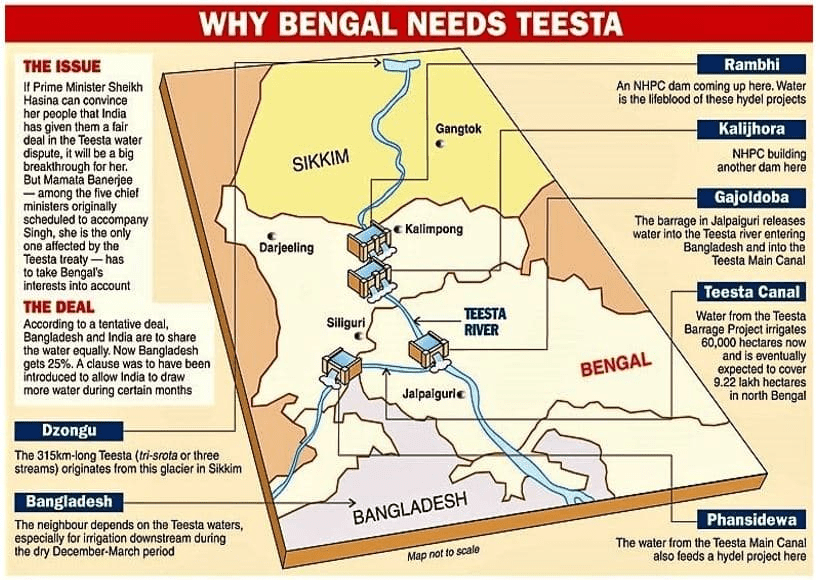
- Teesta Water Issue: The Teesta river originates in the Himalayas and flows through Sikkim and West Bengal to merge with the Brahmaputra in Assam and the Jamuna in Bangladesh. Sharing the waters of this river has been a major irritant between the two nations. Almost half a dozen districts in West Bengal are dependent on this river. It is also a major source of irrigation to the paddy growing greater Rangpur region of Bangladesh.Bangladesh has sought an “equitable” distribution of Teesta waters from India, on the lines of the Ganga Water Treaty of 1996, but the objection of West Bengal CM is that it will obstruct the flow for North Bengal, and as water is a state subject, the centre cannot overrule the concern of the state of West Bengal.
- Bangladesh complains that it does not get a fair share of the water. Since water is a state subject in India, the bottleneck lies in the non-consensus between the state government of Bengal and central government
- Meanwhile, no treaty has been signed yet to resolve the Teesta water-sharing dispute between the two nations.
- China’s Influence: Meanwhile, Bangladesh is also an important part of China’s “One Belt and One Road”. China played an important role in developing Bangladesh’s port at Chittagong even before the OBOR initiative came along, much to India’s dismay. India believes Bangladesh is a part of the “String of Pearls” which China is building across the Indian Ocean. New Delhi has been wary of Bangladesh’s growing military proximity with China, particularly the maritime component. Bangladesh has bought two diesel-electric submarines from China, which will necessitate the construction of a submarine base in Bangladesh, a port that might play host to Chinese submarines in future, as Sri Lanka’s Hambantota port.
- Illegal Migration and Insurgency Issue: The porous border and lack of proper fencing along the country’s longest international border are of the main reasons for the huge amount of illegal migration, which includes both refugees and economic migrants, continuing unabated. Also, the porous border and cattle haats along the border have led to cattle smuggling on a large scale.
- Large influx of such migrants across the boundary has posed serious socio-economic-political problems for the people of Indian states bordering Bangladesh, with serious implications for its resources and national security.
- The issue was further complicated when the Rohingya refugees originally from Myanmar started infiltrating into India through Bangladesh.
- Also, the National Register of Citizens (NRC), which is expected to deter future migrants from Bangladesh from entering India illegally, has also triggered a major concern in Bangladesh.
- Large influx of such migrants across the boundary has posed serious socio-economic-political problems for the people of Indian states bordering Bangladesh, with serious implications for its resources and national security.
- Rohingya Crisis: Considering India’s stature in the region, expectations were high that the country would take a proactive role in resolving the Rohingya crisis. But India’s dilly-dallying was a disappointment for Bangladesh. Later, India categorically conveyed that it wants the “safe, secure and sustainable” return of the Rohingya refugees. However, it was a missed opportunity for India when it could have played a leadership role and brought key stakeholders to the negotiating table.
- Terrorism: The borders are susceptible to terrorist infiltration. A number of outfits are trying to spread their tentacles across India, such as Jamaat-ul Mujahideen Bangladesh (JMB).
- JMB is listed as a terror group by Bangladesh, India, Malaysia and the United Kingdom.
- Recently, The National Investigation Agency has filed a charge-sheet against 6 members of the JMB in a special court in Bhopal.
- Drug Smuggling & Trafficking: There have been many incidences of cross border drug smuggling & trafficking. Humans ( especially children & women) are trafficked & various animal & bird species are poached through these borders.
- Border Disputes: The non-demarcation of a 6.5 km land border along the Comilla – Tripura makes the border question unresolved. India’s reluctance to resolve this issue is attributed to the concerns of the Hindus living in the lands likely to go to Bangladesh after demarcation.
- Public discontentment in Bangladesh over India’s policy includes market access by Indian energy companies, the erecting of borders on the zero point, the unresolved and unimplemented Teesta treaty, and the lack of market access for Bangladeshi companies and TV channels.
- Therefore, a stable, moderate Bangladesh is in India’s long-term interests as constructive India-Bangladesh ties can be a major stabilizing factor for the South Asia region. This makes it imperative for both sides to reduce the mutual trust deficit that has crept into their bilateral ties. India, being the bigger and more powerful of the two, should take the lead in this process by taking constructive steps to improve the relations. India must recognise the strengths and weaknesses with which Bangladesh is naturally endowed by virtue of its geopolitical location.
Major Initiatives
Space Technology
- India made a promise to extend the advanced space technology for the cause of growth and prosperity of the people of South Asia, and felt that the successful launch of South Asia Satellite (GSAT-9) marks a fulfilment of that. Similarly, the NAVIC will help in providing navigational NAVIC (Navigation with Indian Constellation), India’s indigenous global navigation satellite system, will facilitate accurate real-time positioning and timing services over India and the region around it, extending to 1,500 km.
Connectivity
- Connectivity of the two countries through the BBIN corridor and the BCIM corridor will help in the prosperity of the region and provide aid to the economic growth of both countries.
Cultural
- Special emphasis has been laid on the promotion of exchanges in the fields of music, theatre, art, painting, books, etc. A Bilateral Cultural Exchange Programme (CEP) 2009-2012 provides the framework for such exchanges.
Land Boundary Agreement
- India and Bangladesh have a common land boundary of approximately 4,096 km. Given its sheer length, the border between India and Bangladesh has always been difficult to manage. The India-East Pakistan (Bangladesh) land boundary was determined as per the Radcliffe Award of 1947. Disputes arose out of some provisions in the award. Through Land boundary Agreements, efforts have been made to resolve the aforementioned disputes.
1974
- An agreement was signed on May 16, 1974, soon after the independence of Bangladesh, to find a solution to the complex nature of border demarcation. LBA 1974 states that the two countries are expected to exchange territories in Adverse Possession in already demarcated areas. While Bangladesh ratified the agreement, India did not, as it involved seceding territory and indicating these precise areas on the ground.
- The 1974 agreement provided that India would retain half of Berubari Union No. 12, and in exchange, Bangladesh would retain the Dahagram and Angarpota enclaves. The Agreement further provided that India would lease in perpetuity to Bangladesh a small area near Dahagram and Angarpota (the “Tin Bigha” corridor) for the purpose of connecting Dahagram and Angarpota with Bangladesh.
- The agreement was implemented in entirety, with the exception of three issues pertaining to the undemarcated land boundary of approximately 6.1 km in three sectors – Daikhata-56 (West Bengal), Muhuri River-Belonia (Tripura) and Lathitila-Dumabari (Assam); exchange of enclaves; and adverse possessions.
2011
- A protocol was signed by the two countries on September 6, 2011, after written concurrence of the concerned state governments was obtained. The 2011 Protocol provides for redrawing of boundaries so that the adverse possessions do not have to be exchanged; it has dealt with them on an ‘as is where is’ basis by converting de facto control into de jure recognition.
- In respect of adverse possessions, India is to receive 2,777.038 acres of land and to transfer 2267.682 acres to Bangladesh. Over time, it became extremely difficult to implement the terms of the 1974 LBA as it meant uprooting people living in the adverse possessions from the land in which they had lived all their lives and to which they had developed sentimental and religious attachments. Both India and Bangladesh, therefore, agreed to maintain the status quo in addressing the issue of adverse possessions instead of exchanging them as was earlier required in the LBA, 1974.
Land in Adverse Possession
An adverse possession is territory that is contiguous to India’s border and within Indian control, but which is legally part of Bangladesh. People living in territories in adverse possession are technically in occupation and possession of land beyond the boundary pillars, but they are administered by the laws of the country of which they are citizens and where they enjoy all legal rights, including the right to vote. They have deep-rooted ties to their land, which go back decades and are categorically unwilling to be uprooted. Many local communities have sentimental or religious attachments to the land in which they live.
2015
- The historic 2015 LBA facilitated the transfer of 111 enclaves, adding up to 17,160.63 acres, from India to Bangladesh. Conversely, India received 51 enclaves, adding up to 7,110.02 acres, which were in Bangladesh. The benefit of the agreement will be felt primarily by residents, who can now choose which country to join, acquiring basic benefits of citizenship in the process.
- The 2015 LBA implements the unresolved issues stemming from the undemarcated land boundary— approximately 6.1 km long—in three sectors, viz. Daikhata-56 (West Bengal), Muhuri River-Belonia (Tripura) and Lathitila-Dumabari (Assam); exchange of enclaves; and adverse possessions, which were first addressed in the 2011 Protocol. It is important to note that in the land swap, Bangladesh gained more territory than India did.
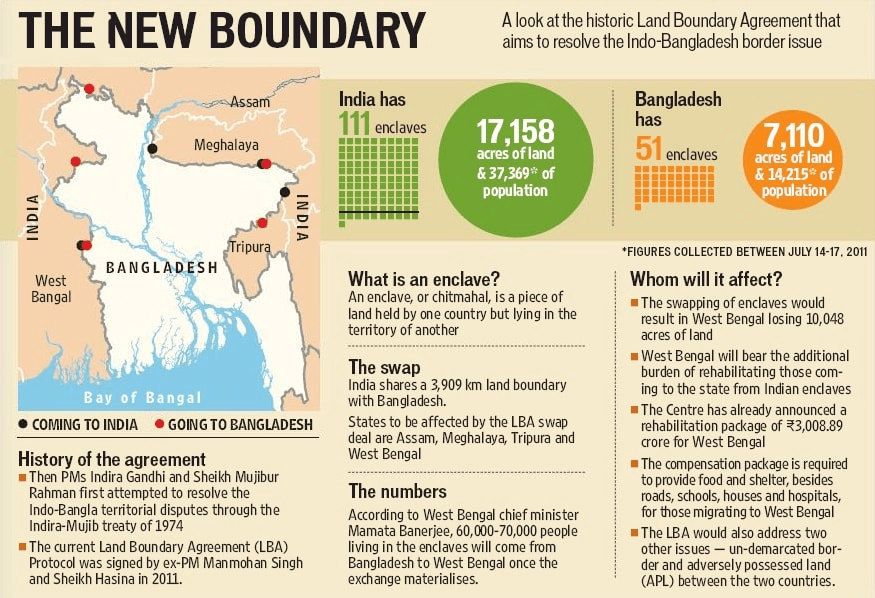
Issue with Enclaves
- The flawed nature of the partition left 111 Indian enclaves in Bangladesh and 51 Bangladesh enclaves in India. Their inhabitants did not enjoy full legal rights as citizens of either country or proper facilities such as electricity, schools and health services. Even law and order agencies did not have proper access to these areas. A joint census in 2010 found that around 51,549 (37,334 of them in Indian enclaves within Bangladesh) people inhabited these enclaves.
- The LBA states that people in these areas have the right to stay where they are as nationals of the State to which the areas were transferred. But a joint India-Bangladesh delegation that visited these enclaves in May 2007 found that people residing in Indian enclaves in Bangladesh and Bangladeshi enclaves in India did not want to leave their land and would rather be in the country where they had lived all their lives. Movement of people, if any, is therefore expected to be minimum.
Benefits of the LBA
- It ensures that the India-Bangladesh boundary is permanently settled and there should be no more differences in interpretation, regardless of the government in power.
- It promotes confidence in building better relations.
- The exchange of enclaves will mitigate major humanitarian problems as the residents in the enclaves and others on their behalf had often complained of the absence of basic amenities and facilities;
- All inhabitants can now look forward to a national identity and enjoy the same benefits and services as their neighbours living outside the enclaves.
- The settlement of Adverse Possessions will lead to tranquillity and peace along the border.
Way Forward
- Addressing Teesta River Water Dispute: To establish a consensus towards demarcating the extent of teesta river water sharing and reaching a mutual agreement, both the Bengal government and the central government should work together with mutual understanding and signal cooperative federalism.
- Better Connectivity: There is a need to enhance connectivity in the region through strengthening cooperation in coastal connectivity, road, rail and inland waterways.
- Energy Security: As the global energy crisis continues to rise, it is imperative that India and Bangladesh cooperate in making use of clean and green energy in order to make South Asia Energy self-sufficient.
- India Bangladesh Friendship Pipeline: This project is being undertaken through ground and once completed will help in the movement of high speed diesel to Northern Bangladesh from India.
- Bangladesh has acknowledged Indian Oil Corporation Limited as a registered government-to-government supplier of refined petroleum products.
- Shifting Focus Towards Comprehensive Economic Partnership Agreement (CEPA): Bangladesh will graduate from a Less Developed Country (LDC) to a developing country by 2026 and will no longer be entitled to trade and other benefits that are accorded to LDCs under international and regional trading agreements.
- Through the Comprehensive Economic Partnership Agreement (CEPA), Bangladesh will be able to manage this transition and preserve its trade privileges. It will also strengthen economic ties between India and Bangladesh.
- Countering China’s Influence: Assisting Bangladesh with Nuclear technology, Artificial intelligence, Modern farming techniques, and flood data exchange will further strengthen India’s relationship with Bangladesh and help India in countering China’s influence to a greater extent.
- Tackling the Refugee Crisis: India and Bangladesh can take the lead in encouraging other countries in the South Asia Association for Regional Cooperation (SAARC) to develop a SAARC declaration on refugees, laying down specific procedures for determining the status of refugees and economic migrants.
Conclusion
- The two countries have immense potential in various areas of cooperation. However, if Bangladesh-lndia relations are to truly succeed, India must seek to win the hearts and minds of the Bangladeshi people and seek out ways to squash their perception of being an unfriendly neighbour. Political will, along with mutually beneficial exchanges, are the components for a sustainable Bangladesh-lndia alliance. The renewing of the 25-year treaty of friendship and cooperation on the basis of sovereign equality can help India gain trust among Bangladeshi people. As both the countries are vulnerable to terrorism, they should jointly cooperate with each other in tackling terrorism. Also, increase in investments can be increased by improving the business climate, connectivity, and reducing nontariff barriers.
Q. With reference to river Teesta, consider the following statements: (2017)
- The source of river Teesta is the same as that of Brahmaputra but it flows through Sikkim.
- River Rangeet originates in Sikkim and it is a tributary of river Teesta.
- River Teesta flows into Bay of Bengal on the border of India and Bangladesh.
Which of the statements given above is/are correct?
(a) 1 and 3 only
(b) 2 only
(c) 2 and 3 only
(d) 1, 2 and 3
Ans: (b)
 UPSCLOGY