
India-Pakistan Relations
- Pakistan is the northwestern neighbour of India, which shares a border with Jammu and Kashmir, Punjab, Rajasthan and Gujarat. The relationship between the two countries has been bitter since their independence. For the same reason, India and Pakistan are also referred to as “Conjugal twins”, and often known as “Brother Enemy”.
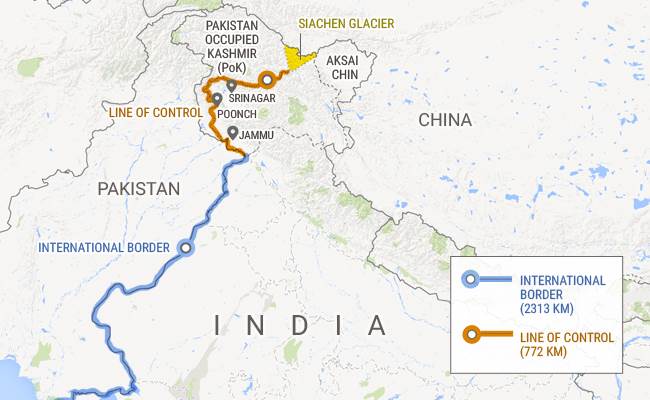
- The India-Pakistan boundary is the result of partition in 1947 under the Radcliffe Award. It starts from the marshy Rann of Kutch in Gujarat, traverses through the sandy deserts of Rajasthan, the fertile plains of Punjab and the mountains of Jammu and Kashmir up to the Karakoram range.
- The India-Pakistan relations have often been afflicted by cross-border terrorism, ceasefire violations, territorial disputes, etc. In 2019, the bilateral relationship was rocked by several tense events like the Pulwama terror attack, Balakot airstrike, scrapping of Jammu and Kashmir’s special status, etc. Improving bilateral ties is vital for both sides, as it would mean the stabilisation of South Asia and the improvement of the economies of both nations.
- India desires peaceful, friendly and cooperative relations with Pakistan, which require an environment free from violence and terrorism.
- To understand the complexity of the relationship, let us first look at the historical roller coaster path with the timeline as below:
India-Pakistan Relations: Historical & Contemporary Overview
- Historical Background (Pre-Partition Era)
- India-Pakistan relations are rooted in the colonial period, shaped by political, religious, and socio-economic factors.
- The British “divide and rule” policy exacerbated Hindu-Muslim communal tensions, particularly in the United Provinces, Punjab, and Bengal.
- The All-India Muslim League, under Muhammad Ali Jinnah, demanded a separate homeland for Muslims, citing fears of marginalization in a Hindu-majority India.
- Partition of 1947: Creation of Pakistan led to massive violence, displacement of over 14 million people, and deep-seated mistrust, setting the stage for enduring bilateral tensions.
- Early Post-Independence Conflicts
- Territorial Disputes: The primary flashpoint has been Jammu and Kashmir, a princely state that acceded to India under contested circumstances.
- Major Wars:
- 1947–48: First Kashmir War; UN-mediated ceasefire established the Line of Control (LoC).
- 1965: Second Kashmir War, leading to Tashkent Agreement.
- 1971: Bangladesh Liberation War; India-Pakistan war ends in creation of Bangladesh.
- 1999: Kargil War in Jammu & Kashmir after Pakistani infiltration.
- Other Issues: Cross-border terrorism, ceasefire violations, water disputes (Indus Waters Treaty, 1960), and political mistrust.
- Role of International Actors
- United Nations (UN): Advocated peaceful settlement of disputes, particularly in Kashmir.
- United States: Played mediatory roles during crises (1965, 1971, 1999), balancing strategic interests in South Asia.
- China: Its strategic partnership with Pakistan, including the China-Pakistan Economic Corridor (CPEC), influences India-Pakistan dynamics and regional geopolitics.
- India-Pakistan Relations in the 21st Century
- Ceasefire and Confidence-Building Measures
- 2003 LoC Ceasefire: Attempted to reduce cross-border firing; several rounds of SCO/SAARC dialogues aimed to build confidence.
- Terrorism and Cross-Border Militancy
- Persistent militant activity linked to Pakistan-based groups like Jaish-e-Mohammed (JeM) and Lashkar-e-Taiba (LeT).
- 2008 Mumbai Attacks and 2016 Uri Attack shaped India’s security policies and hardened public opinion.
- Diplomatic Engagements
- Track-I (official), Track-II (academic and civil society), and back-channel dialogues attempted to stabilize relations.
- Despite engagements, peace has been fragile due to ceasefire violations and unilateral actions.
- Ceasefire and Confidence-Building Measures
- Key Developments Post-2021
- 2021: Ceasefire Reaffirmation
- February 25, 2021: Both countries reaffirmed the 2003 LoC ceasefire.
- Significance: Attempt to de-escalate tensions after sporadic border incidents and maintain regional stability.
- 2025: Pahalgam Attack and Military Escalation
- April 22, 2025: Terror attack in Pahalgam, Jammu & Kashmir, killed 26 civilians; India blamed Pakistan-based groups.
- May 7, 2025: India launched Operation Sindoor, striking alleged terrorist infrastructure across LoC.
- May 10, 2025: International mediation facilitated a temporary ceasefire.
- Implications: Highlights fragility of peace, escalation risks, and nuclear deterrence considerations.
- Strategic and Diplomatic Measures
- Indus Waters Treaty: India suspended certain provisions citing national security.
- Airspace Closure: Pakistan temporarily closed its airspace to Indian carriers.
- Simla Agreement: Pakistan suspended elements of the 1972 agreement.
- Significance: Demonstrates strategic use of international agreements as leverage.
- 2021: Ceasefire Reaffirmation
Key Events in India-Pakistan Relations
| Year | Key Event |
|---|---|
| August 1947 | Britain ends its colonial rule over the Indian subcontinent, and forms two independent nations – secularly governed India and the Islamic republic of Pakistan. The division, widely known as Partition, sparks massive rioting that kills up to 10 lakh, while another 1.5 crore people flee their homes in one of the world’s largest human migrations. |
| October 1947 | The two young nations begun a war over control of Kashmir. It is a Muslim-majority kingdom ruled by a Hindu maharaja. The UN brokered for a cease-fire to end the war resulting in the unclear division of Kashmir. |
| January 1949 | India and Pakistan agree to a UN Security Council resolution calling for a referendum in which Kashmiris would determine their future; the vote never takes place. |
| September 1960 | India and Pakistan sign a World Bank brokered Indus Water Treaty governing six rivers, or three rivers each. It is the only India-Pakistan treaty that has held. |
| August 1965 | A second war begins over Kashmir, ending a month later in another UN mandated ceasefire. |
| December 1971 | A third war is fought, this time as India supports secessionists in East Pakistan. The war ends with the creation of Bangladesh. |
| July 1972 | The countries’ prime ministers sign an accord for the return of tens of thousands of Pakistani prisoners of war. |
| May 1974 | India conducts a nuclear test, becoming the first nation to do so that’s not a permanent UN Security Council member. |
| December 1989 | Armed resistance to Indian rule in Kashmir begins. India accuses Pakistan of giving weapons and training to the fighters. Pakistan says it offers only “moral and diplomatic” support. |
| May 1998 | India detonated five nuclear devices in tests. Pakistan detonated six. Both are slapped with international sanctions. |
| February 1999 | Indian Prime Minister Atal Bihari Vajpayee rides a bus to the Pakistani city of Lahore to meet with Pakistani counterpart, Nawaz Sharif, and sign a major peace accord. |
| May 1999 | Conflict erupts in Kargil as Pakistani forces and Kashmiri fighters occupy Himalayan peaks. India launches air and ground strikes. The US brokers peace. |
| May 2001 | Vajpayee and Pakistan’s President Pervez Musharraf meet in the Indian city of Agra, but reach no agreements. |
| October 2001 | Insurgents attack the legislature building in Kashmir, killing 38 people. |
| December 2001 | Gunmen attack India’s Parliament, killing India blames militant groups Lashkare-Taiba and Jaish-e-Muhammad, and deploys troops to its western frontier with Pakistan. The standoff ends in October 2002 after international mediation. |
| January 2004 | Musharraf and Vajpayee hold talks, launching bilateral negotiations to settle outstanding issues. |
| February 2007 | A train service between India and Pakistan, the Samjhauta Express, is bombed in northern India, killing 68. |
| October 2008 | India and Pakistan open a trade route across Kashmir for the first time in six decades. |
| November 2008 | Gunmen attack Mumbai, killing 166 people. India blames Pakistan-based terror group Lashkar-e-Taiba. |
| May 2014 | India’s new Prime Minister Narendra Modi invites Pakistani counterpart Nawaz Sharif to New Delhi for his swearing in ceremony. |
| December 2015 | PM Modi makes a surprise visit to the Pakistani city of Lahore on Sharif’s birthday and the wedding of his granddaughter. |
| January 2016 | Six gunmen attack an Indian air force base in the northern town of Pathankot, killing seven soldiers in a battle that lasted nearly four days. |
| July 2016 | Indian soldiers kill Kashmiri terrorist and Hizbul Mujahideen leader Burhan Wani, sparking months of anti-India protests and deadly clashes in the region. |
| September 2016 | Uri Attack: Suspected terrorists sneak into an Indian army base in Kashmir’s Uri and kill 18 soldiers. Four attackers are also killed. 11 days later, the Indian Army said it had carried out “surgical strikes” to destroy terror launch pads across the Line of Control in Pakistan. |
| June 2018 | Pakistan placed on FATF grey list. |
| November 2018 | Groundbreaking ceremony of the Kartarpur Corridor held. |
| Feb 2019 | Pulwama Attack: In the early hours of February 26, India conducts air attacks against what it calls Pakistan-based rebel group Jaish-e-Mohammad (JeM)’s “biggest training camp”, killing “a very large number of terrorists”. |
| February 2021 | India and Pakistan issued a joint statement reaffirming the 2003 ceasefire along the Line of Control (LoC). This marked a significant de-escalation after years of heightened tensions. The agreement aimed to reduce cross-border violence and foster stability in the region. |
| Oct 2022 | Financial Action Task Force (FATF) has removed Pakistan from the list of countries under “increased monitoring” (Grey List) |
| April 2025 | Pahalgam Terror Attack & Operation Sindoor: A terrorist attack in Pahalgam, Indian-administered Kashmir, resulted in the deaths of 26 civilians. India accused Pakistan-based militant groups of orchestrating the attack. In retaliation, India launched “Operation Sindoor” on May 7, targeting alleged terrorist infrastructure in Pakistan-administered Kashmir and mainland Pakistan. |
| April-May 2025 | Suspension of the Indus Waters Treaty & Simla Agreement: April 23, 2025: In response to the Pahalgam attack, India suspended the Indus Waters Treaty, citing national security concerns. This move involved halting water flow from the Chenab River and conducting reservoir flushing, actions that were off-season and unnotified to Pakistan, raising tensions over shared water resources. May 2025: Pakistan suspended the 1972 Simla Agreement, which had previously provided a framework for bilateral relations. This suspension further strained diplomatic ties and undermined previous peace efforts. |
Areas of Cooperation b/w India-Pakistan Relations
Political
- Historically, the political and diplomatic relation of the two countries has seen enormous ups and downs which can still be seen when on one hand, after securing a clear majority in the General Elections to the 16th Lok Sabha, the PM-designate invited Prime Minister Nawaz Sharif and other SAARC leaders to attend the swearing in of the new Union Council of Ministers in New Delhi, and on the other hand, due to an escalation in ceasefire violations by Pakistan across the Line of Control (LoC), all the visits including the SAARC summit meeting were cancelled and boycotted.
Commercial
- Since the political environment in the relationship continues to duly change from time to time, so do the commercial relations, affecting the bilateral trade of the two countries. Bilateral trade has seen a significant drop in recent years.
- Main items of export from India to Pakistan are: cotton, organic chemicals, machinery, food products including prepared animal fodder, vegetables, plastic articles, man-made filament, coffee, tea and spices, dyes, oil seeds and olea, etc.
- Main items of import by India from Pakistan are: copper and copper articles, fruits and nuts, cotton, salt, sulphur and earths and stones, organic chemicals, mineral fuels, rubber plastic products, wool, etc.
- Economic cooperation, though limited, has been pursued to improve bilateral relations. Initiatives such as the trade agreements under the South Asian Free Trade Area (SAFTA) and the reopening of cross-border trade routes—including the Kartarpur Corridor and Srinagar–Muzaffarabad trade links—demonstrate both countries’ recognition of economic interdependence.
- Periods of conflict, however, frequently disrupt trade, such as when cross-border tensions led to the suspension of bilateral trade in 2019, showing that economic cooperation is highly sensitive to political and security environments.
Security
- While security concerns remain the most contentious aspect of India-Pakistan relations, there have been limited cooperative mechanisms aimed at crisis management and conflict prevention.
- Confidence-Building Measures (CBMs) such as hotline communications between military commanders, joint statements on ceasefire, and informal Track-II dialogues on counter-terrorism highlight attempts to reduce escalation risks.
- Despite these efforts, the persistent Kashmir dispute, cross-border terrorism, and nuclear deterrence dynamics often overshadow these initiatives, reflecting the complex interplay between cooperation and competition in the security domain.
People to People Contacts
- Cultural and people-to-people exchanges have served as a soft-diplomacy tool to ease tensions and build mutual understanding. Initiatives include cross-border pilgrimages, student exchange programs, joint film festivals, and sporting encounters like cricket and hockey.
- The revised Visa Agreement of September 2012 has led to liberalization of the existing bilateral visa regime and resulted in increased people-to-people contact. This Agreement has liberalized provisions concerning “Business Visas”.
- It introduced “Visa on Arrival” at Attari/Wagah border for nationals above 65 years of age and “Group Tourist Visa”. The new provisions allow bonafide business persons Visas with multiple entries and travel in India up to 10 cities for business purposes.
- In November 2018, the groundbreaking ceremony of the Kartarpur Corridor was held following the government in India’s approval to open a visa-free corridor for Indian Sikh pilgrims to visit Gurdwara Kartarpur Sahib in Pakistan. The corridor is a good confidence-building measure between the two countries and would improve people to people contacts.
- Such measures demonstrate that societal and cultural interactions can complement political diplomacy, although they are often disrupted during periods of political or security crisis.
Environmental and Water Cooperation
- The Indus Waters Treaty (1960) has historically stood as a rare symbol of cooperation between India and Pakistan, allocating water rights over the Indus River system. However, recent geopolitical tensions have strained this framework.
- Suspension of the Indus Waters Treaty (IWT) (April 2025): Following a terrorist attack in Jammu and Kashmir, India suspended the treaty, halting water flow to Pakistan. This move was seen as a response to security concerns, marking a significant shift in bilateral relations.
- Legal Disputes: Both nations have engaged in legal proceedings to address disagreements over water usage and infrastructure projects. Notably, the Permanent Court of Arbitration (PCA) is deliberating on Pakistan’s request concerning India’s hydroelectric projects on the western rivers, which Pakistan claims violate the treaty’s provisions.
- Environmental Challenges and Collaborative Efforts:
- Both countries face significant environmental challenges, including air pollution and climate change impacts, which have prompted calls for cooperation.
- Air Pollution and Smog: In 2024, discussions emerged about the potential for joint efforts to combat severe air pollution affecting cities across both nations. Environmental officials from both sides have acknowledged the shared nature of the problem and the need for collaborative action.
- Climate Change Impacts: The region has experienced extreme weather events, such as Cyclone Biparjoy in June 2023, which affected both Indian and Pakistani coastlines. These events highlighted the necessity for joint disaster preparedness and response strategies.
- Both countries face significant environmental challenges, including air pollution and climate change impacts, which have prompted calls for cooperation.
- Recent Developments and Future Prospects:
- Pakistan’s Appeal for Dialogue: At the COP29 summit in December 2024, Pakistan’s climate change coordinator urged India to engage in bilateral talks to address climate change and pollution issues. However, Indian officials have yet to respond positively to this appeal.
- Strategic Implications: The suspension of the IWT and the lack of progress in environmental cooperation underscore the complex interplay between security concerns and environmental diplomacy. The region’s shared environmental challenges necessitate a shift towards cooperative engagement to ensure sustainable development and regional stability.
Regional Cooperation
- Both countries are members of regional organisations like the South Asian Association for Regional Cooperation (SAARC) and the Shanghai Cooperation Organisation (SCO), providing opportunities for multilateral engagement.
Major Issues b/w India-Pakistan Relations
Kashmir dispute
- India has always been willing to discuss all issues, including the issue of Jammu & Kashmir, with Pakistan. In fact, in the decades of the ‘50s and ‘60s, several rounds of bilateral discussions took place between India and Pakistan over 1950-51, 1953-54, 1956-57 and 1962-63, to resolve the differences over Kashmir.
- Pakistan tried to impose a military solution on J&K, by instigating a war against India. Pakistan’s failure to impose this military solution and the efforts of the people of J&K to thwart the aims and designs of the Pakistani invaders are well documented. Pakistan sponsored terrorists have terrorised the population and hindered political dialogue by intimidating or silencing voices of moderation that wish to engage in dialogue.
History:
- By the terms agreed to by India and Pakistan for the partition of the Indian subcontinent, the rulers of princely states including Jammu and Kashmir were given the right to opt for either Pakistan or India.
- Hari Singh, the maharaja of Kashmir, caught up in a train of events that included a revolution among his Muslim subjects along the western borders of the state and the intervention of Pashtun tribesmen.
- He signed an Instrument of Accession to the Indian union in October 1947.
- This led to intervention both by Pakistan, which considered the state to be a natural extension of Pakistan, and by India, which intended to confirm the act of accession.
Three Wars and a Line of Control
- Three major and bloody wars have been fought by the two countries over Kashmir since 1947.
- The Indo-Pakistan War of 1947 resulted from Maharaja Hari Singh’s execution of the Instrument of Accession. The war ended in December 1948 by which time the Line of Control (LOC) was established to demarcate the administrative segments of Kashmir. The international boundary dispute was still left pending.
- The war of 1965 ended after bleeding the two countries. Thousands of lives had been lost and the intervention of USA and erstwhile USSR had become necessary. India recorded a victory but the damages to both nations.
- Later, in 1999, the Kargil War reopened raw wounds. Pakistani troops infiltrated the Kargil district across the LOC and assisted insurgents in the area. India retaliated and the war that ensued. The Indian army reclaimed the Tiger Hills and other strategic peaks in the Batalik.
Indus Water Treaty (IWT)
Reasons for Signing the Treaty
- Initially, the issue of water sharing was sorted out by the Inter-Dominion accord of May 4, 1948 that laid out that India would release enough waters to Pakistan in return for annual payments from the latter. Since the rivers flowed from India to Pakistan, the latter was unsurprisingly threatened by the prospect of being fed by the former.
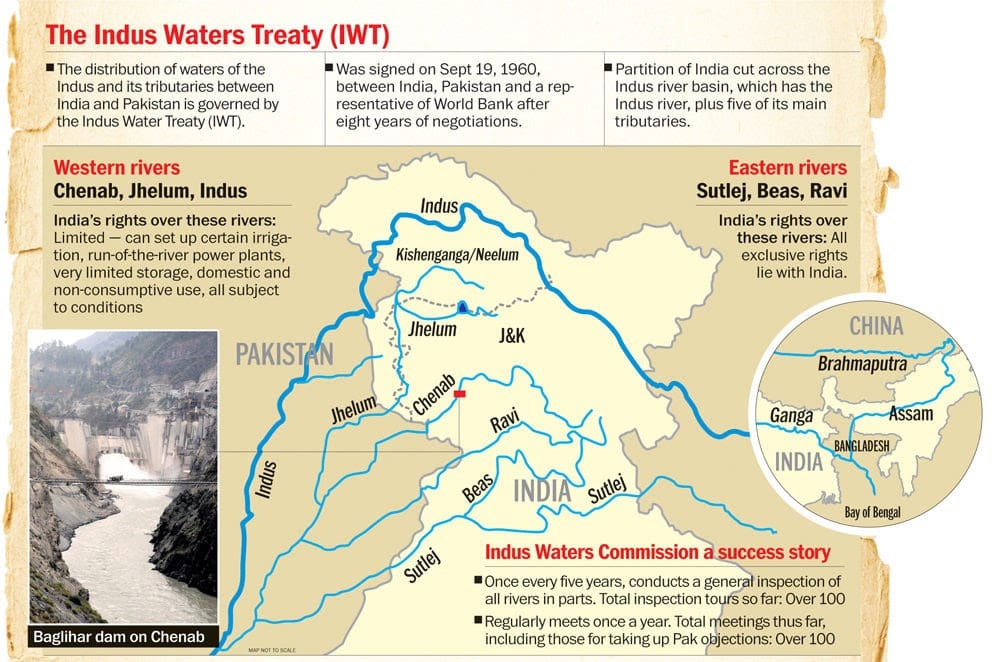
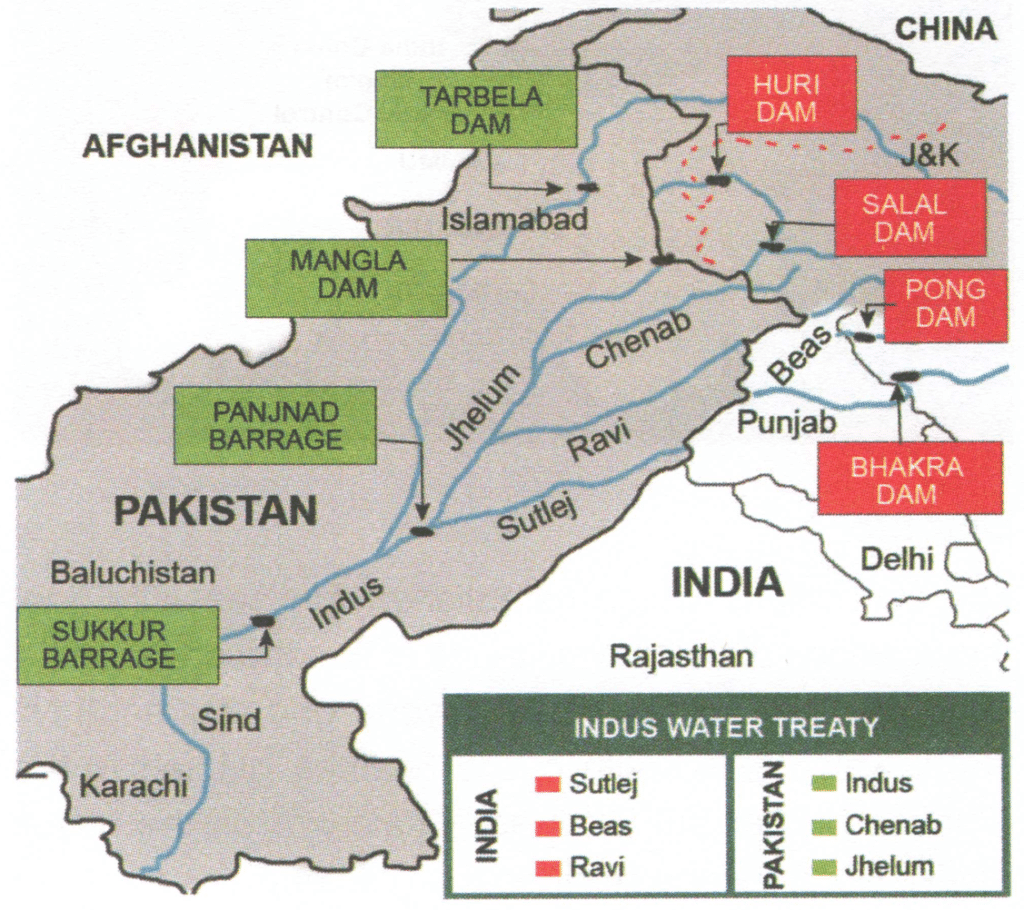
- Eventually, in 1960, the two countries reached a decisive step with the intervention of the World Bank. So in 1960, an agreement (IWT) that was signed by former Prime Minister Jawaharlal Nehru and the then President of Pakistan, Ayub Khan, marked out control over the six rivers running across the Indus basin. The three western rivers (Jhelum, Chenab and Indus) were allocated to Pakistan, while India was given control over the three eastern rivers (Ravi, Beas and Sutlej). While India could use the western rivers for consumption purpose, restrictions were placed on building of storage systems. The treaty states that aside of certain specific cases, no storage and irrigation systems can be built by India on the western rivers.
- India has about 20% of the total water carried by the Indus system while Pakistan has 80%.
A Look Back at What Worked
- Some researchers attribute the breakthrough to the requirements of the time. Pakistan and India needed financial support from the World Bank to expand their irrigated areas and create infrastructure for water storage and transport.
- Another reason working in favor of this cooperation is the fact that both countries were “water rational.” They had realized that cooperation was a prerequisite for safeguarding their country’s long-term access to the shared resource.
- By keeping to the IWT, India could leverage its position as a responsible upstream riparian when it engages with China over water issue. India will definitely be at a loss if China proposes to obstruct or divert the flow of water in the Indus basin.
- The IWT allows India to build a dam to generate hydroelectricity. It also allows for irrigation on a small scale – up to 700,000 acres in total, spread among the Inuds, Jhelun, and Chenab Rivers.
- The Parliamentary Committee recently observed that although the Indus Water Treaty has stood the test of time, it “was framed on the basis of knowledge and technology existing at the time of its agreement in the 1960s” when the perspective of both the nations at that time was confined to river management and usage of water through the construction of dams, barrages, canals and hydro-power generation.
Reasons for Dissatisfaction with IWT
- India’s View: IWT prevents the country from building any storage systems on the western rivers. The treaty lays out that, while under certain exceptional circumstances, storage systems can be built, the complaint raised by India is that Pakistan deliberately stops any such effort due to the political rivalry it shares with India.
- Pakistan’s View: It objects Indian claims of not utilizing the share of water in Western rivers, and that construction of storage dams would not abrogate the treaty .
Does the treaty favour Pakistan?
- Pakistan gets 80% of the water in the 6-river Indus system. This is 90 times greater volume of water than Mexico’s share under a 1944 pact with the US.
- It is Asia’s only treaty with specific water-sharing formulas on cross-border flows.
- A virtual line on the Indian map splits the Indus basin.
- India’s sovereignty lies in the lower rivers, Pakistan’s in the upper.
- Only the water pact compelling an upper riparian state to defer to the interests of a downstream state.
Current Issues
- Both countries are involved in a dispute over the 330 MW Kishanganga project and the 850 MW Ratle project being built on the Jhelum and Chenab rivers.
- Objecting to the design of the Kishenganga project, Pakistan said it flouted provisions of the Indus Waters Treaty and would result in a 40% reduction of water flow. Pakistan also wants the storage capacity of the Ratle project to be reduced from 24 million cubic metres to 8 million cubic metres.
Suspension of Indus Waters Treaty (IWT)
- However, on April 23, 2025, India announced the suspension of its participation in the treaty, citing national security concerns following a terrorist attack in Pahalgam, Kashmir, which resulted in the deaths of 26 civilians.
- Key Developments Post-Suspension:
- Immediate Actions by India: Following the suspension, India took several measures, including halting the flow of water from the Chenab River through the Baglihar Dam and conducting off-season reservoir flushing at the Salal and Baglihar projects. These actions were undertaken without prior notification to Pakistan, leading to concerns over potential flooding.
- Domestic Reallocation Plans: Indian officials announced plans to divert water previously allocated to Pakistan for domestic use, particularly to address water shortages in states like Rajasthan. This includes constructing new canals to redirect water from the Indus system.
- Pakistan’s Response: Pakistan condemned India’s actions, labelling them as an “act of war.” The country expressed concerns over the potential humanitarian and economic impacts, as the Indus system is vital for approximately 80% of Pakistan’s agricultural needs.
- International Reactions: The World Bank, which played a mediating role in the establishment of the IWT, stated that it would not intervene in the dispute, as its role was limited to facilitating the treaty.
- Current Status: As of now, the suspension remains in effect, with no indications from India of plans to restore the treaty. Diplomatic channels between the two countries remain strained, and the future of the IWT is uncertain.
- Immediate Actions by India: Following the suspension, India took several measures, including halting the flow of water from the Chenab River through the Baglihar Dam and conducting off-season reservoir flushing at the Salal and Baglihar projects. These actions were undertaken without prior notification to Pakistan, leading to concerns over potential flooding.
Cross-Border Terrorism
- Cross-border terrorism remains one of the core and persistent issues in India-Pakistan relations. India has consistently highlighted that territory under Pakistan’s control is being used to plan, finance, and execute terrorist attacks against India.
- Despite repeated diplomatic efforts, internationally designated terrorist organisations such as Lashkar-e-Taiba (LeT), Jaish-e-Mohammed (JeM), and their affiliates continue to operate from Pakistan. LeT leader Hafiz Saeed and Masood Azhar, among others, have repeatedly incited violence against India.
- India has moved the UN 1267 Sanctions Committee to list Masood Azhar as a proscribed terrorist; however, these efforts were blocked multiple times by China, citing technical objections. Legal proceedings against individuals involved in the 2008 Mumbai attacks have also progressed slowly in Pakistani courts, reflecting the difficulties in securing accountability.
- Notable Terrorist Incidents:
- Pathankot Airbase Attack (January 2016): Around six terrorists in army attire attempted to storm the Pathankot airbase, linked to JeM. The attack highlighted vulnerabilities in India’s security infrastructure.
- Uri Attack (September 2016): Four terrorists launched a suicide assault on an Army camp in Uri, killing 19 soldiers and injuring 30, marking one of the deadliest attacks on Indian security forces in recent times.
- Pahalgam Attack (April 22, 2025): A terrorist attack in Pahalgam, J&K, killed 26 civilians. India accused Pakistan-based groups of orchestrating the attack, significantly escalating tensions.
- Indian Counter-Terror Operations:
- Operation Sindoor (May 7, 2025): In retaliation to the Pahalgam attack, Indian forces targeted nine terrorist infrastructure sites across the Line of Control (LoC), aimed at dismantling Pakistan-based terror networks including JeM and Hizbul Mujahideen.
- Operation Mahadev (July 28, 2025): Following continued terrorist activity, India eliminated key members of The Resistance Front (TRF), an offshoot of LeT, responsible for recent attacks.
- Counter-Smuggling Operations (September 2025): Indian authorities foiled cross-border heroin smuggling attempts, uncovering networks operating from within Pakistani territory.
- International and Diplomatic Dimensions:
- Despite UN sanctions, Hafiz Saeed and Masood Azhar continue to operate from Pakistan.
- China has historically blocked UN listing of Masood Azhar, limiting international punitive measures.
- The persistent threat of terrorism has prompted India to suspend the Indus Waters Treaty and restrict diplomatic engagement, further straining relations.
- Strategic and Regional Implications:
- Cross-border terrorism has frequently triggered military escalation, with India conducting targeted operations and Pakistan responding with heightened military readiness.
- Terrorist groups have relocated operations to areas near the Afghanistan border, complicating counter-terrorism efforts in the region.
- Civilian populations in both countries face the humanitarian fallout of terrorism and retaliatory measures, highlighting the broader societal impact.
Sir Creek
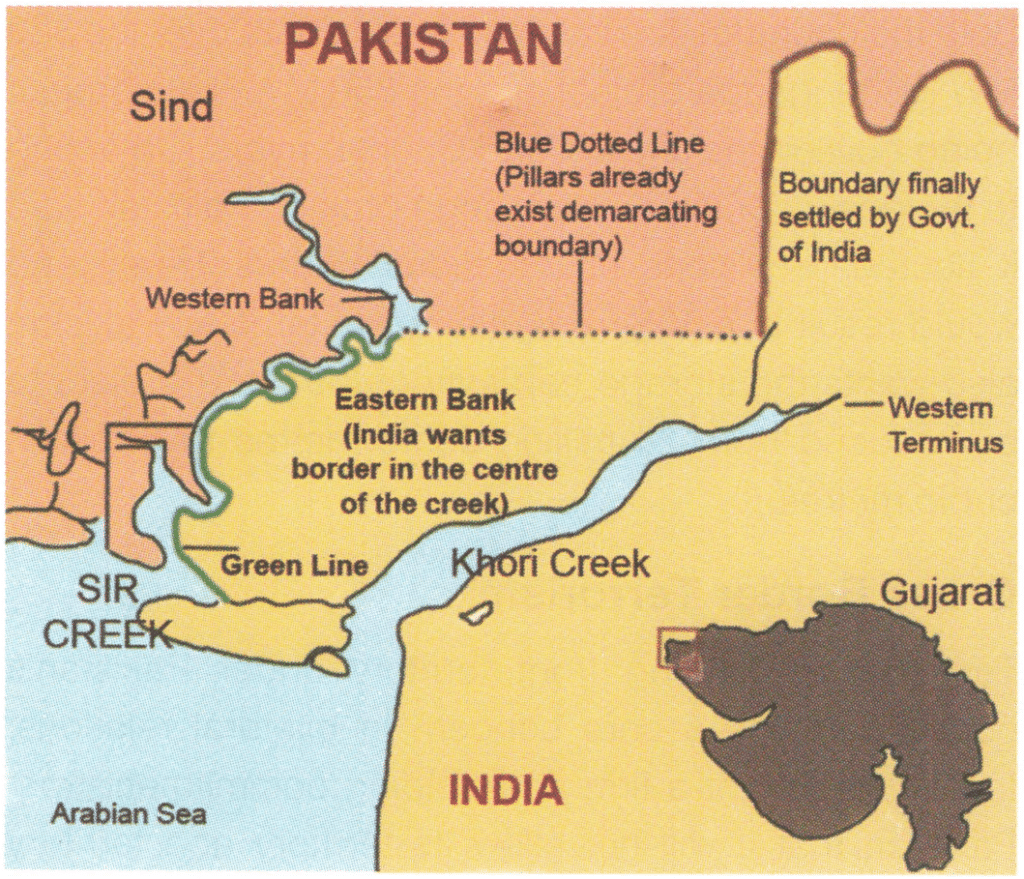
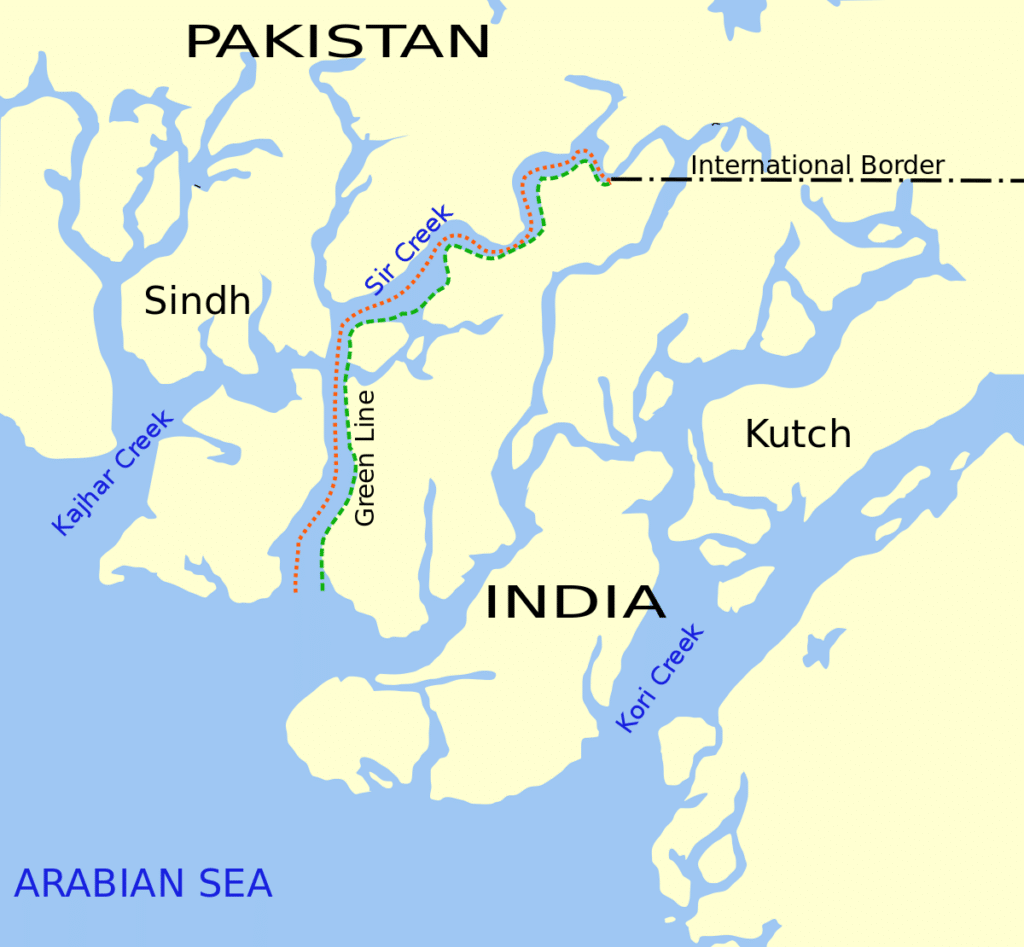
- Sir Creek is a 96 km strip of water disputed between India and Pakistan in the Rann of Kutch marshlands. Originally named Ban Ganga, Sir Creek is named after a British representative.
- The Creek opens up in the Arabian Sea and roughly divides the Kutch region of Gujarat from the Sindh Province of Pakistan.
Dispute
- The dispute lies in the interpretation of the maritime boundary line between Kutch and Sindh. Before India’s independence, the provincial region was a part of the Bombay Presidency of British India. But after India’s independence in 1947, Sindh became a part of Pakistan while Kutch remained a part of India.
- Pakistan claims the entire creek as per paragraphs 9 and 10 of the Bombay Government Resolution of 1914 signed between then the Government of Sindh and Rao Maharaj of Kutch. The resolution, which demarcated the boundaries between the two territories, included the creek as part of Sindh, thus setting the boundary as the eastern flank of the creek popularly known as Green Line. But India claims that the boundary lies midchannel as depicted in another map drawn in 1925, and implemented by the installation of mid-channel pillars back in 1924.
Importance of Sir Creek
- Apart from strategic location, Sir Creek ‘s core importance is fishing resources. Sir Creek is considered to be among the richest fishing grounds in Asia. Another vital reason for two countries locking horns over this creek is the possible presence of great oil and gas concentrations under the sea, which are currently unexploited, thanks to the impending deadlock on the issue.
Siachen
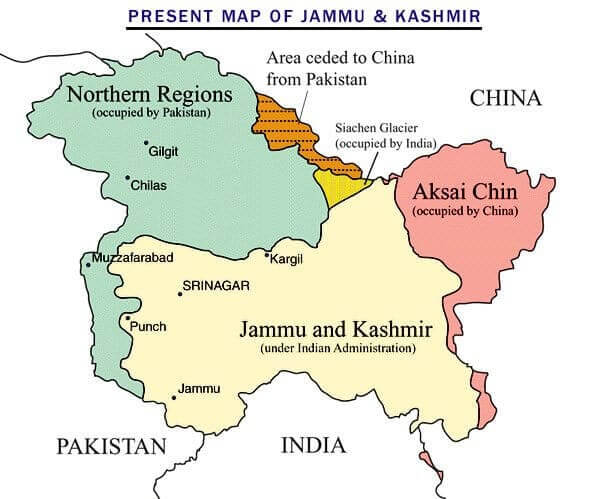
- The divergent positions held by New Delhi and Islamabad on the dispute is one of the primary reasons why the negotiations on demilitarising the Siachen glacier and the adjoining areas have not progressed much.
Dispute
- The agreement, which established the ceasefire line, the positions of the two militaries at the end of the 1947- 1948 war, did not delineate beyond grid reference NJ9842, which falls south of the Siachen glacier, to the Chinese border but left it as “Chalunka (on the Shyok River), Khor, thence North to the glaciers”.
- Indian and Pakistani sides have since interpreted the phrase “thence North to the glaciers” very differently. Pakistan argues that this means that the line should go from NJ 9842 straight to the Karakoram pass on the Sino-lndian border. India, however, insists that the line should proceed north from NJ 9842 along the Saltoro range to the border with China. These contrasting interpretations have made it difficult for a final resolution of the dispute.
India’s View
- India has insisted that joint demarcation of the Actual Ground Position Line (AGPL) on the ground as well as the map should be the first step to be followed by a joint verification agreement and redeployment of forces to mutually agreed positions.
Pakistan’s View
- Pakistan has traditionally objected to it arguing that:
- India is the occupying party in Siachen and it should unconditionally withdraw and the pre-1984 status quo should be maintained;
- By agreeing to a joint demarcation, Pakistan would be accepting the Indian claims in Siachen, at least theoretically; and
- If Pakistan accepts such demarcation, it would amount to endorsing the Indian occupation of 1984.
Ceasefire Violation by Pakistan
- It has become a persistent issue where the Pakistani army officially backed by Pakistan Government breaches the ceasefire and crosses the borders, which has deep impact on the Indian-Pakistan relation.
- This is one of the major issue which hinders the process for creating a peaceful environment in the border region.
Other Issues
- Kulbhushan Jadhav Case: Pakistani authorities had reportedly arrested Jadhav in what they termed as a counter intelligence operation in Mashkal, Balochistan on 3 March, 2016. He has remained in Pakistan’s custody ever since. While the Pakistani side has repeatedly alleged that Jadhav is a Research and Analysis Wing (R&AW) ‘spy’ in Pakistan’s restive Balochistan province, India had categorically denied Islamabad’s charges. However, India has conceded right from the start that Jadhav was indeed an Indian national and a retired naval officer. The Indian side claims that Jadhav ran a legitimate business from Iran, and might have inadvertently crossed over to Paksitan. And that the Pakistani authorities had harassed him and charged him with spying. India has rejected the validity of the video (circulated on alleged confession by Jadhav), and claimed that it was tutored or recorded under immense mental and physical pressure.
- Meanwhile, Pakistan has been using this arrest as a vindication to its stand on alleged Indian interference in Pakistan’s Balochistan province. Pakistan has repeatedly denied consular access to Jadhav, and with death sentencing of Jadhav, India moved to International Court of Justice (ICJ). The ICJ ordered in May not to carry out Jadhav’s execution, pending a final decision.
- CPEC: The route passes through the disputed Kashmir region, which is under illegal occupation by Pakistan. India’s opposition to CPEC reflects a concern over the internationalization of the Kashmir dispute, the growing influence of China in the Indian Ocean, and the sovereignty issue.
- TAPI: TAPI gas pipeline project is a proposed trans-country natural gas pipeline from Caspian Sea, Turkmenistan to India through Afghanistan and Pakistan. The pipe line connects central Asia with south Asia covering around 1,800 km. However, the project faces the challenge of terrorism today. Unless the pipeline is secured from the Taliban that operates on both sides of the Durand Line, and from militant groups operating in Pakistan, it is hard to see how the TAPI dream can go beyond the ground breaking ceremony.
- SAARC: The future of SAARC has been increasingly questioned after the cancellation of the summit that was scheduled to be held in Islamabad in November 2016. The Summit had been cancelled in the heightened tensions following the terrorist attack on a military camp in Jammu and Kashmir ‘s Uri. SAARC Summits can be held only in the presence of all members. Summits will stand cancelled if even one of the members pull out, making the pull-out by a number of countries a significant diplomatic isolation of Islamabad. The continuing tensions between India and Pakistan have given rise to doubts over whether the consensus needed for a SAARC Summit will be reached in the near future. This in turn has led to the idea of a regional grouping without Pakistan being mentioned with increasing frequency in the discourses of South Asian countries.
- Hafiz Saeed: The JuD chief Saeed was put under house arrest after the terror attack in Mumbai, but he was freed by a court in 2009 due to a lack of evidence against him. India’s demand to reinvestigate the 2008 case and put on trial Jamaatud Dawah chief Hafiz Saeed has been negated by demanding “concrete” evidence against Hafiz Saeed, the mastermind of 26/11 assault.
- MFN Status Issue: The MFN status was accorded to Pakistan in 1996 as per India’s commitments as a WTO member. But Pakistan has not reciprocated, reportedly citing “non-tariff barriers” erected by India as well as huge trade imbalance.
- Afghanistan Trade: Afghanistan-Pakistan Transit Trade Agreement (APTTA) regulates the transit of goods through the territory of both countries. Pakistan has consistently refused to allow any Indian goods to travel over land to Afghanistan, insisting that India use the sea-route via Karachi.
- Afghanistan-Pakistan Transit Trade: Pakistan has categorically rejected the demand voiced by Afghan President that India be made a party to its transit trade pact with Kabul, saying it is not possible given Islamabad’s sensitivities on security and other related issues.
Role of Pakistan’s non-state actors
- Non-state actors, hereafter NSAs, rightly view bilateral peace in the subcontinent as an existential threat, detrimental to their survival. Consequently, they have time and again demonstrated their unalloyed goal of violating the peace process as a cynical tactic to sustain and thereby achieve their political goals.
- Kargil was a glaring example of the audacious use of NSAs to further state policy, albeit to a ludicrous end. Both Pakistani troops and insurgents were fighting alongside each other as brother soldiers against a common enemy i.e. India.
Lashkar-e-Taiba:
- Mumbai attacks drew international attention to Lashkar-e-Taiba (LeT), which till then was considered merely a regional terror outfit with interests primarily in J&K.
- LeT, with its strong base in Pakistan, is one of the most formidable NSAs, with both the ability and capability to mount an attack anywhere in the hinterland of India. Any attack by LeT in India is understood by India as an attack by Pakistan.
Ansar-ut-Tawheed:
- The appearance of Ansar-ut-Tawheed fi bilad al-Hind (AuT) on the jihadi landscape indicates a growing interest in enticing India’s Muslim population to carry out jihad in India.
- The main goal of AuT is to develop a transnational network of jihadist and redirect their focus toward India.
- With access to larger resources, knowledge of local geography, and the help of IM members in Pakistan, AuT has the capacity to stage lethal strikes in India.
- Such attacks would be seen by India as attacks supported by the Pakistani state, as AuT members share a long history of association with ISI.
Pakistan’s blind eye towards NSA:
- Though Pakistan joined the global war on terror, yet its approach toward targeting terror groups has been faulty and selective.
- India-centric terrorist outfits were conveniently overlooked as they did not apparently pose a direct threat to the United States and other Western allies.
- With numerous attacks on Pakistani military installations, their actions are not only damaging to India but also detrimental to Pakistan’s national interests.
Steps Pakistan must take:
- Islamabad needs to realize that its continued tolerance of these NSAs as anti-India proxies is prohibitively costly. Pakistan has in the past tried to rein in these actors but its efforts were cosmetic.
- The idea of reining in these groups by restricting their activities has failed miserably. Pakistan needs to devise a solution to this anathema by completely removing, rather than reining in, these threats.
- The key to Pakistani’s success in eliminating NSAs lies in its will to completely divest itself of its terror protégés.
- Global peace cannot be held ransom by these sinister NSAs. Their potential to stoke a conflict is in itself a challenge to the legitimate states and their sovereign authority.
Confidence Building Measures between India and Pakistan
- Since the Partition, India and Pakistan have signed many agreements to generate confidence and reduce tensions.
- Perhaps the most notable among them are Liaquat-Nehru Pact (1951), Indus Waters Treaty (1960), Tashkent Agreement (1966), Rann of Kutch Agreement (1969), Shimla Accord (1972), Salal Dam Agreement (1978), and the establishment of the Joint Commission.
- Except for the Joint Commission, all the others were the products of either a crisis or a war that necessitated a logical end to the preceding developments.
- Though CBMs are efficient tools to improve inter-state relations, trust between the two sides is vital for its success.
- CBMs are difficult to establish but easy to disrupt and abandon.
- Some continue to be successful while others are abandoned.
Military CBMs:
- Agreement on the Prohibition of Attack against Nuclear Installations and Facilities was signed in 1988 and ratified in 1990. The first exchange took place on January 1, 1992. As per the Agreement, India and Pakistan exchange the list of their nuclear installations to prevent attacking each other’s atomic facilities. This practise has been followed to date.
- Agreement on Advance Notification on Military Exercises, Manoeuvres and Troop Movements were brought into effect in 1991. This agreement played a crucial role in deescalating the tensions on both the sides of the LoC.
- A communication link between Pakistan Maritime Security Agency and the Indian Coast Guard was established in 2005 to facilitate the early exchange of information regarding anglers who are apprehended for straying into each other’s waters.
- A hotline between Directors-General of Military Operations (DGMOs) of both the countries have been in effect since 1965 and was used in an unscheduled exchange to discuss troop movements and allay tensions in the aftermath of the 26/11 attacks.
Non-military CBMs:
- Most of these CBMs focused on improving people-to-people interaction. Some of the significant ones that more or less withstood the test of times are as follows:
- Delhi-Lahore Bus Service was initiated in 1999. It was suspended in the aftermath of the 2001 Indian Parliament Attack. The bus service was later resumed in 2003 when bilateral relations had improved. This service was recently suspended in 2019 in the aftermath of the abrogation of Article 370 and 35A of the Indian Constitution.
- Samjhauta Express that was launched following the signing of the Shimla Agreement connects Pakistani city of Lahore and the Indian town of Attari. It had been suspended frequently, but due to negotiations, it was restarted. In 2019, it was suspended after the revocation of the special status of Kashmir.
- Weekly Bus Service between Srinagar and Muzaffarabad was initiated in 2005. It has withstood the test of times and still operational.
- India extended humanitarian aid to Pakistan in the aftermath of the 2005 earthquake. Pakistan too had earlier provided relief in the aftermath 2001 Gujarat Earthquake.
Failures in the CBM process:
- Although there are hotlines connecting both military and political leaders in both countries, they have been scarcely used when required the most. The absence of communications has led to suspicions and accusations of misinformation.
- There is a disproportionate emphasis on military CBMs and inadequate recognition of several momentous non-military CBMs.
- Governments of both sides often use CBMs as political tools to win over specific constituencies, which can be very damaging in the long-run. Public conciliatory statements, which are meant to be CBMs, can have the opposite effect if they are insincere.
What was the progress made in 2019?
- The year 2019 has in many ways, set the tone, tenor and tempo of how 2020 will pan out between India and Pakistan.
- Early last year, the Pulwama suicide bombing carried out by the Pakistani terrorist group Jaish-e-Mohammad (JeM) led to the death of 40 CRPF personnel. This was the starting point of the steep decline in relations.
- Within a few days after the incident, India’s fighter jets targeted a JeM terrorist camp, not in Pakistan Occupied Kashmir (PoK), but in Balakot in the Pakistani Province of Khyber Pakhtunkhwa. This led to retaliation from Pakistan.
- This incident led to a paradigm shift to the traditional India-Pakistan tensions.
- Later that year, the amendment and hollowing out of Article 370, scrapping of Article 35A, the bifurcation of the erstwhile Jammu and Kashmir into two Union Territories stunned Pakistan.
- This move effectively killed whatever remained of the bilateral ties post-Balakot airstrike.
- Pakistan responded by expelling the Indian High Commissioner and suspending all trade between the two countries.
- Trade had already fallen steeply after India withdrew Pakistan’s Most Favoured Nation (MFN) status and imposed a 200% import duty on Pakistani goods earlier that year post-Pulwama.
- However, within days, Pakistan was forced to allow the import of medicines from Indian to provide relief to its patients who were affected due to its suspension of bilateral trade with India.
- Amid the post Article 370 breakdown, Pakistan went ahead with the Kartarpur Corridor. Even this move is seen with mistrust by many due to Pakistan’s support to the Khalistani movement.
- Furthermore, any progress in the diplomatic ties in the political front is going to be difficult because of Pakistan military’s dominance in the country’s foreign policy. Any progress made has often led to a terror attack or ceasefire violation.
- In the current situation, the prospects for meaningful engagement between the two nations remain bleak and the best that can happen is that the diplomatic relations are fully restored, trade is opened up and easing of travel between the two nations.
Future Measures
- India and Pakistan should seriously consider initiating an institutionalised, regular but discreet dialogue between the intelligence chiefs.
- The media is playing a critical role in shaping popular perceptions. They have thus a great responsibility to help strengthen the constituency for peace. A continuing dialogue between journalists, editors and proprietors of media houses is needed.
- It is vital that Track II dialogues be encouraged by both New Delhi and Islamabad. Recently, a group of Indian experts has visited Pakistan to discuss all aspects of bilateral ties and revive the Track II diplomacy process with Islamabad amidst the chill in the relationship. The original Track II initiative, Neemrana Dialogue, received a fresh start with the visit.
- A stable, prosperous, sovereign and independent Afghanistan is in the interest of India and Pakistan, and both countries must work for this goal and hold talks to allay each other’s apprehensions.
- Temporary setback in inter-governmental relations should not be allowed to impinge on people-topeople cooperation. Attempts should be made to create a visa-free regime for important stakeholders: including academics, journalists, businessmen, students, artists and former senior officials.
- Creating international pressure on Pakistan to curb state sponsor terrorism. In June 2018, Pakistan has been placed on the grey list by the Financial Action Task Force (FATF) for failing to curb anti-terror financing. Such steps can increase the cost of using state-sponsored terrorism as a tool by Pakistan.
- Resumption of dialogue between the two countries and deep engagement of the two, where the chances of conflict is less and coordination is more. For example, working together on climate change, technological exchange of information, etc.
Track II diplomacy
- Track II diplomacy or “backchannel diplomacy” is the practice of “non-governmental, informal and unofficial contacts and activities between private citizens or groups of individuals, sometimes called ‘non-state actors’“.
- It contrasts with track I diplomacy, which is official, governmental diplomacy that occur inside official government channels.
Conclusion:
- South Asia has not yet progressed despite it having the potential to ensure fast-paced economic growth and development. This is mostly because of the differences and tensions between India and Pakistan.
- Improved India-Pakistan relations can ensure the addressing of any threat the subcontinent may face in the future. Cooperation and coexistence through trust can ensure an establishment of peaceful and prosperous South Asia.
- Way forward for India-Pakistan relations lies in sustained dialogue, curbing cross-border terrorism, promoting soft diplomacy through strengthening and enhancing India’s Foreign Policy in its Neighbourhood and trade cooperation:
- Sustained Dialogue: Both countries need to engage in consistent and sincere dialogue at various levels, addressing core issues like terrorism, Kashmir, and trade in a constructive manner.
- Promoting Soft Diplomacy: Promoting cultural and academic exchanges, sports diplomacy, and tourism can build trust and reduce the deep-seated animosities between the people of both nations.
- Economic Cooperation: Expanding trade relations and economic ties could create a vested interest for both nations to maintain peaceful relations. Trade can act as a bridge to broader diplomatic dialogue.
- Confidence-Building Measures: Enhancing military-to-military communication, such as hotlines and periodic meetings, can prevent misunderstandings and reduce the chances of accidental escalation.
 UPSCLOGY