
The ancient South Indian city of Madurai, often called Thoonganagaram—the ‘City That Never Sleeps’—owes its vibrant spirit to its guardian, Princess Meenakshi, the warrior goddess who eternally watches over it. Step into this timeless temple town in Tamil Nadu, and you’ll sense the enchanting pulse of its age-old legends. Among them, perhaps the most captivating is the tale behind its name, Madurai, said to have originated from the divine nectar that dripped from Lord Shiva’s matted locks.
In Madurai, history and legend blend so seamlessly that it becomes difficult to tell where one ends and the other begins. Every street, temple, and monument seems to whisper stories that oscillate between fact and folklore—of kings who ruled with divine grace, of gods who walked among mortals, and of timeless traditions that still shape the city’s soul. Madurai isn’t merely a place of the past; it is a living chronicle where myth breathes through history itself.
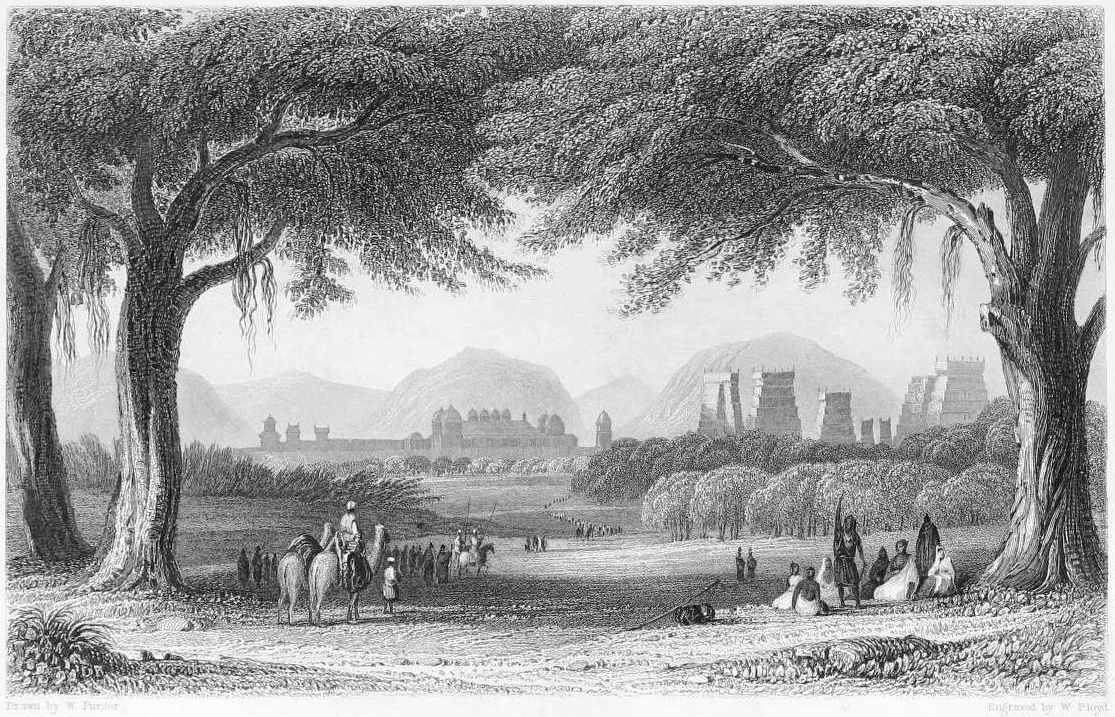
Madurai served as the capital of the Pandyan dynasty from the 4th century BCE until the 16th century CE. Renowned for its prosperity, the city maintained thriving trade links with the Roman world, a fact frequently mentioned in ancient accounts. It also hosted the last and most celebrated of the great Tamil Sangams (440 BCE – 200 CE)—prestigious gatherings of poets and scholars that produced many of Tamil literature’s enduring classics.
In ancient records, Greek historian and ambassador Megasthenes referred to Madurai as Pandaie, while The Periplus of the Erythraean Sea (c. 59–62 CE)—believed to have been written by a Greek living in Egypt—mentions it as Pandi Mandala, highlighting the city’s prominence in early global chronicles.
Recent excavations at Keezhadi, located about 12 kilometers from Madurai, have shed new light on the city’s vibrant trade connections with Europe and Rome. Archaeological evidence reveals that Madurai exported pepper, pearls, ivory, textiles, and gold, while importing a range of luxury goods from the West. In antiquity, the city was especially renowned for its fine textiles, lustrous pearls, and prized beryl stones.
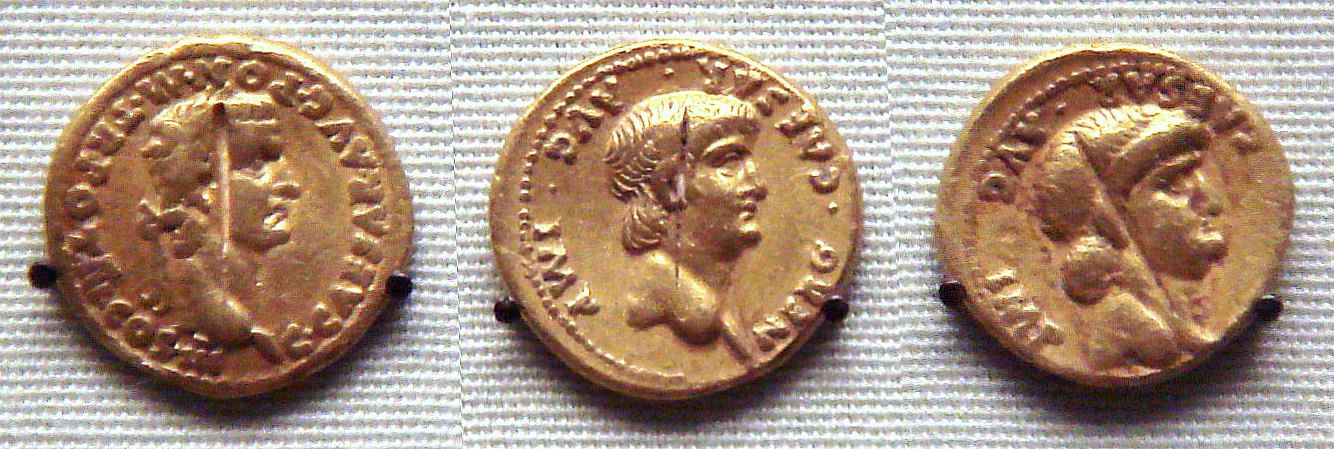
Thousands of Roman coins discovered in and around Madurai testify to the scale of this ancient commerce. Classical writers such as Strabo (c. 64 BCE – 24 CE), the Greek geographer and philosopher from Asia Minor, and Pliny the Elder (29 – 79 CE), the Roman naturalist and naval commander, described in detail the trade routes linking Rome to Tamilakam—the land of the Tamil-speaking peoples.
It was Hippalus, a Roman sea captain of the 1st century BCE, who first harnessed the power of the monsoon winds to sail directly to India. In the prosperous Pandya country, both the royal treasury and local merchants amassed vast reserves of Roman currency. Pliny famously lamented Rome’s trade deficit, writing that India, China, and Arabia together drained nearly one hundred million sesterces annually from Rome—of which almost half went to India, and the greatest share to South India.
Legends Surrounding Madurai
While archaeologists have to dig deeper to piece together the full story of Madurai’s ancient past, locals believe this city was built in accordance with Lord Shiva’s guidance. Interestingly, it is believed that Madurai was planned in the shape of a coiled serpent, Halasya. The snake marked the outer boundaries of the town and coiled itself such that its mouth and tail pointed to the centre of the town, where the Meenakshi temple was built.
– It is believed that Madurai was planned in the shape of a coiled serpent, Halasya.
The story goes that Madurai was originally a Kadamba (Nauclea Cadamba) forest. In this forest, one full moon night, a merchant witnessed Lord Indra worshipping a Shiva linga. On hearing about this, the king cleared the forest and built a small shrine to Lord Shiva. This shrine, it is believed, grew into the present-day Meenakshi temple, where Meenakshi and Sundareshvara or Chokkanathar, as Shiva is known in Madurai, are enshrined. In Madurai, Shiva is said to have performed 64 miracles known as the Thiruvilaiyadal.
A legend narrated in the, Tiruvilaiyatarpuranam, a 13th century Tamil text, narrates the story of Pandyan king Malayadhwaja of Madurai (a legendary figure), who was childless. The king performed a yajna, a ritual before a sacrificial fire, to ask for the boon of an heir, a son. Out of the fire appeared a three-year-old girl with three breasts. The child was raised by the king and his wife Kanchamalai, and taught all the arts including warfare. It was prophesied that the girl’s third breast would disappear when she met the man destined to be her husband. The king and queen named the little girl ‘Tadaatagai’, but since her eyes were shaped like fish, the people of Madurai fondly called her ‘Meenakshi’. The flag of the Pandyan kings featured two fish as also their coins.

Meenakshi grew up to be a great warrior. She went out with her armies on a digvijay, a conquest of lands in all the eight directions. When she reached the Himalayas, Shiva’s abode, she encountered Shiva’s Ganas or hoards, and Shiva seated on Nandi bull. As soon as she saw him, her third breast disappeared as prophesied, and she accepted Shiva as the one she would marry. On returning to Madurai, her father crowned her as the ruler of Madurai and celebrated her wedding with great pomp and splendour.
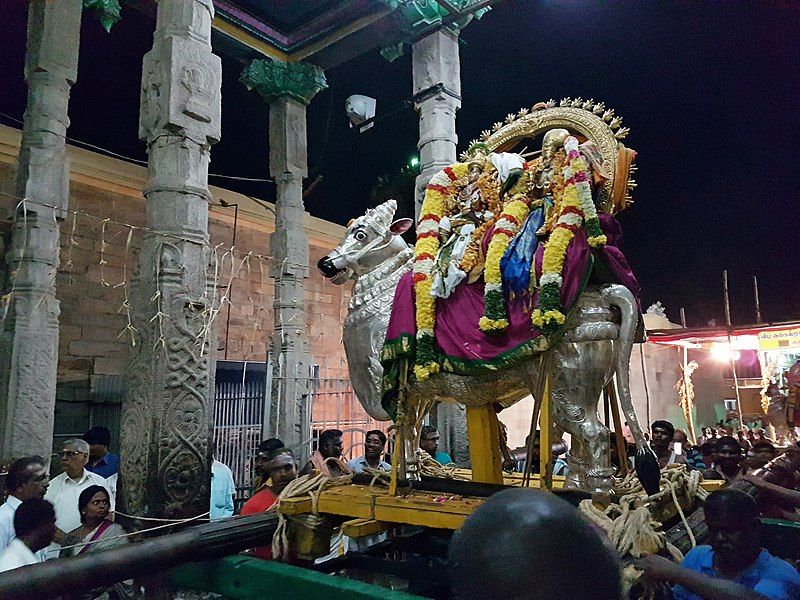
The wedding of Meenakshi and Sundareshvara (Shiva) is enacted to this day in Madurai in the month of Chaitra (April-May). Bronze images of Meenakshi and Sundareshvara are adorned with jewels and brought out in procession. The conquest of Meenakshi is enacted as also the wedding – crowds from all over the world gather to witness the celestial wedding, which is telecast live on television for those living far away. It is believed that Meenakshi and her consort are the true rulers of Madurai and the kings, Pandyan, Nayakas, and so on, ruled on their behalf.
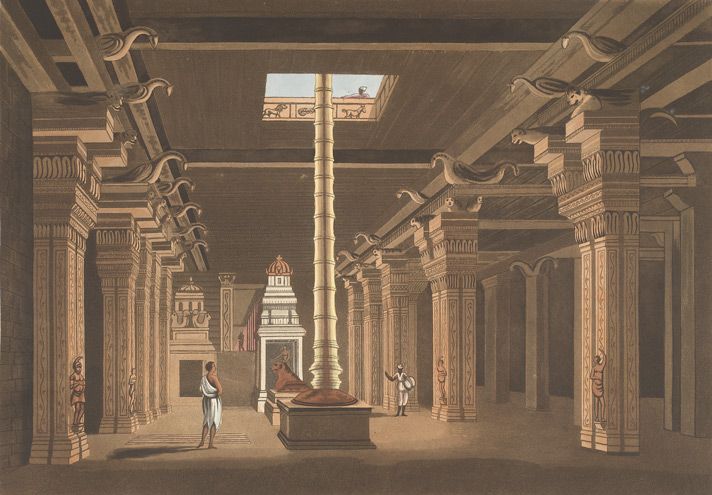
In 1801, Madurai came under the control of the British East India Company. The British made donations to the Meenakshi temple and participated in the temple festivals. One of the British administrators of Madurai and the temple was Rous Peter, who became the Collector in 1812. He was well known for his fair administration of the temple and the Tanjore Division Gazetter (1914) records that “vernacular ballads” are being sung in honour of Rous Peter.
According to a legend, one rainy night, a little girl visited Rous Peter in his room and held him by his hand and led him outside. Suddenly, lightning struck his bungalow, reducing it to ashes. As a gesture of thanksgiving, Rous Peter donated a pair of gold stirrups studded with rubies to the goddess, who he believed had come in the guise of a little girl and saved his life. Rous Peter did not return to England after retirement and, according to his wishes, was buried in Madurai with his face turned towards the Meenakshi temple. The stirrups presented by him are still worn by the goddess when she rides a horse in procession during temple festivities.
– A British Collector of Madurai, Peter Rous donated a pair of gold stirrups studded with rubies to the goddess, who he believed had saved his life
At Madurai, Shiva as Sundareshvara (Nataraja), danced his Ananda Natanam, the dance of bliss, witnessed by Patanjali and Vyagrapada during his wedding festivities. When dancing the Tandava, Shiva is usually depicted in sculpture, bronze and paintings with his left foot raised and his right foot placed on apsamara purusha, a demon signifying in philosophical terms the erasing of ignorance. At Madurai, Shiva danced with his right foot raised to fulfil the request of Rajashekara Pandyan, who felt that the right foot may hurt if it is permanently grounded during the dance.
Beautiful, fluid bronze images and classical songs capture the movement and romance of the moment: “I fell in love with you Oh Lord! When you danced with your right leg raised at the request of the Pandyan king.”
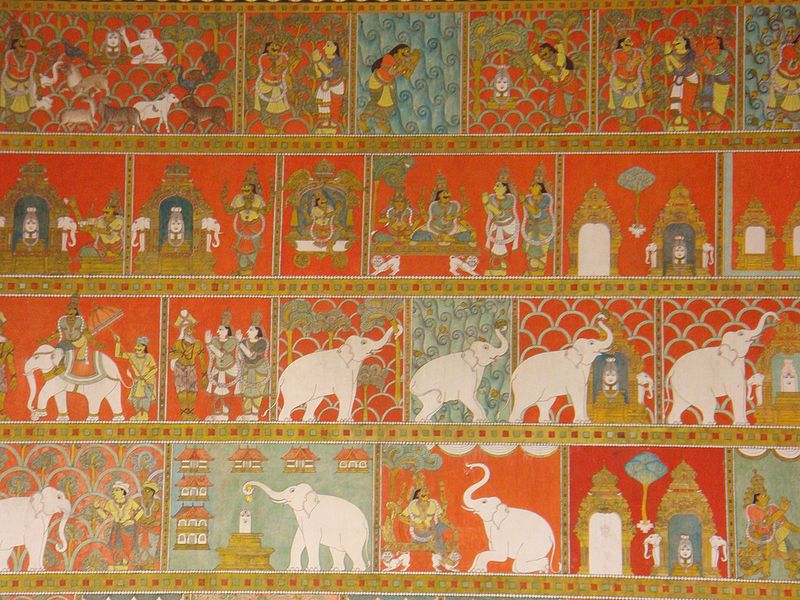
The city of Madurai is steeped in legends of 64 miracles executed by Shiva known as the Tiruvilaiyaadal, These are painted as murals on the temple walls.
One of these legends speaks of the temple at Madurai as a dance hall of Shiva, as Velli Sabha or Rajata Sabha, the silver hall. It is believed that the cosmic dance was performed by Shiva in panch sabhas, or five dance halls: Chidambaram, Madurai, Tiruvalangadu, Tirunevelli, and Coutallam.
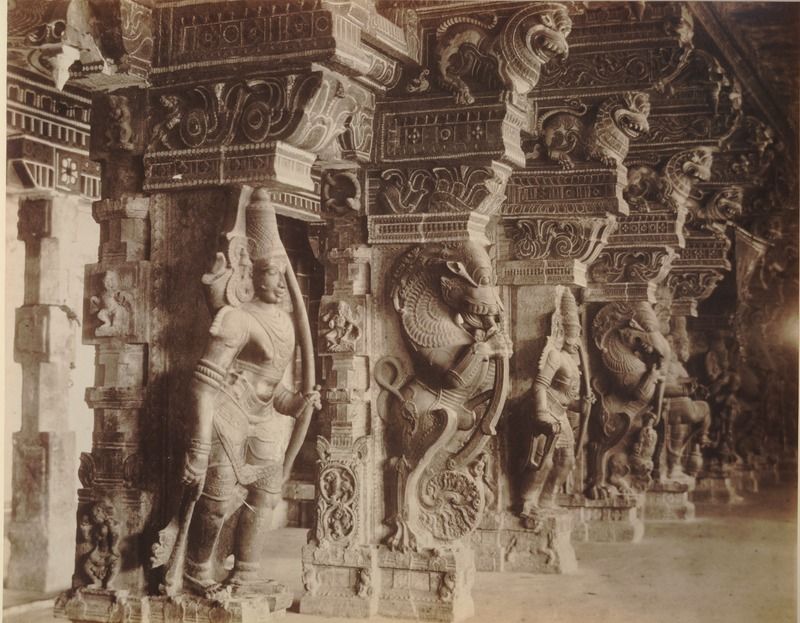
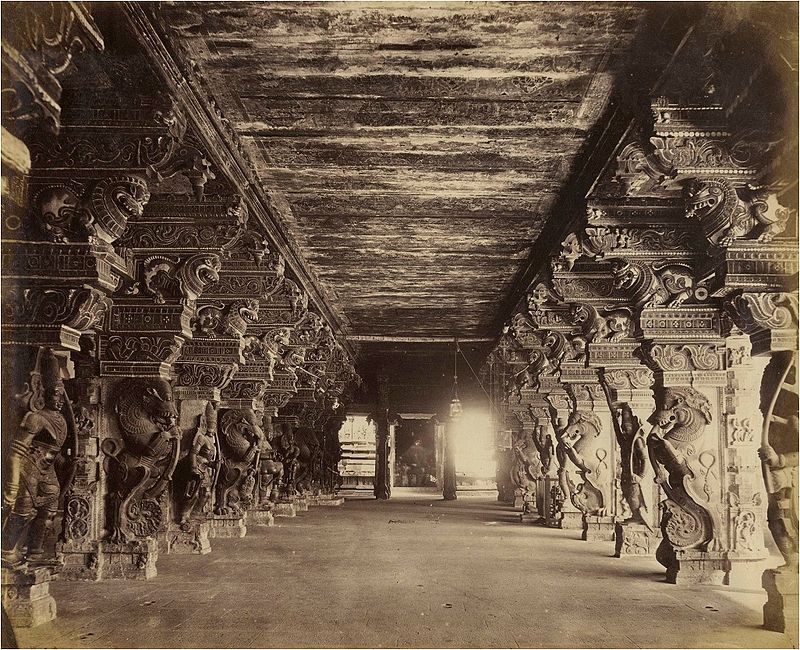
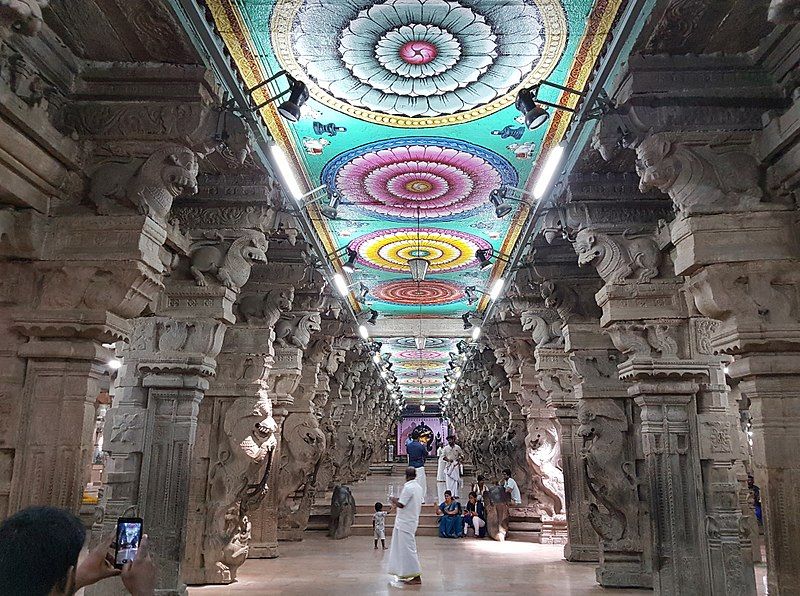
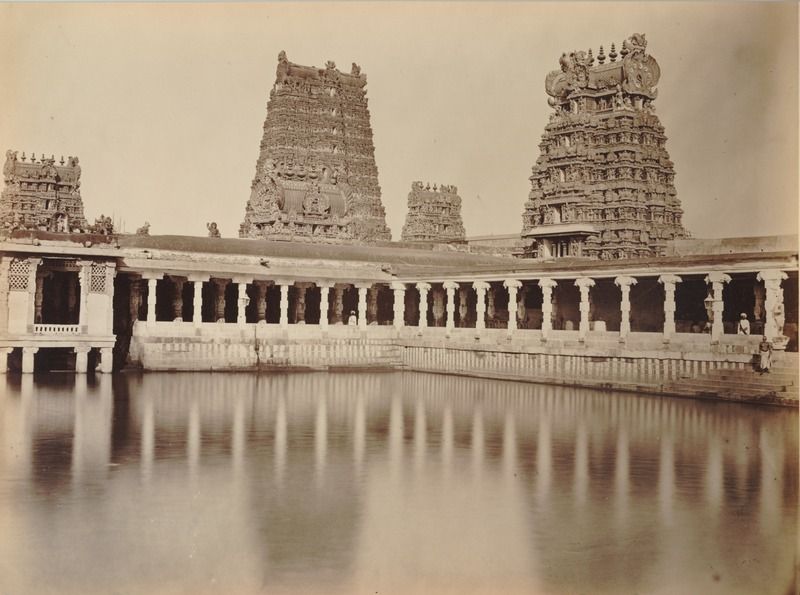
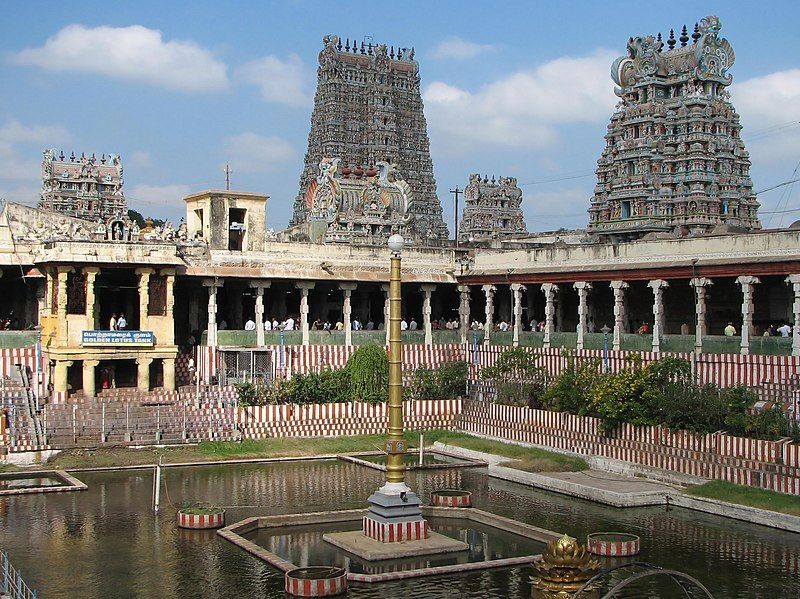
In Tamil tradition, palaces were built in the form of temples for the gods, and the kings ruled on behalf of the gods. The Meenakshi temple in Madurai has been built on this premise and has elaborately decorated towering gopuras, many pillared halls, a lotus tank and a museum. There are two shrines – one to Meenakshi and the other to Sundareshvara. Murals on the walls and ceiling of the shrine depict the wedding as well as many miracles that took place in Madurai. The temple complex, spread across 14 acres, has 14 gopurams, towers that range from 45-51 metres in height. These are the most elaborate in South India.
The temple as it stands today was rebuilt by the Nayakas in the 16th and 17th centuries. They closely followed rules of temple building as laid down in the Shilpa Shastras, treatises on architecture.
The prosperous capital of Madurai attracted merchants and craftsmen from all over the subcontinent for its trade links. It was during the Nayaka rule, during the reign of Tirumalai Nayaka (1623-1659 CE), that weavers from Saurashtra migrated to Madurai. They were welcomed by the king as they were expert weavers and dyers – they were locally known as the ‘patnulkararsi’, or ‘silk thread people’. These weavers created a cotton textile prized even today and known as ‘Madurai Sungdi’. The term ‘sungdi’ to the Saurashtrians meant ‘round’ and refers to the circular dots that comprise the motif of the sungditextile.
The ancient city of Madurai has flowered into a modern city with IT parks, special economic zones, rubber industries and more. Yet it straddles two worlds – a modern realm with ancient, living traditions. In the month of April-May, people pour in from all over the world to witness the ‘wedding pageantry’ of the great goddesses Meenakshi. In many homes, one can hear young voices in synchrony with old, singing Carnatic songs that capture the magic of Meenakshi and her indelible and deep connection to the city she watches over.
The Legend of Maanikkavaachakar
A well-known story from the 64 miracles of Shiva in Madurai, handed down across generations and narrated as a bedtime story for children even today, is of a minister sent by Pandyan King Varagunavarman II (c. 826-885CE) to procure horses from the east coast. On his journey, he was drawn to a teacher seated beneath a tree – he grew so absorbed by the teacher and his teachings that the minister forgot his mission.
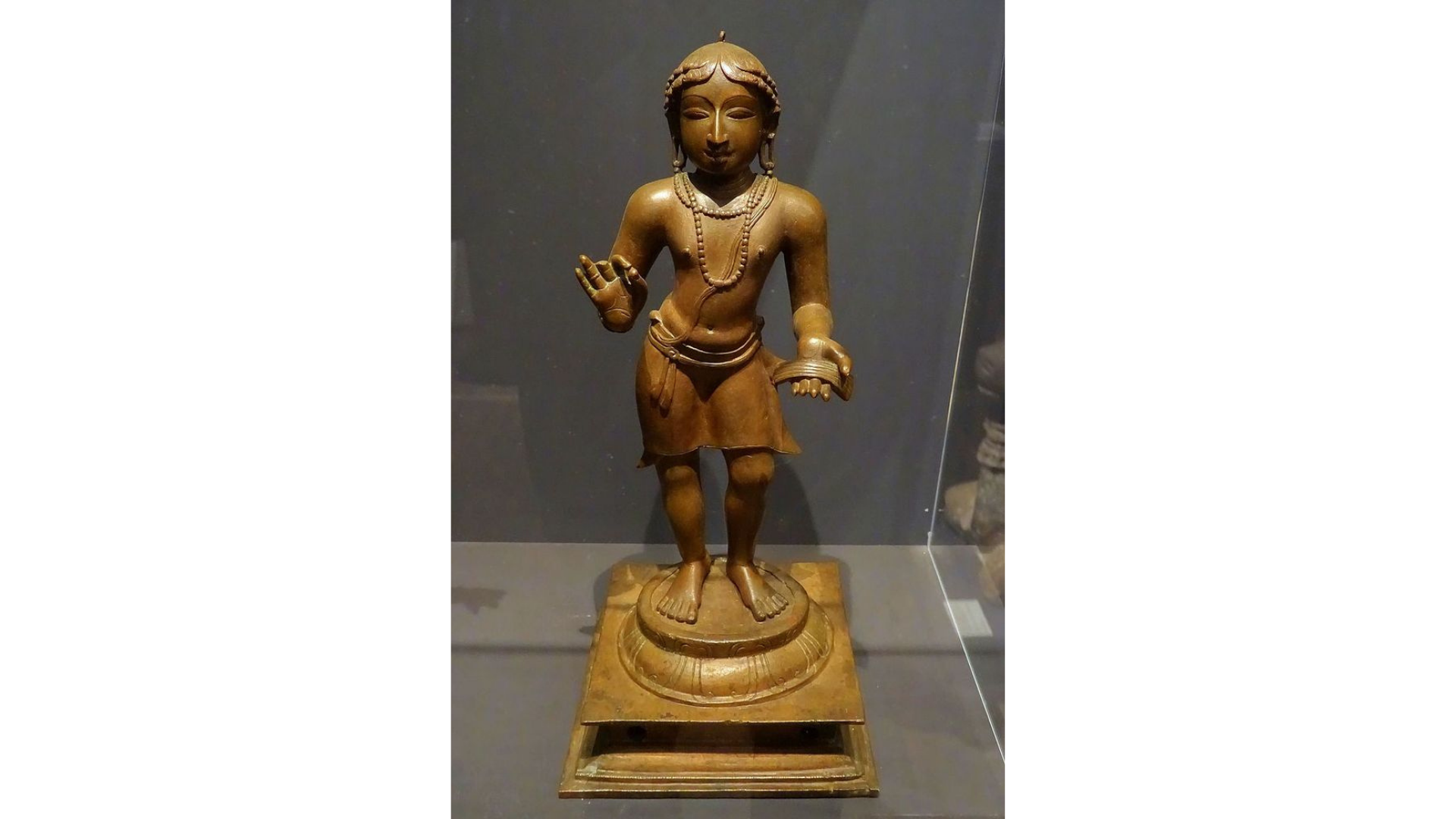
The guru, who was Lord Shiva himself, addressed the minster as ‘Maanikkavaachakar’, ‘one whose words are like rubies’. The minister became an ardent devotee of the teacher, Shiva. Maanikkavaachakar (c.9th century), became a poet and wrote volume eight of Tirumurai, a book of Shaivite hymns. He spent all the money the king had given him on renovating a Shiva temple in Tirupperunturai in Pudukkottai district.
An anxious king grew tired of waiting for his minister and sent out emissaries in search of him. On hearing of the turn of events, the king grew furious. So Shiva is said to have sent the king a priceless ruby with a message that the horses would arrive in Madurai in the month of Avani.
As promised, it was Maanikkavaachakar who brought the herd of splendid horses to the king, who welcomed him with pomp. However, at night, the horses turned into jackals and the furious king ordered that Maanikkavaachakar be tortured.
When the soldiers and Maanikkavaachakar were standing on the hot sands of the river bank, suddenly, the Vaigai river swelled and began flooding the banks. The swirling waters began to enter the city and the worried king asked all his citizens to carry mud and build an embankment.
Among the people was an old lady who was being forced by the soldiers to carry mud. However, she was too feeble and, instead, offered handfuls of puttu, a nutritious sweet made of flour and jaggery, to anyone who would help her. No one was willing. Suddenly, a young lad came forward and said he would do her duty. He ate the puttu with relish and instead of carrying the mud, he sat down and whiled away his time.
The king spied him and struck him on his back with a cane. The lash was felt by everyone – the king, queen, couriers and citizens. The ruler realized that the young lad was none other than Shiva and asked for forgiveness. The flood abated and the lad disappeared. The king became a great devotee of Shiva and governed his kingdom as a just ruler.
 UPSCLOGY