
An ever-expanding city and a premier metropolis known as India’s Silicon Valley, Bengaluru is home to people who come from all over the country to live and work here. But hidden away in the heart of the city are clues to Bengaluru’s medieval past and its dramatic story.

A marble plaque, an ornate stone gate and four watch towers are all that remain of a historic fort that was the nucleus of the city built by the man who founded Bangalore in the 16th century CE.
Here are 5 things about the Bangalore Fort that you may not know.
1. BANGALORE FORT STARTED AS A MUD FORT
Hiriya Kempe Gowda, a local chief of the Vijayanagara Empire (1336–1646 CE), picked the land that is now Bengaluru as his capital city in 1537 CE. He constructed a busy business district with markets, large roadways, and set aside areas for people to live. This area became known as Bengaluru Pete. Kempe Gowda built mud walls around this 2.24 square kilometer region to make the first Bangalore Fort.
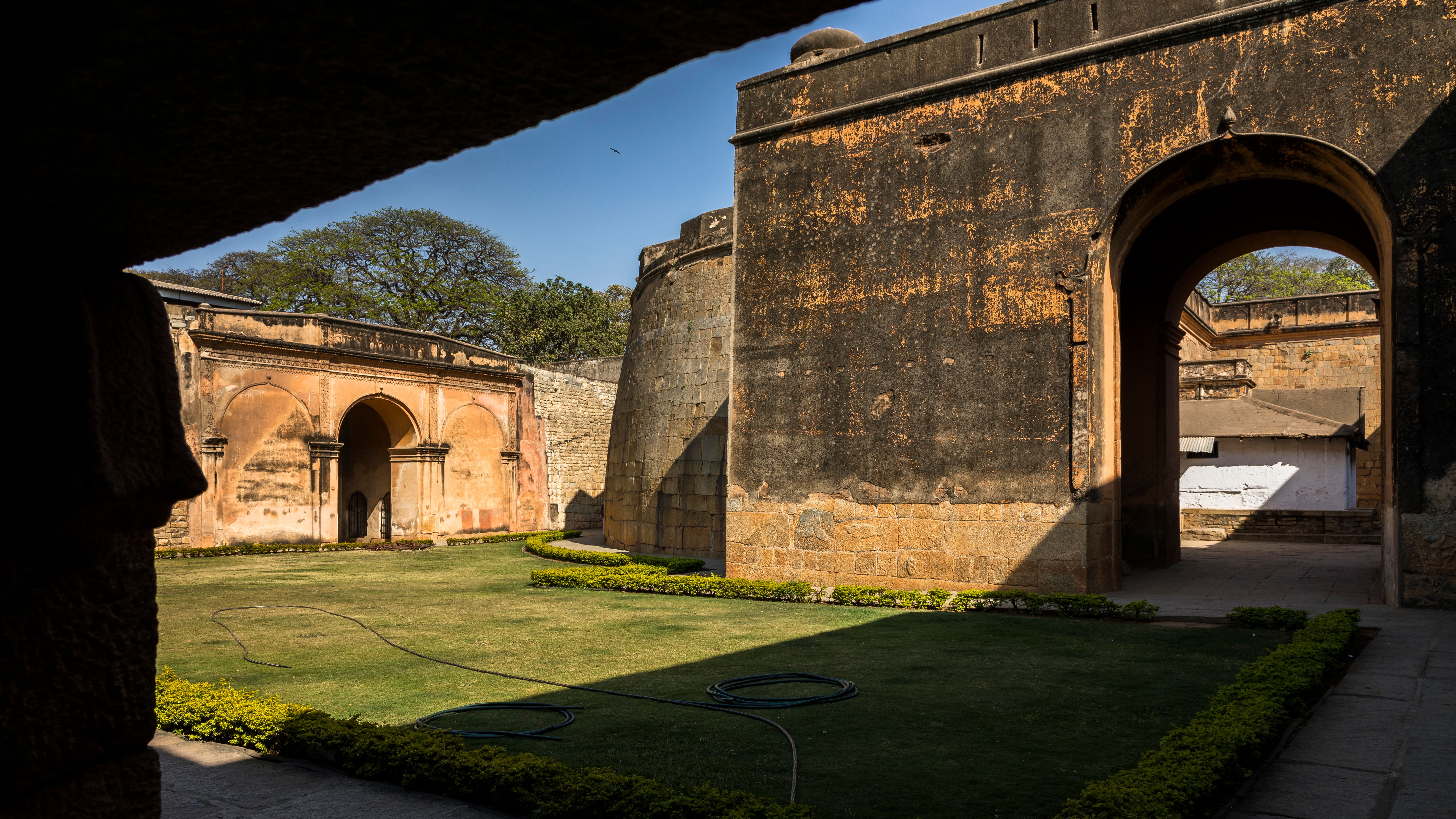
Four of the seven original stone guard towers and several of the markets he built are still in use today. You can still see them in Ulsoor Lake, in the Kempegowda Tower Park near Mekhri Circle, in the Botanical Gardens of Lalbagh, and behind the Bandi Mahakali Temple.
2. A DAUGHTER’S SACRIFICE
People say that the Southern Gate kept falling down while the Bangalore Fort was being erected. Kempe Gowda was instructed that the Gods would be angry if a pregnant lady was not sacrificed, so the gate and walls would stay up. Kempe Gowda, on the other hand, would not listen. People say that his pregnant daughter-in-law Lakshmi Devi snuck out of the house in the middle of the night and killed herself to get him out of this mess. Kempe Gowda erected the Lakshmamma Devi Temple in Koramangala in her remembrance. It is still there today. There is a plaque in a nearby city park that marks the place where Lakshmi Devi is thought to have killed herself.
3. BANGALORE FORT WAS RECEIVED BY HYDER ALI AS JAGIR
The fort changed hands numerous times. At one point, the Bijapur Sultanate (1489–1686 CE) and subsequently the Mughal Empire were in charge of it. The Wodeyars of Mysore, commanded by Chikka Devaraya Wodeyar, bought Bangalore for 3 lakh rupees in 1689 CE. The Wodeyars added to the fort even further between 1673 and 1704 CE. In 1758 CE, Hyder Ali, a Wodeyar military leader, got the fort as a jagir, or land grant, and started fixing it up. Hyder Ali had the original mud walls of the fort restored with stone walls, some of which we can still see today.
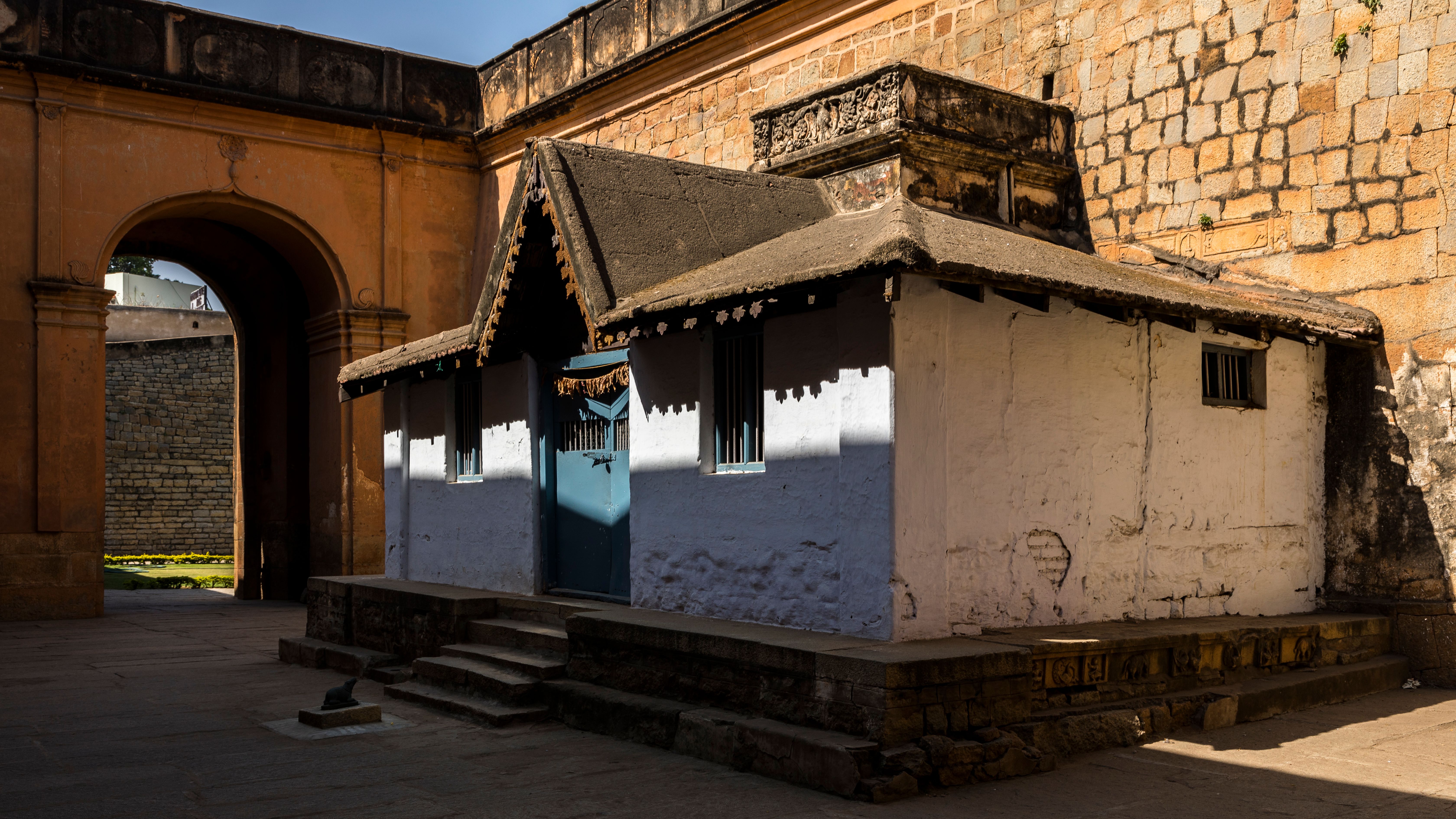
4. EAST INDIA COMPANY LAID SIEGE TO BANGALORE FORT
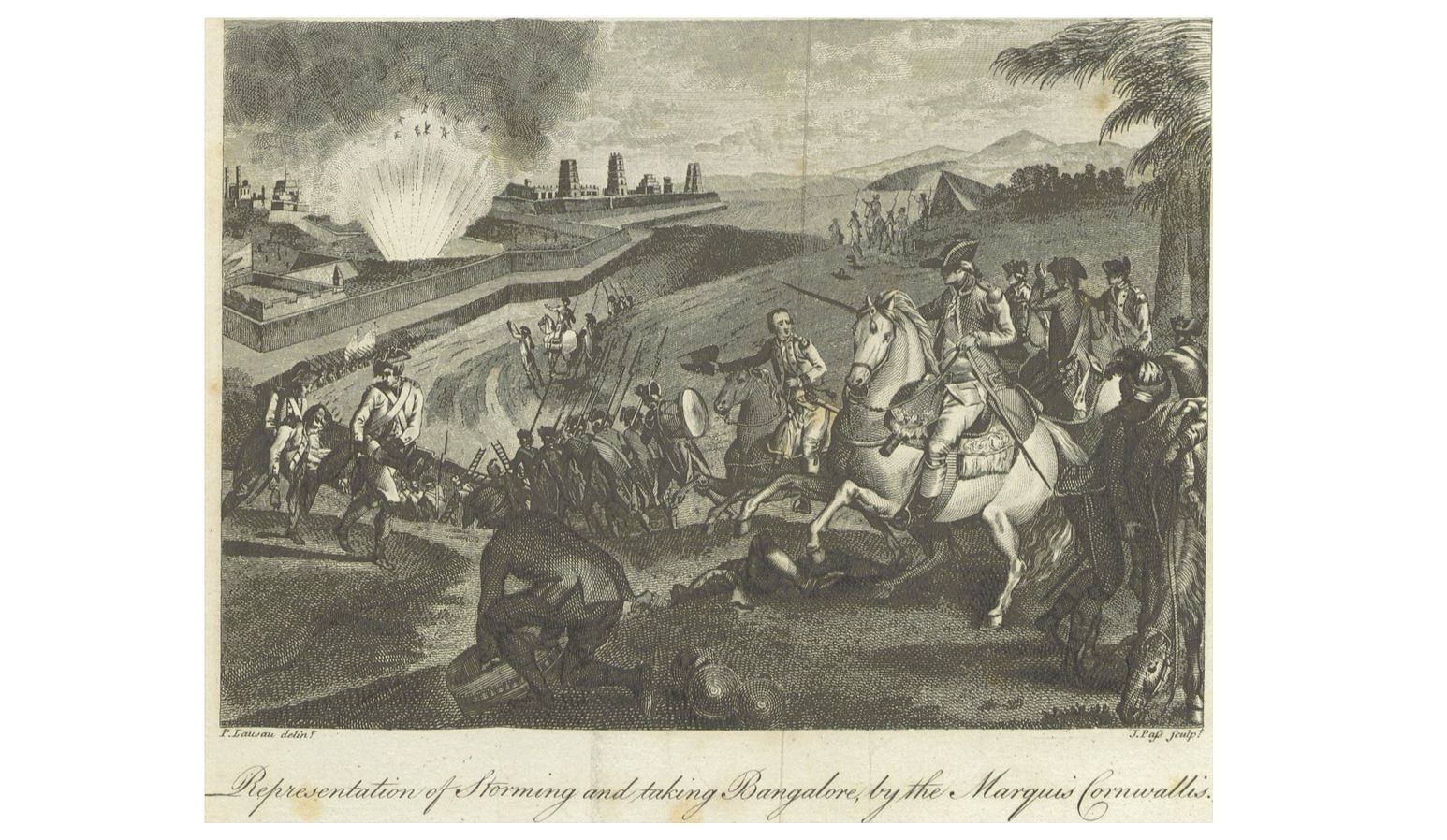
Storming of Bangalore Fort by Lord Cornwallis | Wikimedia Commons
The East India Company army, led by Lord Cornwallis, laid siege to Bangalore in March 1791 CE during the Third Anglo-Mysore War. For 12 days, the British surrounded the fort. At the same time, two companies of the Madras Pioneers surreptitiously dug trenches that went all the way to the fort’s ditch. Cornwallis stormed through these trenches on March 21, 1791, and the fort collapsed. Taking the Bangalore Fort offered the British a good place to attack Srirangapatna, the capital of Tipu Sultan, who was the ruler of Mysore at the time.
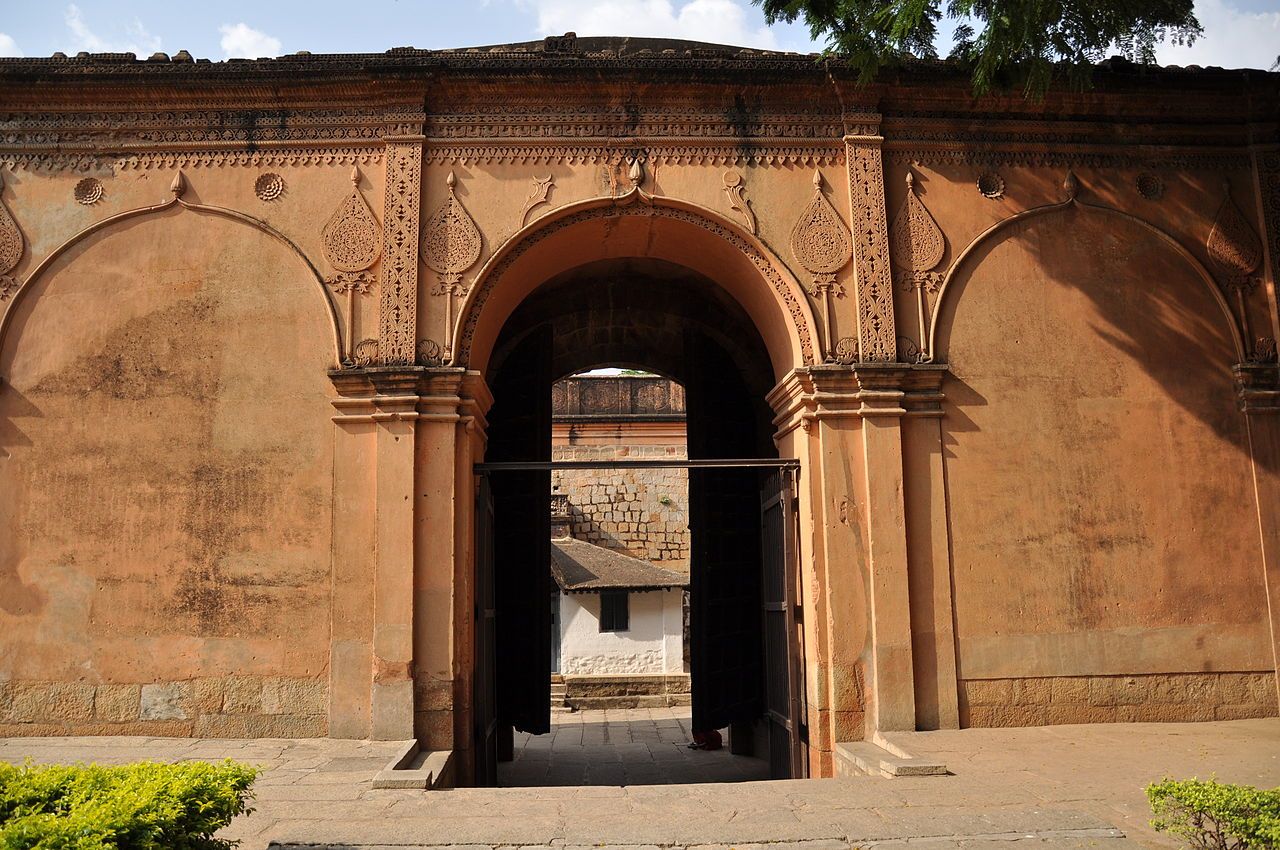
Existing gate of the Bangalore Fort | Pavithrah- Wikimedia Commons
There were multiple gates that led to the fort, but only Delhi Gate is still standing. There is a plaque next to the entrance that shows where the attack came through a hole in the fort’s walls.
5. THE KILLEDAR OF BANGALORE IS REVERED AS A SAINT TODAY
The British saw a man that looked almost like a saint when they attacked the fort. The man was quite tall, fair, and good-looking. His white beard almost reached his waist. He was almost 70 years old, but he battled like he was just 35. Bahadur Khan was the killedaror commandant of the Bangalore Fort.
Roderick Mackenzie, a lieutenant in the East India Company’s troops, later recounted that the brave commander died after “receiving almost as many wounds as Caesar on the capitol.” The British were immensely impressed by his bravery and promised to send his body back to Tipu Sultan. When Tipu heard that his commandant had died, he is believed to have cried and then declared, “The Khan could be buried nowhere with greater propriety than in the neighborhood of the place at the defense of which he had fallen.”
The East India Company gave him a complete burial at a place that is today K R Market, just three minutes from the Delhi Gate, at the corner of S J P Road and N R Road. That place of burial has now become a dargahor tomb for an Islamic or Sufi saint. Bahadur Khan is recognized as “Hazrat Meer Bahdur Shah Al-Maroof Syed Pacha Shaheed.” People of both Hindu and Muslim faiths pray at his tomb, however not many know that he is not a saint but a fallen soldier.
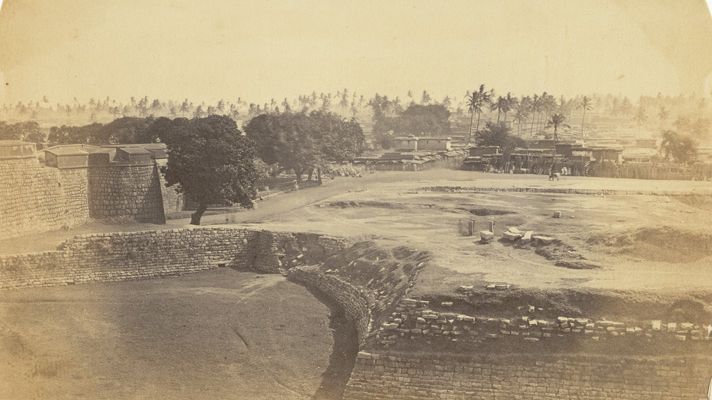
Fort, Bangalore, 1860 | British Library
There isn’t much left of the old Bangalore Fort now. In 1861, the town’s protective walls were taken down and the ditch was filled in. By 1912, the Fort Cemetery, which kept the graves of British soldiers, was gone. Only a small part of the fort is still standing, and most of it is closed off to the public. The stories it tells are quite dramatic, even though the monument itself isn’t that impressive. #history #Upsc #BANGALORE #Facts
 UPSCLOGY