
“In this desert, there are a lot of bad spirits and scorching winds. Anyone who comes across them dies. There are no birds in the sky or animals on the ground. Looking in all directions as far as the eye can see to find the path, the only help comes from the decaying bones of dead men, which signpost the way.
This is a quote from the trip memoirs of Fa-Hien, a Chinese monk who left Chang’an in 399 CE at the age of 62. He traveled via Central Asia to India and finally Sri Lanka. He went on a mission to visit the country of the Buddha and look for Buddhist literature with four other people.
The trip was not easy. Sixteen hundred years ago, no one had ever been to the Gobi Desert, and it was dangerous to cross the Himalayas. It takes months to go from one area to another. The weather was extremely hot and very cold, and as much of the trip was on foot, they were highly exposed. There were also wild animals and thieves waiting for them.
So Fa-Hien’s journey was, in every sense of the word, legendary. This monk traveled for 15 years, and his trips would eventually provide the world many facts about life on the subcontinent. For example, we owe a lot to him for what we know about what Patna looked like back then and what festivities were held in Sri Lanka. He wrote down everything he saw in a travelogue called Fo-Kwo-Ki (Travels of Fa-Hien) as he traveled across what is now Pakistan, Nepal, Northern India, and finally Sri Lanka.
People who go into this desert alone risk death at the hands of the numerous malevolent spirits and scorching winds that inhabit there. There are no birds in the sky and no monsters in the underworld. Unless you want to use the decaying bones of dead men as a map, you will have to look as far as your eyes can see to find a path.
That is a passage from the travelogues of Fa-Hien, a 62-year-old Chinese monk who departed from Chang’an in 399 CE and journeyed across Central Asia to India and, finally, Sri Lanka. He had set out on a quest with four companions to find Buddhist scriptures in the homeland of the Buddha.
It was a challenging trip. The Gobi Desert was uncharted territory and the Himalayan mountain ranges were treacherous terrain to traverse sixteen centuries ago. Transporting one location to another required months. Due to the long distances covered and the extreme temperatures experienced, the risk of exposure was high throughout the trip. Also, bandits and dangerous animals were lurking around.
As a result, Fa-Hien’s mission was legendary. The detailed descriptions of subcontinental life that this wandering monk, who walked for fifteen years, would provide to the globe centuries later. For example, he is primarily responsible for our knowledge of the festivals held in Sri Lanka and the appearance of Patna at that period. Fo-Kwo-Ki (Travels of Fa-Hien) is a travelogue he wrote while traversing what is now Pakistan, Nepal, Northern India, and Sri Lanka.
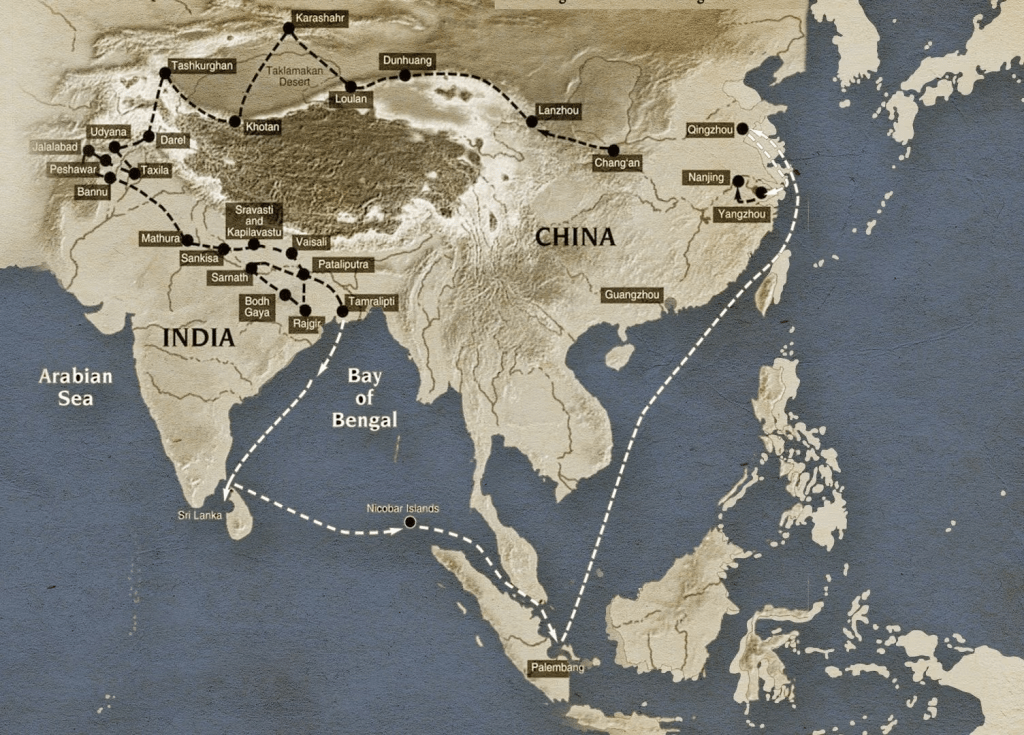
Hien Fa’s map.
Hien Fa’s map.
Fa-Hien made it to India before many other Chinese traveller-pilgrims. There has not been a significant first-hand description of the subcontinent by travelers who saw it since Megasthenes’ Indica (4th-3rd century BCE) and Theperiplus of the Erythraean Sea (1st century CE) until Fa-Hien’s works in the 5th century CE.
By the time the second century CE rolled around, the teachings of the Buddha had already gone global. The land trade routes of Uttarapatha and Dakshinapatha, as well as the Indian Ocean trade network, served as conduits for the preaching of Dhamma by the Mauryan Emperor Ashoka (r. 269 – 232 BCE) to locations such as Myanmar, Mysore, and Greece.
The Kushana Emperor Kanishka (r. 128 – 150 CE) was a Buddhist, and his followers spread the faith over China and Central Asia. The territory under Kushana rule extended from what is now Afghanistan to parts of Pakistan and India’s northwest, as well as from the Chinese border to Mathura and beyond in the Indo-Gangetic plains. These estates, located on the Silk Road, were also strategically vital. Buddhism and its adherents, the monks, set out for the globe at the same time as traders and commodities.
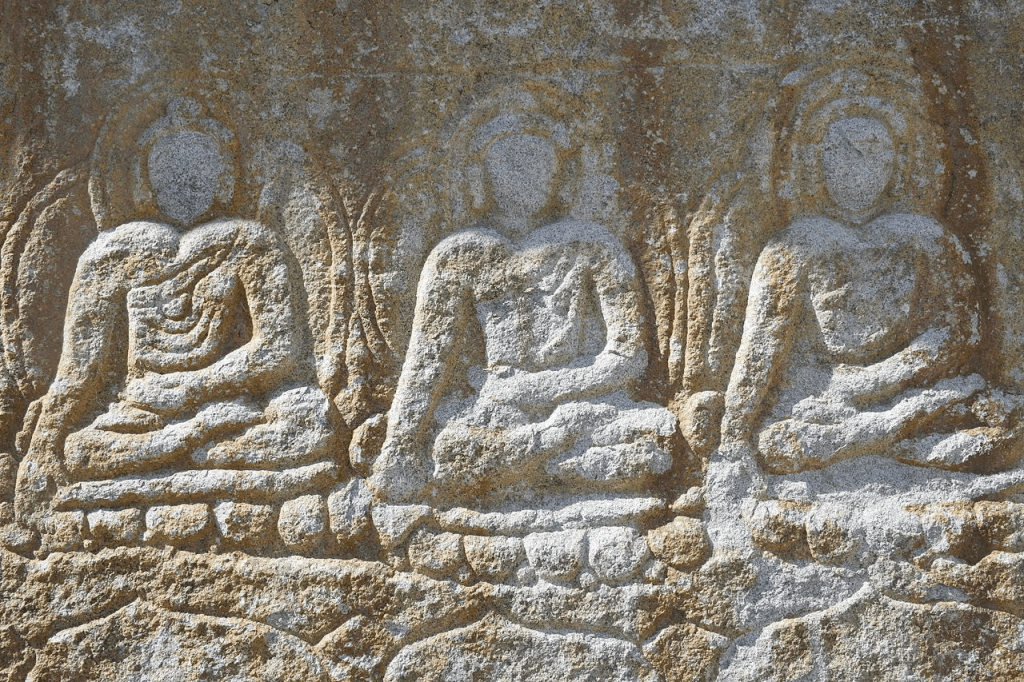
The routes of Gilgit-Baltistan still have hundreds of stone carvings of Boddhisattavs and Buddhas, as evidence that traveling monks placed markers along their paths.
via with other early monks, Fa-Hien retraced his steps via the Silk Road to reach the Indian subcontinent. He started his voyage in North-Central China, where he visited several Buddhist sites. The fact that he recorded every detail allows us to know this. After returning home at the age of 77, he penned a travelogue that is rich with priceless details on the life, sights, and nature of Buddhism in the 5th century.
Just who was he?
After growing up as an orphan, Fa-Hien devoted the most of his adult years to living in a Buddhist monastery. The revered Buddhist was shocked to see the Books of Discipline, or Vinaya Pitakas, in such a ragged and worn condition during his visit to Chang’an, the old capital city of the Buddhist religion.
Fa-Hien made up his mind to visit the sacred realm of the Buddha in order to get an improved version of these writings. In all, he persuaded four other monks to join him: Hwuy-king, Tao-ching, Hwuy-ying, and Hwuy-wei. Later on in their travels, in the Chang-yih emporium, another group of five monks joined this one. During the reign of Yao Xing (r. 394-416 CE), Chang’an (modern-day Xi’an) was a component of the Later Qin empire that Fa-Hien belonged to. The first formal governmental sponsorship for Buddhism in China came under his reign.
From Chang’an, Fa-Hien traveled to what is now the Chinese region of Xinjiang, where he established the kingdoms of Loulan and Khotan. At a Mahayana monastery known as Gomati, a county lord in Khotan provided a comfortable home for Fa-Hien and the other monks. They remained at Khotan for three months to see a chariot-procession, which Fa-Hien recounts in great detail in his writings, while three men from the company departed ahead of schedule for their next destination:
Approximately three or four li (Chinese miles) outside of the city, they constructed a four-wheeled replica vehicle that resembled the main hall (of a monastery) and was over thirty cubits tall. Surrounding it was a magnificent exhibition of the seven precious stones: agate, rubies, diamonds or emeralds, lapis lazuli, rock crystal, and gold. In the center of the chariot stood the (main) picture, who was likely Sakyamuni. At a distance of one hundred yards from the gate, the monarch removed his crown of state and proceeded to meet the image outside.
In 1887, the Chinese monk Fa-Hsien traveled to India and Ceylon (A.D. 399–414) in search of the Buddhist books of discipline. James Legge, a Scottish sinologist, translated his travels and published it. The original title was A Record of Buddhistic Kingdoms. Everything you see here comes straight from it; it is the gold standard of English translations.
The procession ended in K’eeh-cha, which is likely Skardu in modern-day Pakistan, and the troop continued south. Here the monarch was presiding over a religious gathering known as a pancha parishad. According to Fa-Hien, this kingdom was in possession of many relics from the Buddha.
There is a stone spittoon in the countryside that belonged to Buddha; its color matched that of his alms-bowl. In honor of a tooth from the Buddha, the locals have built a stupa, and over a thousand monks and laypeople who practice the Hinayana school of thought are associated with it.
En route to Northern India, Fa-Hien traversed flora that was drastically different from what he had seen in the Land of Han (China, in his mind). The only plants he recognized were the sugarcane, pomegranate, and bamboo. Fa-Hien chronicled the perils the party faced on land and water during their journeys, albeit parts of his descriptions seem overblown. One example is what Fa-Hien says just before he sets foot on the Indian subcontinent:
Among them are venomous dragons, who unleash deadly winds, snowstorms, and sand and gravel storms when angered. Out of every 10,000 people who face these threats, hardly a single one makes it out alive.
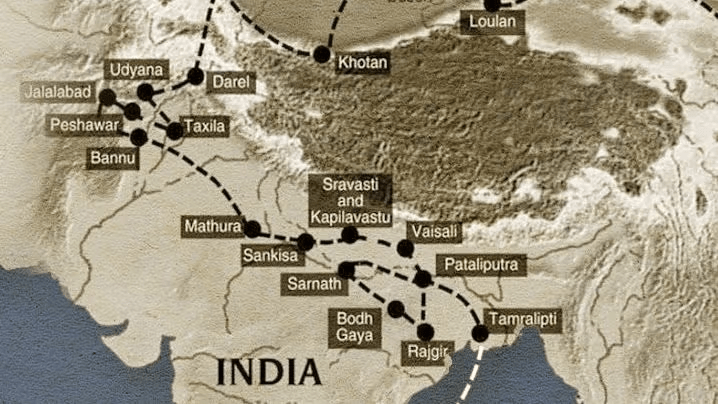
Udyana, an old city in what is now Pakistan’s Swat area, was the gateway that Fa-Hien used to reach the Indian subcontinent. His tale is replete with allusions to stories surrounding the life of the Buddha, and it is intriguing that he connects several locations he sees with events from the Jatakas. For example, he says that at Udyana there is a rock where the Buddha’s imprint is and there the Buddha supposedly dried his garments. He mentions a spot close to Taxila where the Buddha sacrificed himself to save a tigress from famine.
He reflects on how the Buddha, who lived from 571 to 485 BCE, had foretold the birth of a monarch called “Kanishka” who would construct a beautiful stupa at this location upon their arrival in Purushpura (Peshawar). By this point, it was obvious that mythology had taken over, and someone was trying to make it seem like the Buddha had gone even more off than he had. On the outskirts of Peshawar, in what is now Shaji-ki-Dheri, is the stupa of Kanishka, constructed in the second century CE. Fa-Hien describes it as…
No other tope or temple that we seen on our travels could compare to this one in terms of somber beauty and magnificent majesty. Popular belief is that this is Jambudvipa’s best tope.
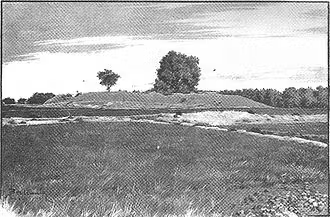
One of Fa-Hien’s comrades died just before he crossed the Indus River to go east. Fatigue may have been the cause of death for the monk Hwuy-king. According to Fa-Hien, Hwuy-king begged his comrades to go back home in his last words so that they would not all perish in the same manner. The gang resumed their trek, despite Fa-Hien’s overwhelming anguish.
Mathura was one of the most significant cities that Fa-Hien visited. He mentions the “Majjhima-desa” (Middle Kingdom) as the name of the whole region to the south of this. As he recounts his time here, he notes that the city was quiet, rich, and that the majority of its residents abstained from eating meat and other processed foods:
People are plenty and happy…There is no beheading or other physical penalties under the king’s rule.People in this nation abstain from eating onions or garlic, killing any kind of living thing, and imbibing in alcoholic beverages. The Chandalas are the only exception. Separate from the others, those who are (supposedly) bad guys go by that label. They make themselves known by striking a piece of wood at the entrance of a city or market-place. This way, folks will know to avoid them and not come into touch with them.
Fa-Hien chronicles the support of Buddhist priests by the rulers of Mathura following the Buddha’s death:
The grants were engraved on metal plates, so they could be passed down from king to king inviolably, and they remain to this day. After Buddha attained parinirvana, the rulers of the different countries and the Vaisya chiefs constructed viharas for the priests and bestowed upon them fields, houses, gardens, orchards, and the resident populations and their cattle.
Note that Fa-Hien does not write much on religion or general politics. Surprisingly, he fails to mention the Gupta Emperor Chandragupta II, who was at the pinnacle of his authority when Fa-Hien visited (r. c. 380 – 415 CE).
Kapilavastu, the ancient city most mentioned by Fa-Hien, is one of many possible locations along the boundary between India and Nepal. He yearned to see the splendor of the birthplace of the Buddha. It was a major letdown in the end. According to his writing:
Neither a monarch nor his subjects appeared in it. A landscape of desolation and mounds. There were a handful of monks and a dozen or so families living there. Travelers should exercise caution since white elephants and lions lurk in the area.
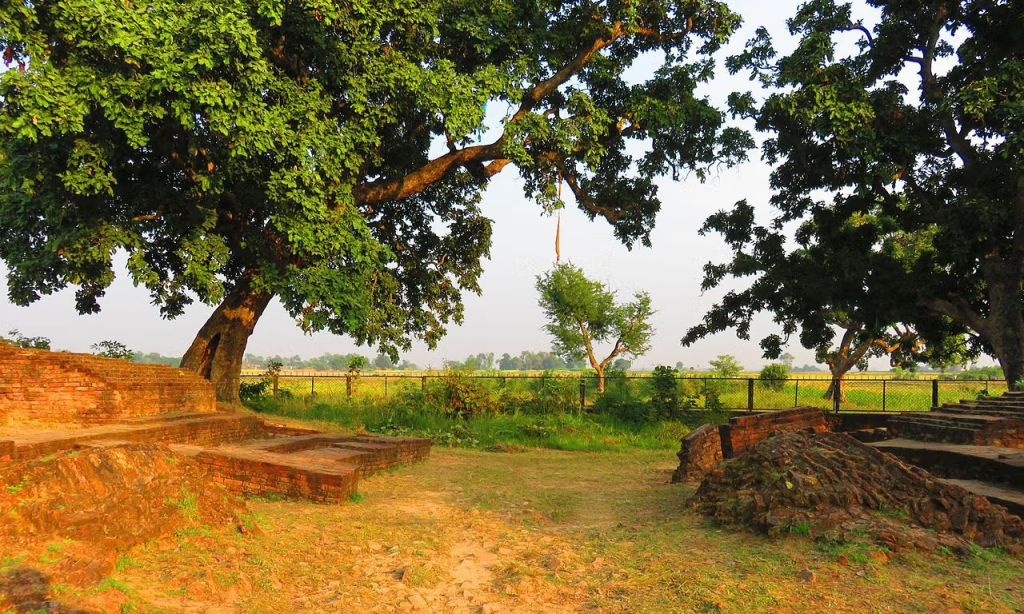
Pataliputra (modern-day Patna) was his center of operations when exploring India. Over the course of three years, Fa-Hien stayed here, saw the construction of monasteries, and visited sites important to Buddhism. Regrettably, none of the Patna stupas or monasteries that Fa-Hien describes in his works have survived to the present day.
There are two magnificent monasteries here: one belonging to the Mahayana school and one to the Hinayana school. Together, they house some 600–700 monks, and they stand proudly before the Asoka tope. The scholastic setups and regulations of conduct inside them are noteworthy. The most virtuous shamans from all over the world visit these monasteries, as do students and curious souls looking for answers about the nature and foundations of truth.
He went on to say that these towns and cities were the most important in the Middle Kingdom, that the people lived well, and that they competed with each other to be the most kind and ethical.
No matter how many places Fa-Hien visited in India related to the life of the Buddha—Sravasti, Sarnath, Bodh Gaya, Vaishali, Rajgir, and so on—his primary goal for visiting India remained unfulfilled. The authentic Buddhist scriptures he was looking for remained elusive. There were no transcriptions or written records of the rules, but he had discovered masters passing them down verbally throughout the several North Indian kingdoms.
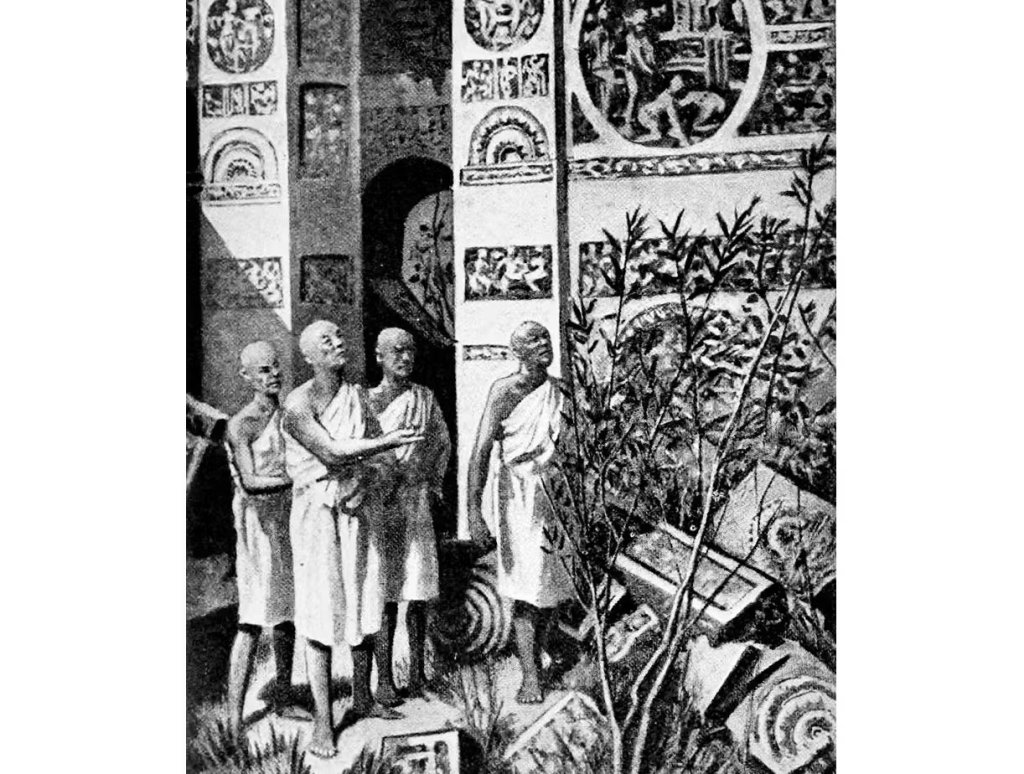
A copy of the Vinaya Pitaka, which included the Mahasanghika rules—those established at the first Great Council when the Buddha was still alive—was discovered by him in a Mahayana monastery in Pataliputra. Nevertheless, Sanskrit was the language of choice. For three years, Fa-Hien resided in Patna, where he studied Sanskrit and transcribed the Vinaya principles.
Fa-Hien continued eastward down the Ganga River from Patna to Champa and finally to the port of Tamralipti in what is now West Bengal. He departed from this port on a massive trade ship and arrived at Singhala (Sri Lanka) fourteen days later. As he heard them, he records the island’s myths and legends:
Spirits and nagas, rather than humans, previously lived in the land, and traders from all over the world traded with them. No ghosts appeared while the trafficking was going on. All they had to do was lay out their valuable goods with price tags on them, and the vendors would buy and sell them based on the prices.
That the Buddha came to this land to change the evil nagas is what Fa-Hien narrated, which is in line with other tales of the period. However, historically, there is no record of the Buddha travelling as far as Sri Lanka.
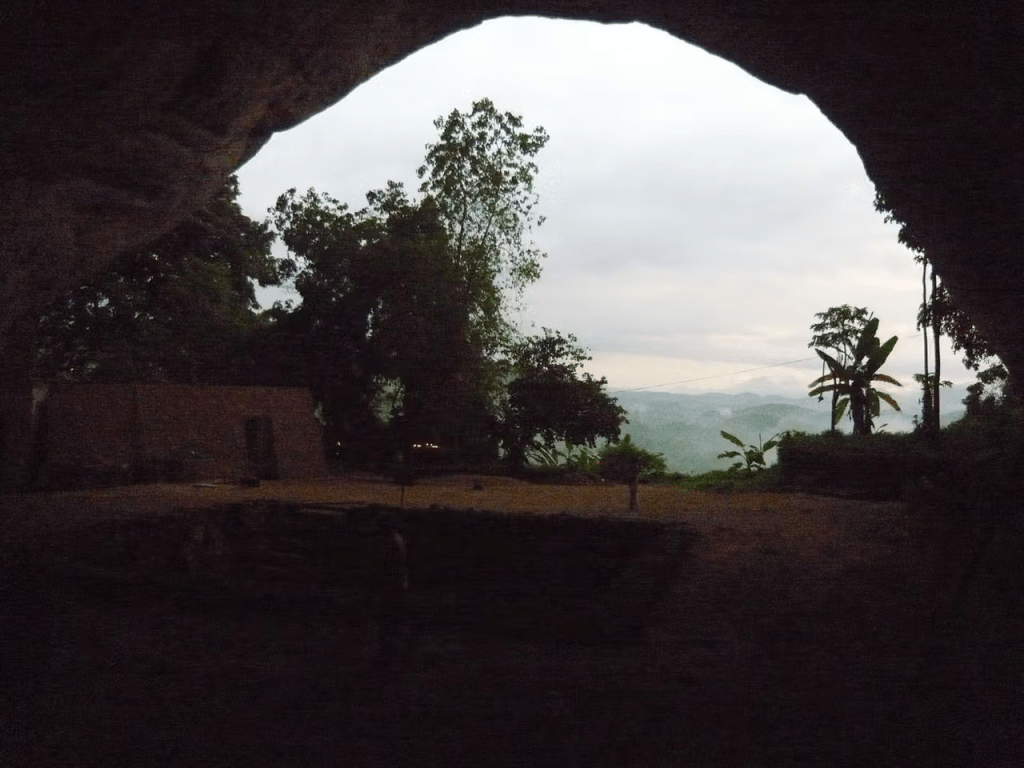
In Singhala, Fa-Hien lauded the abundance of Buddhist influence, citing the many temples, a gigantic jade Buddha statue, and the sacred tooth relic festival as evidence. Fa-Hien stayed in Sri Lanka for two years before choosing to return to China by a perilous maritime route. In honor of Fa-Hien, a cave in Sri Lanka’s Kalutara area was named after him today. People think he lived there.
Upon his return home at the age of 77, Fa-Hien devoted the next ten years—the last ten years of his life—to editing and interpreting the many scriptures he had collected, as well as compiling his travelogue. Unfortunately, not much is known about the Indian monk Buddhabhadra, who assisted him.
For ages to come, Chinese pilgrims and travelers would trace Fa-Hien’s route. Two of the most well-known were the travelogue writers Hiuen Tsang (602-664 CE) and I-tsing (635-713 CE).
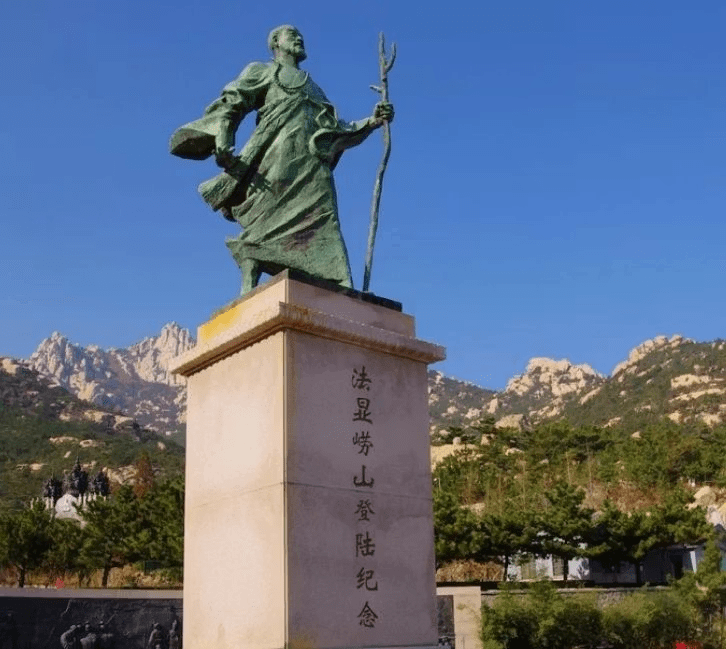
Located next to the Huayan Temple in Dataong, China, a magnificent monument honoring Fa Hien exists today. It may be a new monument, but it faithfully commemorates the brave monk who embarked on a perilous voyage. The temple does, in fact, contain a vast collection of Buddhist scriptures, some of which may have been based on the ideas expressed by Fa-Hien over 1600 years ago!
 UPSCLOGY