
The artistes of Paravur popularised the Villadichanpattu, a form of storytelling that’s now virtually extinct. The group looks back at a bygone time
Villu Paatu also known as Villadichampaatu, is an ancient form of musical story-telling in India where narration is interspersed with music, an art of southern state of Kerala and Thovalai in Kanyakumari district of Tamil Nadu. This art form is popular among Nadar and Chettiar castes of erstwhile Travancore kingdom. Simple tunes and verses make the story easy to follow. The villu (bow), the age-old weapon of warriors – paradoxically lends itself to be used as a primary musical instrument for the Villu Paatu artists.
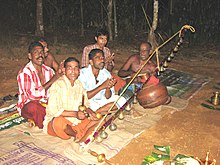
In villages, performers narrate stories ranging from mythological to social. The main storyteller narrates the story striking the bow. The bow rests on a mud pot kept facing downwards. A co-performer beats the pot while singing. There is usually anothe
r co-singer who acts as active listener to the narration, uttering appropriate oral responses. The local
government sometime utilise this as a vehicle for social messages and propaganda.
North Paravur has always had its share of artistes, dreamers and sportsmen who created art to sustain themselves. In one of the remotest parts of Paravur, Thathapilly, a group of artistes, bound by their shared love for villadichanpattu (an art form, which involved narrating a story through music) formed a club in 1962. In the following year, they performed their first Villadichanpattu—‘Unniyarcha’— at the Thathappilly Khandakarnan temple. The group later came to be known for their Villadichanpattu.
In 1964, the club was registered as Jawahar Arts and Sports Club. “We felt we needed a space to keep our musical instruments under one roof, and to meet. A stage was not accessible to us and music in those times was restricted to a few. We had among us people who loved sports too. Thus, came the idea of an Arts and Sports Club,” says A K Shekharan, a member of the club since its inception and who did the role of the ‘joker’ in almost all performances. Slowly, the arts club evolved from being just a meeting place to a space that ushered in change.
After four years of formation, the artistes of the club began touring Kerala, performing in festivals. They even had a separate team of women performers.
During Christmas, in 1968, they passed an audition in Thiruvananthapuram to record for All India Radio—a lifetime opportunity to showcase their talent to a larger audience. With successful recordings in Kozhikode and well-received programmes, AIR decided to extend their 15-minute programmes to undisrupted half-an-hour shows.
Slowly they shifted their focus to theatre drama. Picking up odd jobs and working through the day, they sourced funds for a show in New Delhi, their first major breakthrough in theatre. Writer Sippy Pallipuram scripted the story and lyrics for the drama Sakunthalam and joined them on the trip to Delhi.
The club did 34 performances in 30 days, in the northern areas of Kerala performing mainly on the tambourine. There have even been occasions when during performances in winter, audiences had to light a fire to keep themselves warm.
Each member had his own style of telling a story, which gave their productions an unusual touch. This was how ‘Baale’ (drama) was included in their show list. During the late 70’s, they performed ‘Yaagam’, their first ‘baale’ act, which brought in positive responses even from Kalamandalam.
Their three-hour re-enactment of ‘Kumarasambhavam’, a translation of Kalidasa’s epic poem from Sanskrit to Malayalam, was a memorable show. Performed in a temple festival at Kottappady in Thrissur, the troupe was praised for retaining the originality even in translation.
As contemporary art forms flourished, the popularity of Villadichanpattu declines.
In 2014, the troupe performed for the final time for a high school anniversary in Paravur.
“Times have changed. With all the money we made, we put up (this) club , not realising that it may not go on forever. The new generation never tried to learn what we inherited from our ancestors and to be honest, we didn’t bother much,” says P M Mohanan, another founding member.
As the Arts Club and Library cherishes memories of a glorious past, the artistes hope that once again they will get a chance to perform this fading art form.
-
Source – Hindu
 UPSCLOGY
I am reallyy oving the theme/design of your website.
Do you ever run into any web browser compatibility problems?
A couple of mmy blog readers have complained about my site
not operatng correctly in Explorer but looks great in Firefox.
Do you have any solutions to help fix this issue?
LikeLike